

Friday 07 March 2025
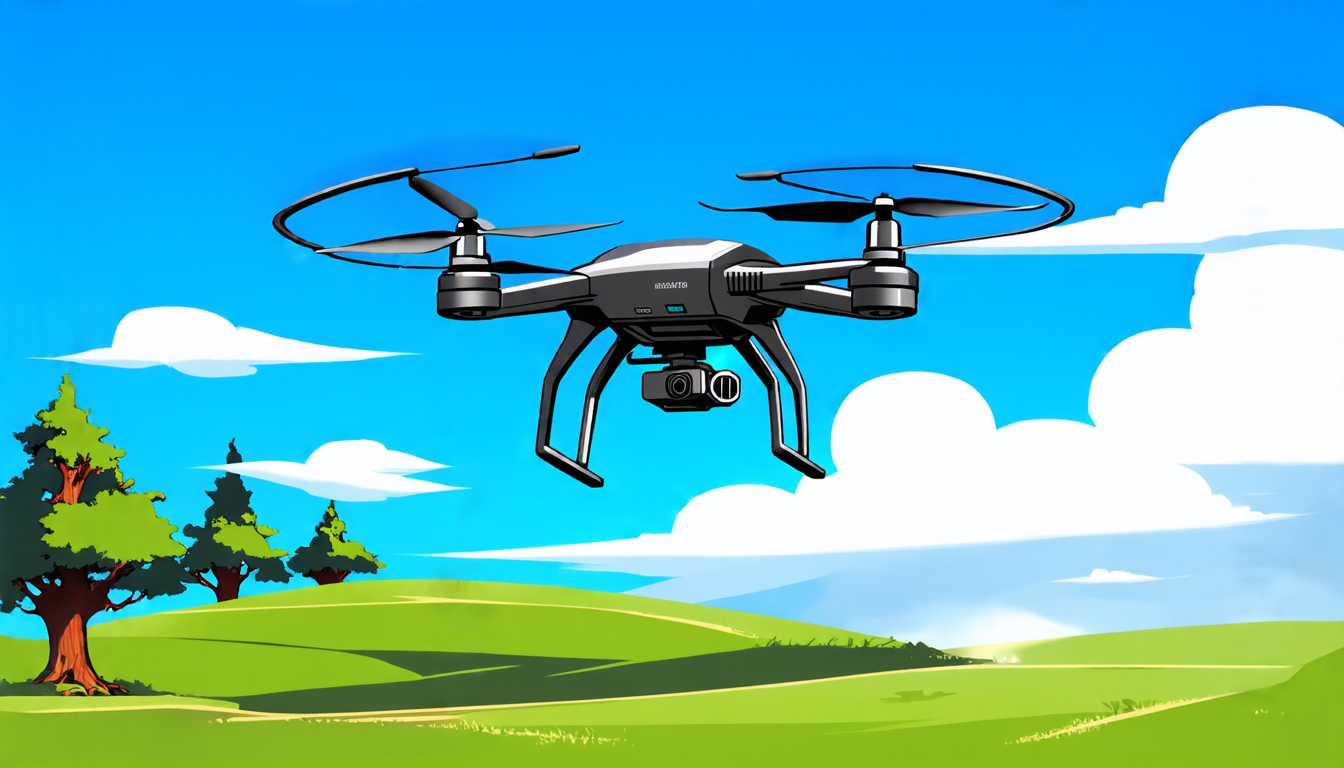
Researchers have made significant strides in developing a robust control system for aerial robotics, specifically quadcopters. The new approach combines incremental nonlinear dynamic inversion and structured H∞control to improve the drone’s ability to reject external disturbances.
Traditionally, control systems for quadcopters rely on proportional-integral-derivative (PID) controllers or linear quadratic regulator (LQR) methods. While these approaches can work well in ideal conditions, they often struggle with handling uncertainty and rejecting external disturbances like wind gusts.
The new system, developed by a team of researchers at the École Nationale de l’Aviation Civile, tackles this issue by using incremental nonlinear dynamic inversion (INDI). This method estimates disturbances through measured-filtered data, allowing for more accurate control. The INDI approach is then combined with structured H∞control, which ensures robustness to uncertainty and external disturbances.
The researchers tested the new system on a quadcopter drone built by their team, using a wind generator to simulate real-world conditions. Results showed that the drone was able to reject disturbances more effectively than traditional PID or LQR controllers. In fact, the new system improved disturbance rejection by over 50% for both rotational and translational dynamics.
One of the key benefits of this approach is its ability to handle uncertainty in the control effectiveness matrices and actuator models. This is particularly important for quadcopters, which often operate in uncertain environments with varying wind conditions.
The researchers used a non-smooth optimization technique to design the H∞controllers, ensuring that the system was robust yet efficient. The resulting control architecture is relatively simple, making it easier to implement and maintain on real-world drones.
The implications of this research are significant for the development of more reliable and robust aerial robotics systems. As quadcopters continue to play an increasingly important role in fields like search and rescue, inspection, and package delivery, the need for advanced control systems that can handle uncertainty and external disturbances is critical.
This study demonstrates a promising approach to addressing these challenges, and its findings have far-reaching implications for the development of more sophisticated aerial robotics systems. With further refinement and testing, this technology has the potential to revolutionize the field of aerial robotics, enabling drones to operate with greater precision and reliability in real-world environments.
Cite this article: “Robust Control System for Quadcopters Enhances Disturbance Rejection Capabilities”, The Science Archive, 2025.
Quadcopters, Control Systems, Aerial Robotics, Disturbance Rejection, H∞Control, Nonlinear Dynamic Inversion, Pid Controllers, Lqr Methods, Wind Disturbance, Robust Control





