

Friday 07 March 2025
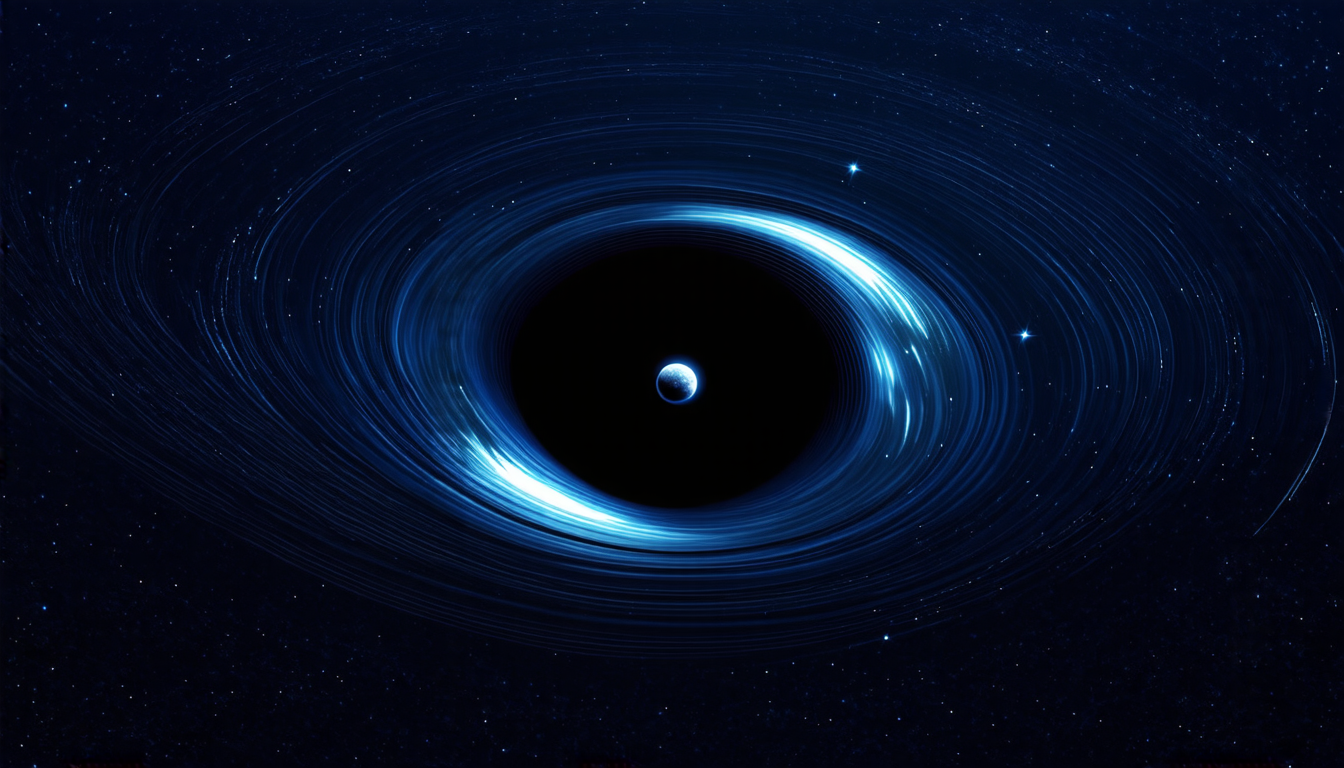
In the vast expanse of space, there exist phenomena that defy our understanding of gravity and the behavior of black holes. Extreme-mass-ratio inspirals (EMRIs) are one such enigma, where a small object, like a star or a neutron star, orbits a massive black hole with incredible precision. These events provide an unparalleled opportunity to test the fundamental laws of physics, particularly general relativity.
Detecting EMRIs is no easy feat. The gravitational waves emitted by these inspirals are faint and require incredibly sensitive instruments to detect. The Laser Interferometer Space Antenna (LISA) and its future successors will be capable of detecting these whispers from space. However, the accuracy of these detections relies on sophisticated waveform models that simulate the behavior of EMRIs.
Researchers have long known that these waveform models can introduce systematic errors, which could lead to incorrect scientific conclusions. A new study has shed light on the impact of these errors and offers a promising solution.
The researchers investigated the effects of two types of systematic errors: fundamental bias and modeling error. Fundamental bias arises from limitations in our understanding of general relativity itself, while modeling error stems from inaccuracies in waveform templates. They found that at low signal-to-noise ratios (SNRs), there is a risk of misidentifying a non-general-relativity EMRI signal as one that conforms to the theory.
However, this risk diminishes significantly as the SNR increases to around 40 or higher. The researchers also discovered that modeling errors could reduce the SNR of detected EMRI signals and be misinterpreted as deviations from general relativity, leading to incorrect conclusions.
To mitigate these issues, the team developed a Bayesian inference framework that takes into account the uncertainties in waveform templates. This approach allows scientists to accurately estimate the parameters of EMRIs, even when faced with noisy or incomplete data.
The implications of this research are far-reaching. By improving our understanding of systematic errors, researchers can develop more accurate waveform models and ultimately test general relativity in ways previously thought impossible. The detection of EMRIs will provide a window into the strong-field regime of gravity, allowing scientists to probe the nature of black holes and the universe itself.
The study’s findings have significant implications for future gravitational wave observatories like LISA. By accounting for systematic errors and developing more accurate waveform models, researchers can unlock the secrets of EMRIs and push the boundaries of our understanding of the cosmos.
Cite this article: “Unraveling the Mysteries of Extreme-Mass-Ratio Inspirals”, The Science Archive, 2025.
Gravitational Waves, Extreme-Mass-Ratio Inspirals, Black Holes, General Relativity, Laser Interferometer Space Antenna, Waveform Models, Systematic Errors, Bayesian Inference, Signal-To-Noise Ratio, Gravitational Wave





