

Friday 07 March 2025
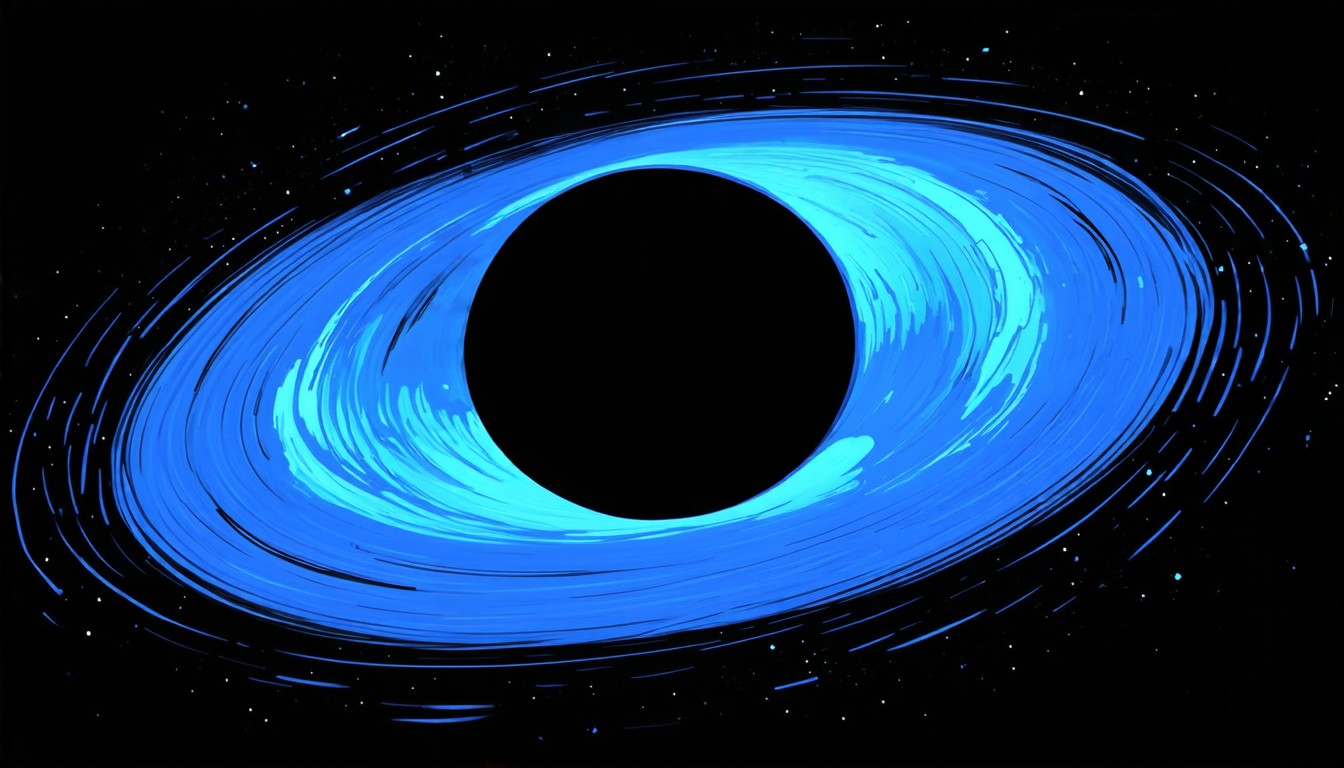
In a recent study, scientists explored the fascinating phenomenon of thin relativistic magnetic accretion disks surrounding distorted black holes. These celestial bodies are known for their intense gravitational pull and ability to warp space-time around them.
The researchers focused on the interplay between the strong magnetic fields and quadrupole moments that can distort the shape of a black hole. They used complex mathematical equations to model the behavior of these accretion disks, which are swirling structures of matter spiraling into the black hole.
The team discovered that the presence of a quadrupole moment, an inherent distortion in the black hole’s shape, significantly affects the properties of the disk. The study found that negative quadrupoles have a more pronounced influence on the disk’s structure and radiation flux compared to positive quadrupoles.
One of the most striking findings was the effect of the magnetic field on the disk’s pressure and temperature. The researchers observed that the magnetic pressure plays a crucial role in shaping the disk’s geometry, causing it to become thinner and more compact as it approaches the event horizon.
The team also investigated how different quadrupole values affect the radiation flux emitted by the disk. They found that the radiation flux increases as the distance from the black hole decreases, with negative quadrupoles resulting in a higher flux compared to positive quadrupoles.
These findings have significant implications for our understanding of accretion disks and their behavior around distorted black holes. The study highlights the importance of considering both magnetic fields and quadrupole moments when modeling these complex systems.
The research also has practical applications in the field of astrophysics, as it provides a more accurate representation of the radiation emitted by these accretion disks. This information can be used to better understand the behavior of black holes in binary star systems and their role in shaping the universe around us.
The study’s results demonstrate the intricate dance between gravity, magnetism, and quadrupole moments that occurs in the vicinity of a black hole. By shedding light on this complex phenomenon, scientists are one step closer to unraveling the mysteries of these cosmic behemoths and their impact on the universe.
Cite this article: “Unraveling the Mysteries of Black Hole Accretion Disks”, The Science Archive, 2025.
Thin Relativistic Magnetic Accretion Disks, Distorted Black Holes, Gravitational Pull, Space-Time Warping, Quadrupole Moments, Magnetic Fields, Radiation Flux, Event Horizon, Astrophysics, Binary Star Systems





