

Friday 07 March 2025
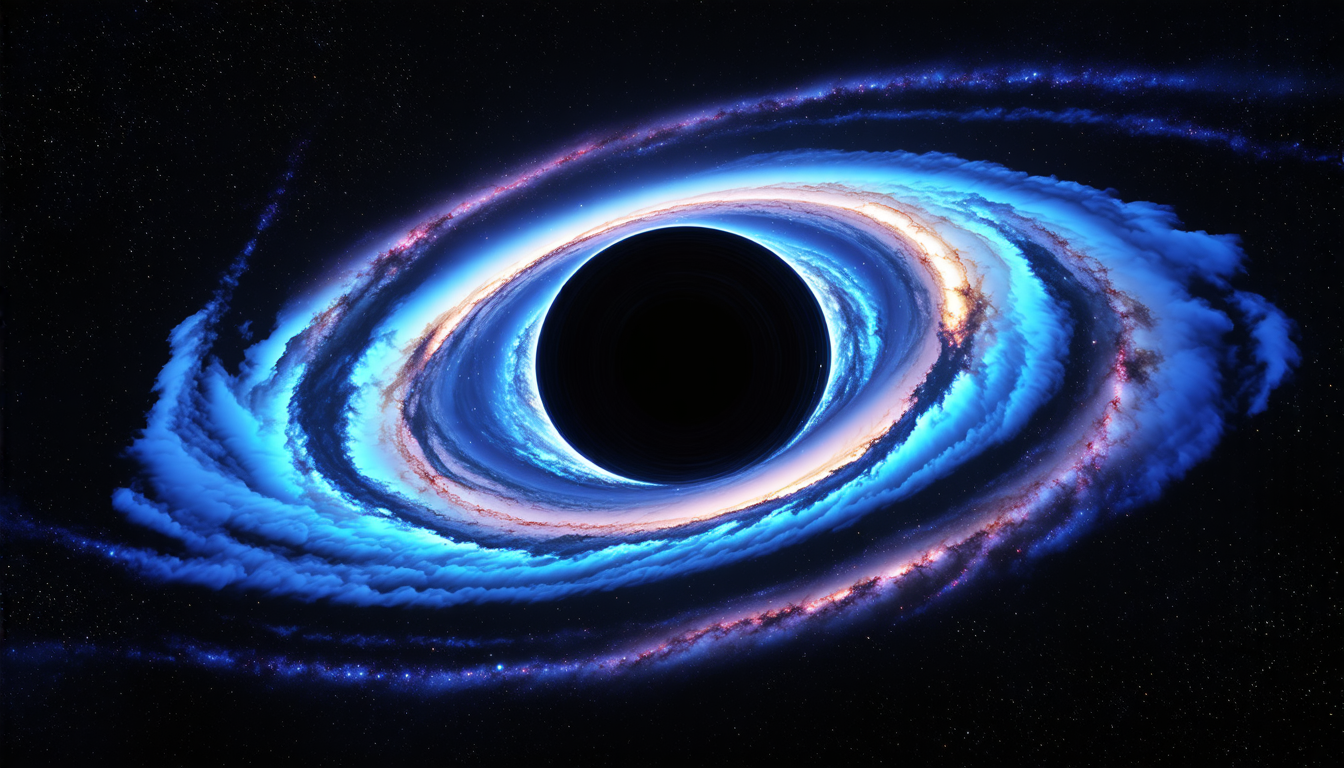
A team of scientists has made a significant breakthrough in understanding the mysterious behavior of Sgr A*, the supermassive black hole at the center of our galaxy. By observing the black hole’s mid-infrared (MIR) emissions, researchers have been able to model its magnetic field strength and electron density with unprecedented precision.
Sgr A* is known for its unpredictable flares, which can shoot up thousands of times brighter than its usual steady glow. These outbursts are thought to be caused by the accretion of material onto the black hole’s event horizon, but the exact mechanisms behind them remain unclear. By analyzing data from the James Webb Space Telescope (JWST), scientists have been able to pinpoint a specific MIR flare and study its properties in detail.
The research team used a sophisticated model to simulate the behavior of electrons in the accretion disk around Sgr A*. They found that the magnetic field strength is much stronger than previously thought, with values ranging from 40-70 gauss. This is significant because it suggests that the black hole’s magnetic field plays a crucial role in shaping its environment and influencing the behavior of nearby stars.
The team also discovered that the electron density in the accretion disk is extremely high, reaching levels of up to 10^7 particles per cubic centimeter. This is remarkable because it indicates that the material surrounding Sgr A* is incredibly hot and dense, with temperatures soaring above millions of degrees Celsius.
One of the most intriguing aspects of this study is its implications for our understanding of black hole physics. The data suggests that the event horizon of Sgr A*, which marks the boundary beyond which nothing can escape the black hole’s gravitational pull, is not as sharp as previously thought. Instead, it appears to be a gradual transition zone where the gravity becomes so strong that matter and energy are effectively trapped.
This finding has significant implications for our understanding of black hole behavior and its impact on the surrounding environment. It also opens up new avenues for research into the mysteries of Sgr A* and other supermassive black holes at the centers of galaxies.
In addition to providing insights into black hole physics, this study highlights the impressive capabilities of the JWST. The telescope’s ability to observe in the MIR range has allowed scientists to study Sgr A*’s behavior in unprecedented detail, revealing new information about the black hole’s magnetic field and electron density.
Cite this article: “Unraveling the Mysteries of Sgr A: Scientists Make Breakthrough Discoveries About Supermassive Black Holes Magnetic Field and Electron Density”, The Science Archive, 2025.
Black Holes, Supermassive, Sgr A*, James Webb Space Telescope, Magnetic Fields, Electron Density, Accretion Disks, Event Horizon, Galaxy Centers, Infrared Emissions





