

Friday 07 March 2025
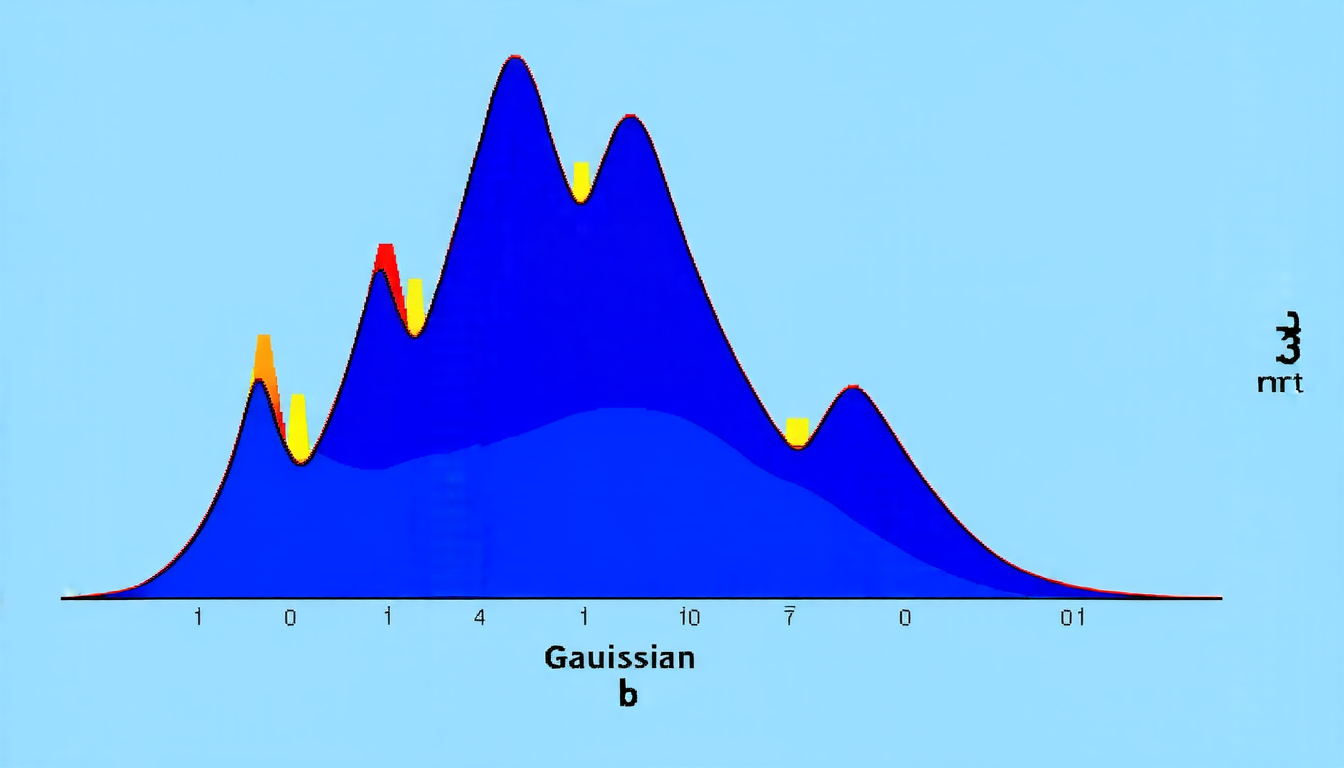
Scientists have made a significant breakthrough in understanding how to measure the distance between two complex statistical models, known as Gaussian Mixture Models (GMMs). These models are used to describe and analyze large datasets in various fields such as computer vision, machine learning, and biometrics.
GMMs are powerful tools for modeling complex data distributions. They can capture subtle patterns and relationships within the data, making them useful for tasks like image recognition, speech recognition, and medical diagnosis. However, working with GMMs can be challenging due to their high dimensionality and non-linear nature.
Measuring the distance between two GMMs is crucial in many applications. For instance, it’s essential in clustering algorithms to determine how similar or dissimilar clusters are. In image recognition, measuring the distance between GMMs of different classes can help improve classification accuracy. Unfortunately, existing methods for calculating distances between GMMs have limitations and may not accurately capture the true similarity between the models.
The researchers developed a new method that embeds the GMMs into a higher-dimensional space, allowing them to calculate a more accurate distance between the models. This approach is based on the concept of information geometry, which provides a mathematical framework for understanding how statistical models are related to each other.
The team’s innovative technique involves transforming the GMMs into a set of symmetric positive definite matrices and then calculating the distance between these matrices using an affine-invariant metric. This process ensures that the distance calculation is robust and insensitive to rotations and scaling of the data.
The new method has several advantages over existing approaches. It provides a more accurate measure of similarity between GMMs, which can lead to improved performance in applications such as clustering and classification. Additionally, it offers a flexible framework for modeling complex data distributions and can be extended to other types of statistical models.
The researchers validated their approach using various datasets and demonstrated its effectiveness in tasks like image recognition and texture analysis. Their work has the potential to revolutionize the field of machine learning and statistics by providing a more accurate and robust way of measuring distances between complex statistical models.
In summary, scientists have developed a new method for calculating distances between Gaussian Mixture Models that offers improved accuracy and flexibility. This breakthrough has significant implications for various fields where GMMs are used, including computer vision, machine learning, and biometrics.
Cite this article: “Measuring Distance Between Gaussian Mixture Models with Improved Accuracy”, The Science Archive, 2025.
Gaussian Mixture Models, Distance Calculation, Information Geometry, Statistical Models, Machine Learning, Computer Vision, Biometrics, Clustering Algorithms, Image Recognition, Texture Analysis





