

Friday 07 March 2025
The study of dark matter halos has long been a topic of interest in the field of astrophysics, and a recent research paper takes a closer look at the effects of these mysterious structures on the behavior of black holes.
Dark matter is an invisible form of matter that makes up approximately 27% of the universe, yet its presence can be felt through its gravitational pull. Halos are the regions around galaxies where dark matter dominates over ordinary matter. In the case of supermassive black holes at the centers of galaxies, these halos play a crucial role in shaping their behavior.
The researchers used computer simulations to model the dynamics of gas flowing into a black hole surrounded by a dark matter halo. They found that the presence of dark matter significantly altered the flow’s behavior, causing it to heat up and become more turbulent as it approached the event horizon.
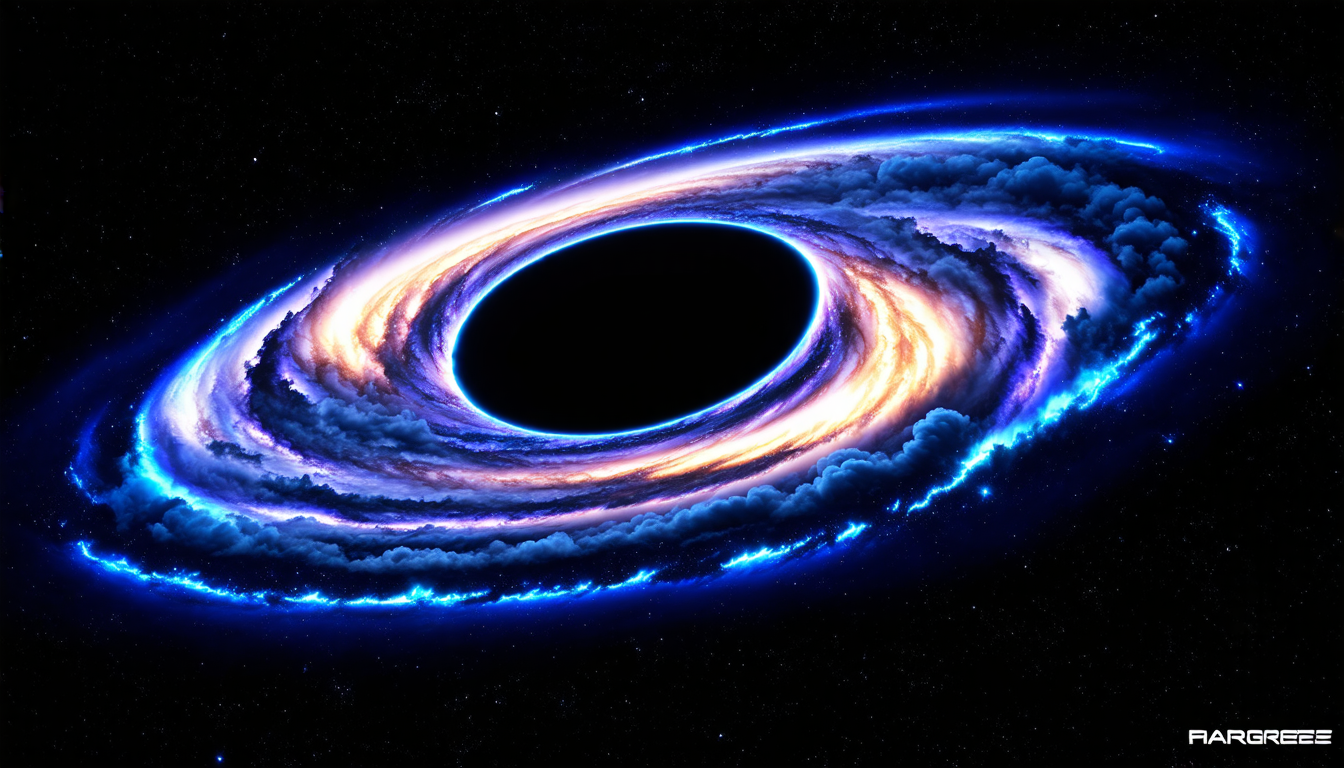
This increased turbulence leads to the formation of shocks within the accretion disk, which is a disk of hot, glowing gas that surrounds the black hole. These shocks can have a profound impact on the radiation emitted by the black hole, making it easier for scientists to detect and study these cosmic monsters.
The findings also suggest that dark matter halos may be responsible for shaping the properties of quasars, which are incredibly luminous objects thought to be powered by supermassive black holes. Quasars have been observed in distant galaxies, and understanding their behavior can provide valuable insights into the early universe.
The study’s results have significant implications for our understanding of black hole physics and galaxy evolution. By taking into account the effects of dark matter halos on accretion disk dynamics, scientists may be able to better explain the observed properties of quasars and other active galactic nuclei.
In addition, the research highlights the importance of considering the role of dark matter in astrophysical phenomena. As our understanding of this mysterious substance continues to grow, it is likely to play an increasingly important role in shaping our understanding of the universe as a whole.
The study’s findings are a testament to the power of computational simulations in advancing our knowledge of complex astrophysical systems. By using advanced computer models to simulate the behavior of dark matter halos and black holes, scientists can gain valuable insights into the underlying physics that govern these phenomena.
As research continues to uncover the secrets of dark matter and its role in shaping the universe, it is clear that this mysterious substance will remain a fascinating topic of study for years to come.
Cite this article: “Dark Matter Halos Shape Black Hole Behavior”, The Science Archive, 2025.
Dark Matter, Black Holes, Halos, Galaxies, Astrophysics, Supermassive, Quasars, Accretion Disk, Event Horizon, Simulations





