

Friday 07 March 2025
Scientists have made a significant breakthrough in understanding the behavior of light as it travels through the extreme environment near a black hole. This research has shed new light on the mysteries of these cosmic monsters and could potentially lead to new discoveries about the universe.
Black holes are regions of spacetime where gravity is so strong that nothing, not even light, can escape once it gets too close. The intense gravitational pull creates a boundary called the event horizon, which marks the point of no return. Any object that crosses the event horizon is trapped by the black hole’s gravity and cannot leave.
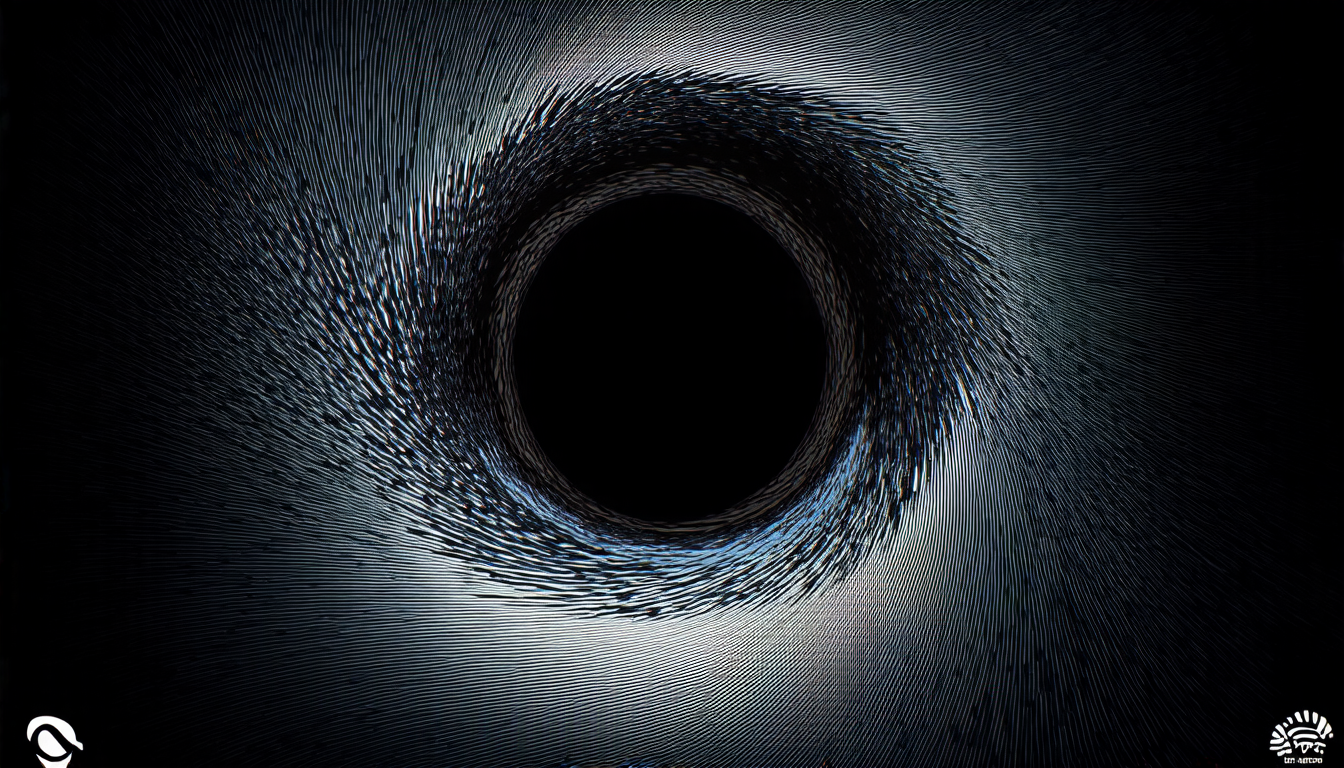
The new research focuses on the behavior of light as it approaches the event horizon of a rotating black hole. In this region, the laws of physics are severely distorted, and the rules that govern our everyday experience do not apply. The extreme gravitational forces cause the fabric of spacetime to warp and twist in ways that are difficult to comprehend.
The researchers used complex mathematical models to simulate the behavior of light as it travels through this warped spacetime. They found that the light becomes twisted and distorted, a phenomenon known as gravitational Faraday rotation. This effect is similar to what happens when light passes through a magnetic field on Earth, but it’s much more extreme in the vicinity of a black hole.
The team also discovered that the trajectory of the light can become closed, meaning it can travel along a circular path and eventually return to its starting point. This phenomenon is known as a gravitational Faraday holonomy, and it has significant implications for our understanding of spacetime.
The findings have far-reaching consequences for our understanding of black holes and the universe as a whole. They could potentially lead to new insights into the nature of spacetime and the behavior of light in extreme environments. The research also highlights the importance of continued exploration and study of these mysterious cosmic phenomena.
The study is part of an ongoing effort to better understand the properties of black holes and their role in the universe. Scientists are using a range of techniques, including observations from spacecraft and supercomputers, to gain insights into these complex objects.
As researchers continue to unravel the mysteries of black holes, they may uncover new secrets about the universe and its workings. The study of these cosmic monsters is an exciting and rapidly evolving field, with new discoveries being made regularly. The latest findings are a testament to the power of human curiosity and our desire to understand the unknown.
Cite this article: “Unveiling the Mysteries of Black Holes: New Research on Light Behavior Near Extreme Environments”, The Science Archive, 2025.
Black Holes, Light, Gravity, Spacetime, Event Horizon, Rotation, Mathematical Models, Gravitational Faraday Rotation, Holonomy, Universe
Reference: Blake Parvin, Mark T. Lusk, “Gravitational Faraday Holonomy” (2025).





