

Friday 07 March 2025
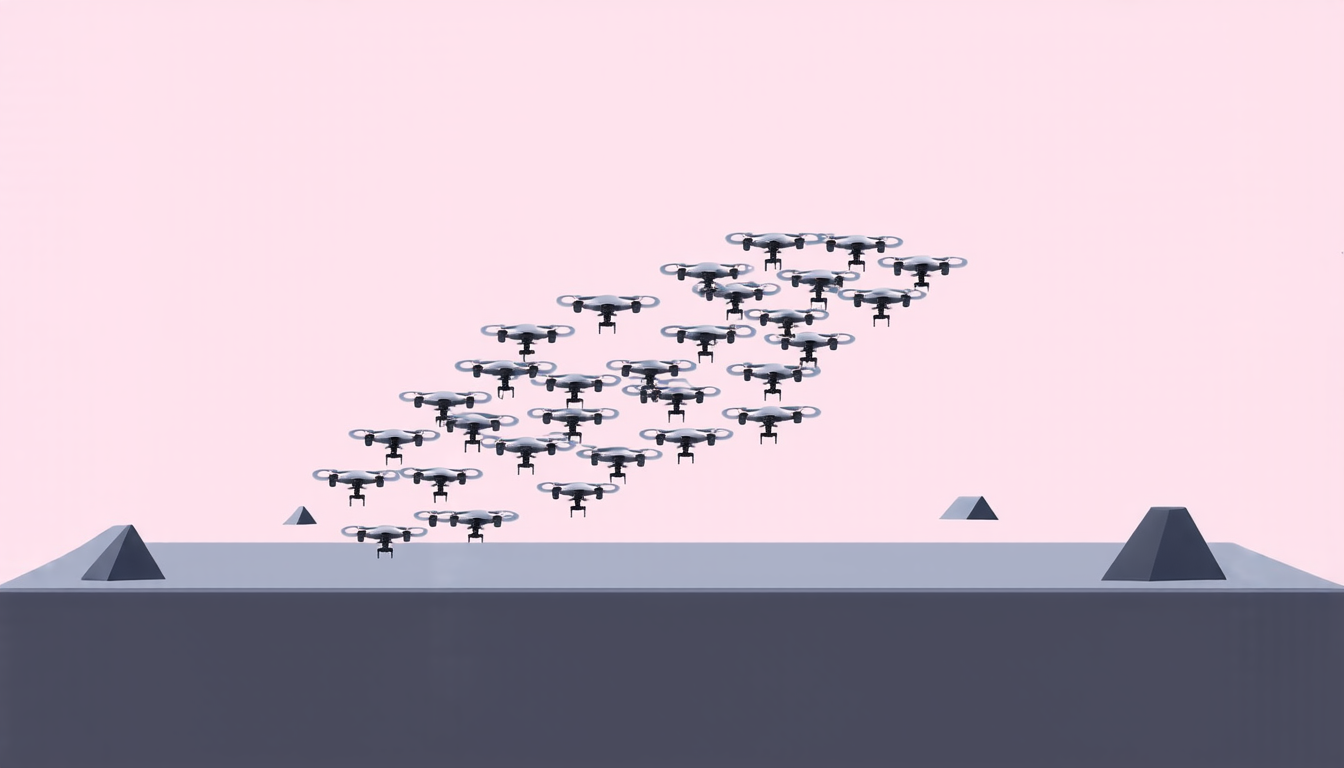
A swarm of drones has been trained to land safely and efficiently in crowded environments using a novel approach that combines reinforcement learning and safe learning techniques.
The researchers, from Skoltech Moscow, have developed an algorithm that allows multiple drones to navigate through complex obstacle courses and avoid collisions with each other or the environment. The system is designed to adapt to new situations and can even learn from its mistakes.
In the experiment, a swarm of Crazyflie 2.1 micro quadrotors was trained to land on moving landing pads in an indoor environment filled with obstacles such as cubes and cylinders. The drones were equipped with sensors that allowed them to detect their surroundings and make adjustments accordingly.
The researchers used a combination of reinforcement learning and safe learning techniques to train the drones. Reinforcement learning is a type of machine learning that involves training an agent to perform a task by providing rewards or penalties based on its performance. In this case, the drones were rewarded for landing safely and efficiently, while penalties were given for collisions or failures.
The safe learning component was added to ensure that the drones did not learn to take unnecessary risks or ignore safety constraints. This was achieved by incorporating a control barrier net algorithm into the system, which prevents the drones from entering dangerous zones.
The results of the experiment were impressive, with the swarm of drones achieving an accuracy rate of 95% and a mean landing time of 17 seconds. The drones also demonstrated adaptability to new situations, such as changes in wind direction or unexpected obstacles.
The development of this technology has significant potential for applications in industries such as search and rescue, construction, and logistics. For example, swarms of drones could be used to quickly survey damaged buildings after a natural disaster or to deliver small packages to remote locations.
However, there are also challenges that need to be addressed before the technology can be widely adopted. For instance, the system requires a high level of processing power and memory, which may not be feasible on smaller drones. Additionally, the training process is complex and time-consuming, requiring large amounts of data and computational resources.
Despite these challenges, the researchers are optimistic about the potential of their technology. They believe that with further development and refinement, swarms of drones could become a valuable tool for a wide range of applications.
Cite this article: “Swarms of Drones Trained to Land Safely in Crowded Environments”, The Science Archive, 2025.
Drones, Reinforcement Learning, Safe Learning, Swarm Robotics, Obstacle Avoidance, Collision Avoidance, Machine Learning, Control Barrier Net, Autonomous Systems, Navigation





