

Friday 07 March 2025
The quest for a unified theory of quantum mechanics and general relativity has been an ongoing pursuit in physics for decades. The two theories, which describe the behavior of particles at the atomic level and the nature of spacetime itself, respectively, have long been considered separate and distinct entities. However, researchers have been working to bridge this gap by developing new frameworks that can reconcile the principles of quantum mechanics with those of general relativity.
One such framework is known as the holographic principle, which suggests that the information contained in a region of spacetime is encoded on its surface. This idea has been successful in describing black holes and other exotic objects, but it has also led to some intriguing implications for our understanding of reality.
Recently, researchers have made significant progress in developing a new approach to the holographic principle, one that aims to merge quantum mechanics with general relativity in a more fundamental way. The key insight behind this approach is the idea that the principles of quantum mechanics can be used to describe not just particles, but also spacetime itself.
In essence, this means that spacetime is not a fixed background against which particles move, but rather it is an emergent property of the collective behavior of particles themselves. This perspective has far-reaching implications for our understanding of reality, and could potentially lead to new insights into the nature of gravity, time, and space itself.
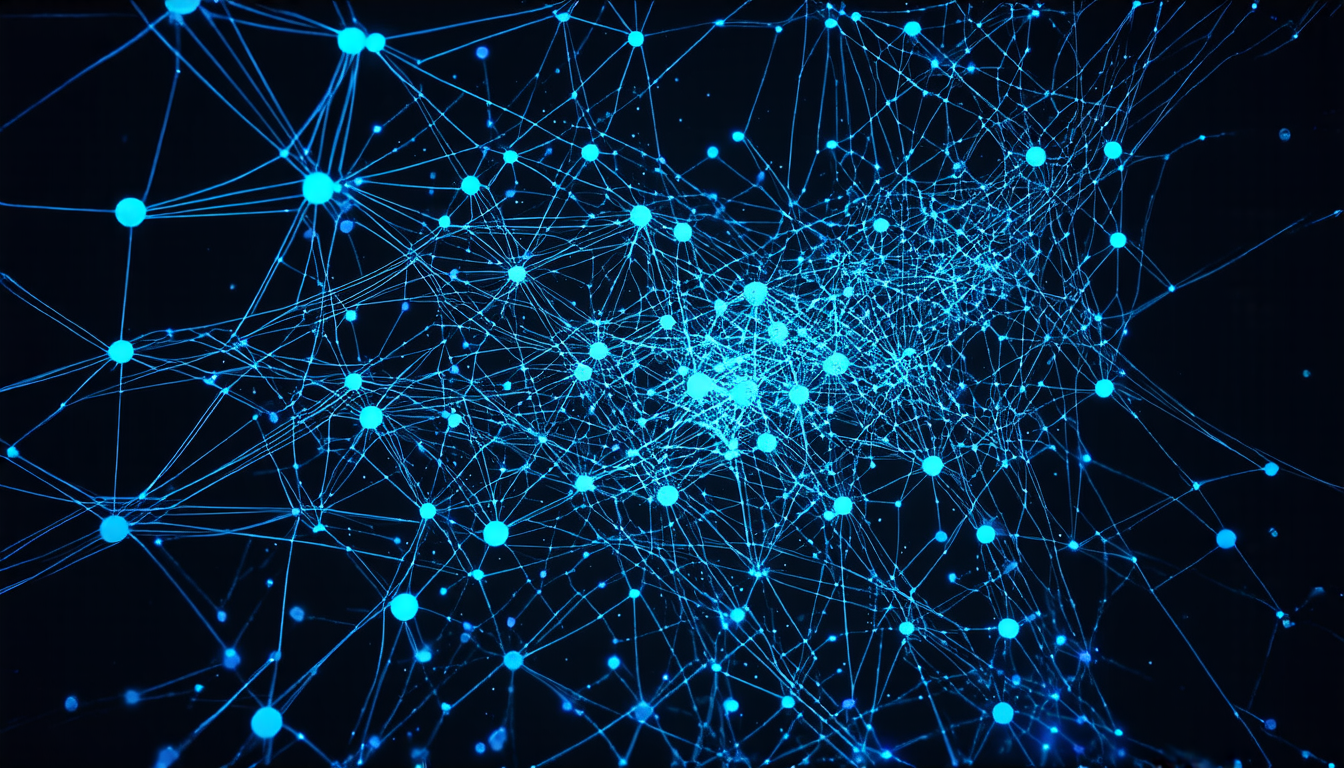
The approach being developed by researchers involves using a type of mathematical object known as a tensor network to describe the behavior of particles in spacetime. These networks are capable of encoding complex patterns of quantum entanglement, which can then be used to describe the emergent properties of spacetime itself.
One of the key benefits of this approach is that it allows researchers to study the behavior of spacetime at very small scales, where the principles of general relativity typically break down. This could potentially lead to new insights into the nature of black holes, dark matter, and other exotic objects, as well as the fundamental laws of physics themselves.
The development of this new approach has been made possible by advances in our understanding of quantum mechanics and general relativity, as well as the availability of powerful computational tools. Researchers are now working to further develop and refine these ideas, with the goal of creating a more complete and consistent theory that can describe all aspects of reality.
Overall, the quest for a unified theory of quantum mechanics and general relativity remains an active area of research, with many exciting developments on the horizon.
Cite this article: “Quantum Gravity: A New Approach to Unifying the Fundamentals of Reality”, The Science Archive, 2025.
Quantum Mechanics, General Relativity, Holographic Principle, Spacetime, Particles, Gravity, Time, Space, Tensor Networks, Quantum Entanglement





