

Friday 07 March 2025
A distant quasar’s X-ray output has been caught in the act of changing its tune, providing astronomers with a rare glimpse into the earliest days of the universe.
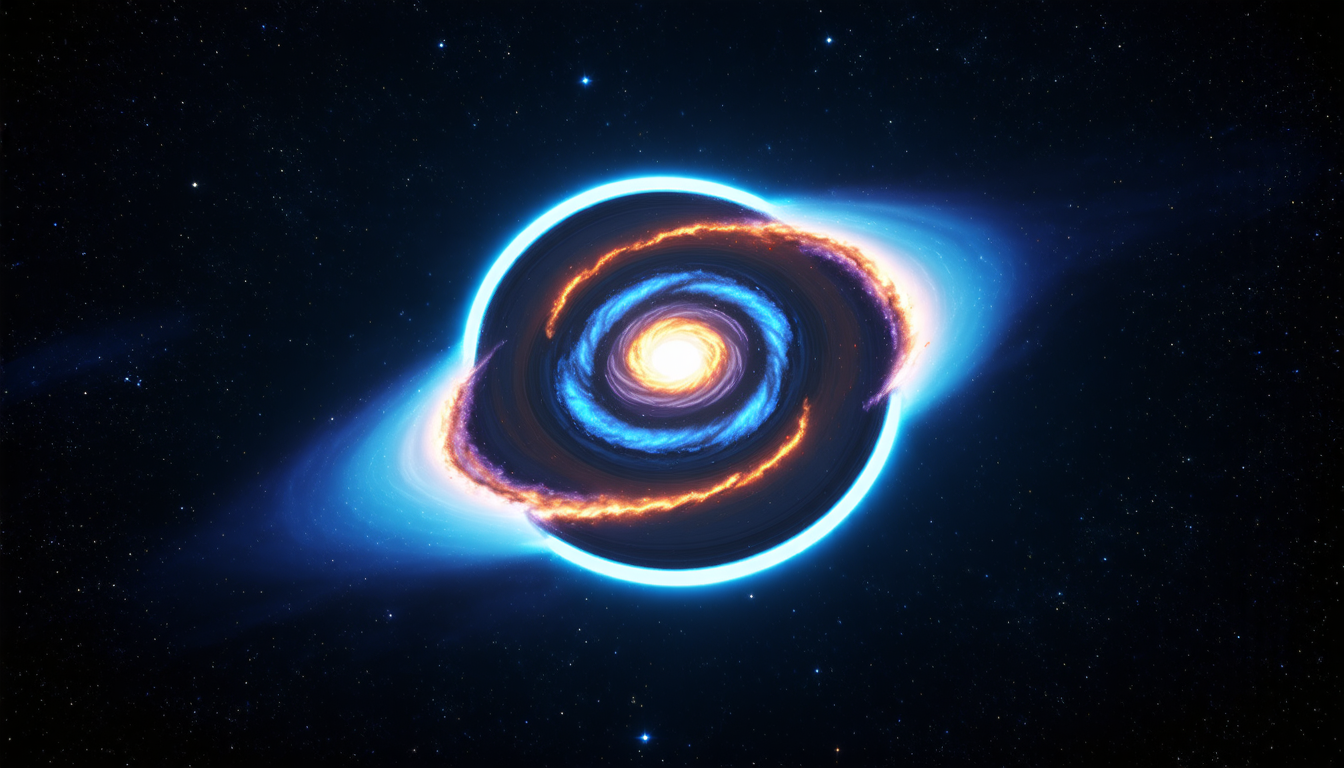
Quasars are incredibly luminous objects that form when supermassive black holes at the centers of galaxies gobble up vast amounts of gas and dust. They’re so bright that they can be seen from millions of light-years away, making them valuable tools for studying the early universe.
The quasar in question, known as CFHQS J142952+544717, is one of the most distant and luminous ever detected. Located about 12 billion light-years away, it’s a relic from the era when the first galaxies were forming and the universe was still in its adolescence.
Using NASA’s NuSTAR space telescope, astronomers observed CFHQS J142952+544717 over a period of two weeks, capturing its X-ray output in unprecedented detail. What they found was surprising: the quasar’s X-ray flux varied significantly during that time, brightening by a factor of about 2.6.
This type of variability is rare in quasars, which are typically thought to emit steady streams of radiation. The observed change suggests that there might be some kind of process at play that can alter the quasar’s output over relatively short periods of time.
One possibility is that CFHQS J142952+544717 has a jet of energetic particles shooting out from its central black hole. These jets are known to affect the surrounding environment and could potentially cause the quasar’s X-ray output to fluctuate.
Another theory is that the quasar’s accretion disk, which is responsible for feeding gas onto the black hole, might be oscillating or wobbling in some way. This could also lead to changes in the quasar’s radiation patterns over time.
The discovery of this variability has important implications for our understanding of the early universe. Quasars are thought to have played a key role in reionizing the universe, ionizing the gas that filled it and allowing light to travel freely.
By studying these distant objects, astronomers can learn more about the processes that shaped the universe during its formative years. The discovery of variability in CFHQS J142952+544717 provides new insights into the complex interplay between supermassive black holes and their surroundings.
Cite this article: “Unraveling the Secrets of a Distant Quasars X-ray Output”, The Science Archive, 2025.
Quasars, X-Rays, Nasa, Nustar, Space Telescope, Variability, Supermassive Black Holes, Accretion Disk, Jets, Early Universe





