

Friday 07 March 2025
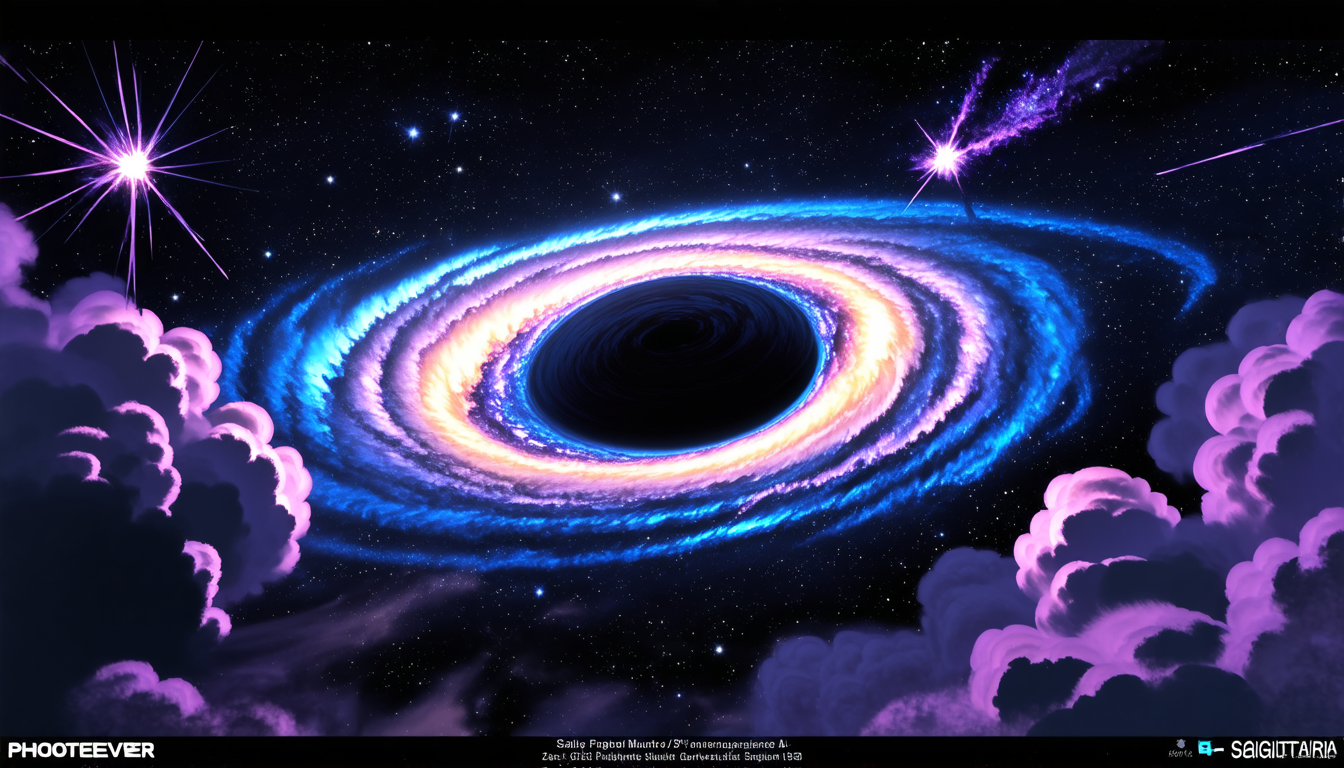
Deep in the heart of our galaxy, a massive black hole lurks, waiting to unleash its fury on the surrounding stars and gas. At the center of the Milky Way, this behemoth known as Sagittarius A* (Sgr A*) has been quietly accumulating material for millions of years, growing stronger with each passing day.
But how does it do it? Scientists have long puzzled over the mysterious mechanisms that fuel Sgr A*’s appetite for destruction. Recently, a team of researchers made a significant breakthrough in understanding the black hole’s feeding habits. By analyzing X-ray data from NASA’s Chandra space telescope, they were able to map the 3D structure of one of the closest molecular clouds to Sgr A*.
This cloud, known as the Stone Cloud, is a dense region of gas and dust that orbits the black hole at incredible speeds. As it hurtles through space, it releases X-rays that can be detected by telescopes on Earth. By tracing these X-ray emissions over time, scientists were able to reconstruct the cloud’s shape and motion in exquisite detail.
The results are nothing short of astonishing. The Stone Cloud is not a single, cohesive entity but rather a collection of dense clumps, each one moving at different speeds and directions. This chaotic dance of gas and dust creates a complex pattern of X-ray emission that can be used to map the cloud’s internal structure.
But what does this mean for our understanding of Sgr A*’s feeding habits? It turns out that the black hole is not simply a passive observer, waiting for material to drift its way. Instead, it actively interacts with the surrounding gas and dust, stirring up the Stone Cloud like a cosmic potter at work.
As the cloud’s clumps collide and merge, they release bursts of energy that can be detected as X-rays. This process is thought to occur over thousands of years, creating a slow but steady supply of fuel for Sgr A*. The black hole then devours this material, growing stronger with each passing day.
This new understanding of the Stone Cloud’s structure and behavior has significant implications for our understanding of supermassive black holes like Sgr A*. It suggests that these behemoths are not simply passive objects but rather dynamic, interacting systems that play a crucial role in shaping the evolution of galaxies.
Cite this article: “The Cosmic Dance of Sagittarius A”, The Science Archive, 2025.
Black Holes, Sagittarius A*, Milky Way, X-Rays, Nasa’S Chandra Space Telescope, Molecular Clouds, Stone Cloud, Gas And Dust, Supermassive Black Holes, Galactic Evolution





