

Friday 07 March 2025
The flow of liquid through a duct is a fundamental concept in physics, but it’s also incredibly complex. When you combine this flow with an external magnetic field, things get even more interesting. In recent years, researchers have been studying this phenomenon to better understand the transition from laminar to turbulent flow.
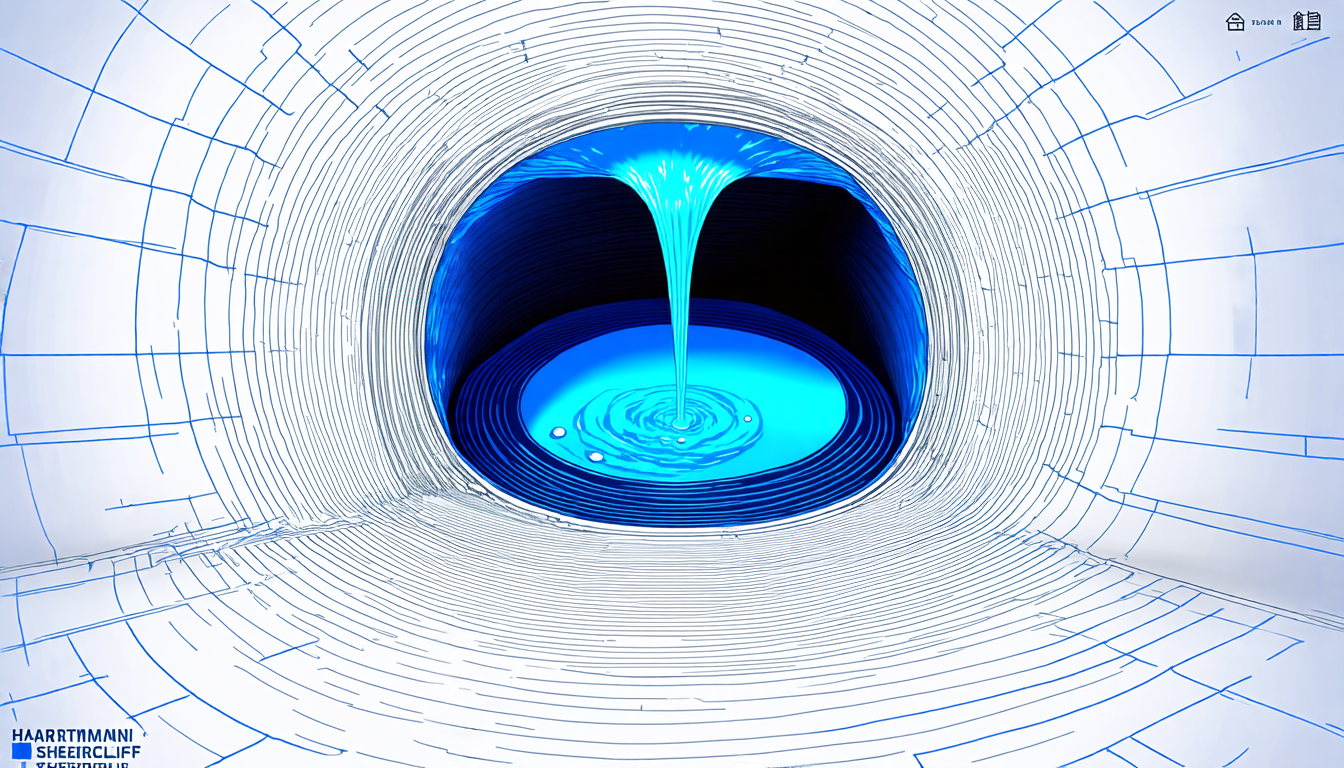
One of the key findings is that the presence of a transverse magnetic field creates two distinct layers: the Hartmann layer and the Shercliff layer. The Hartmann layer forms on the walls parallel to the magnetic field, while the Shercliff layer develops on the walls orthogonal to it. This separation leads to unique properties in each layer, influencing the flow dynamics.
Researchers used direct numerical simulations to investigate the competition between transition mechanisms specific to each boundary layer. They found that the transition to turbulence relies exclusively on a tripping of the Shercliff layer by perturbations, while the Hartmann layer plays a passive role. This is attributed to the spatial localization of edge states in the Shercliff layer at the expense of the Hartmann layer.
The study also highlighted the connection between these nonlinear coherent structures and linear optimal modes known from non-modal stability theory. These findings shed light on the intricate dynamics governing magnetohydrodynamic duct flow.
In a typical channel flow, laminar flow is stable at all Reynolds numbers. However, with the addition of an external magnetic field, this stability is disrupted, allowing for the transition to turbulence. The researchers used spectral element methods and high-performance computing to accurately simulate the flow and study the behavior of localized edge states.
The results suggest that these edge states can be seen as mediators of bypass transition in boundary-layer flows. They act as precursors to turbulence, triggering a cascade of instabilities that ultimately lead to chaotic flow. This research has important implications for our understanding of turbulent flows and their control.
By exploring the complex interplay between magnetic fields and fluid dynamics, scientists can better grasp the intricacies of magnetohydrodynamic duct flow. These findings have far-reaching potential applications in fields such as engineering, where precise control over fluid flow is crucial.
In the future, researchers will continue to delve deeper into this phenomenon, seeking a more comprehensive understanding of the underlying mechanisms driving transition and turbulence. With each new discovery, our grasp on these complex dynamics grows stronger, opening doors to innovative solutions and improved performance in various industries.
Cite this article: “Unlocking the Secrets of Magnetohydrodynamic Duct Flow”, The Science Archive, 2025.
Magnetohydrodynamic Duct Flow, Turbulence, Laminar Flow, Transition Mechanisms, Boundary Layers, Hartmann Layer, Shercliff Layer, Nonlinear Coherent Structures, Linear Optimal Modes, Spectral Element Methods





