

Friday 07 March 2025
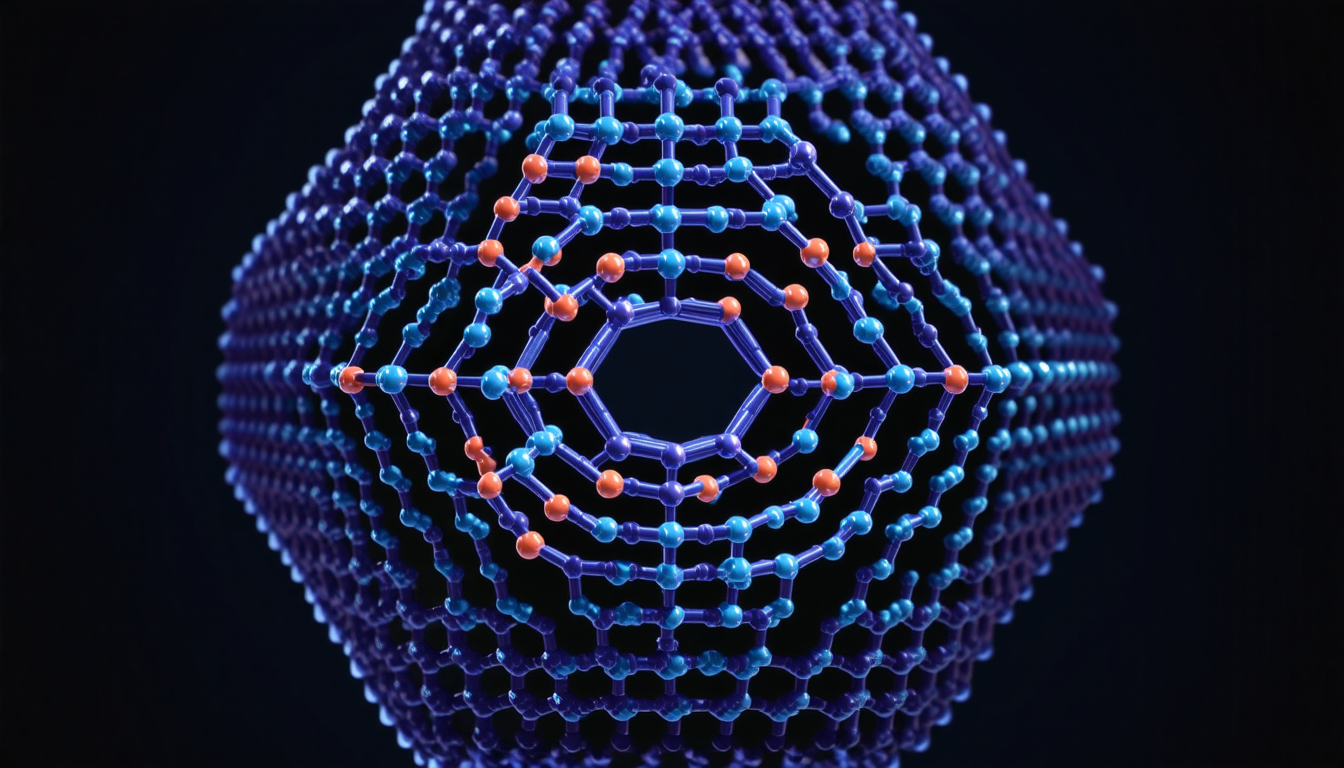
The quest for understanding the shape of crystals has been a long-standing problem in mathematics and physics. For over a century, researchers have sought to determine how crystals minimize their energy and take on specific shapes. A recent breakthrough by Emanuel Indrei, a mathematician at Kennesaw State University, sheds new light on this question.
Indrei’s work focuses on one-dimensional crystals, which are essentially lines of atoms arranged in a repeating pattern. These crystals are particularly interesting because they can exhibit unique behavior that doesn’t occur in higher dimensions. In the one-dimensional case, Indrei showed that convex sets – shapes that curve outward like a circle or an ellipsoid – are actually minimizers of energy.
To understand what this means, let’s consider how crystals form. Atoms arrange themselves to minimize their energy, which is influenced by factors such as temperature and pressure. In the one-dimensional case, Indrei found that convex sets have the lowest possible energy when compared to other shapes. This is because they are able to distribute their atoms in a way that maximizes their interactions with each other.
Indrei’s proof relies on a technique called optimal transport theory, which is used to study how particles or objects move from one place to another. In this case, Indrei applied the theory to show that convex sets have a unique property: they are able to minimize energy while also satisfying certain constraints. These constraints include the requirement that the crystal has a specific mass and that its atoms interact with each other in a particular way.
The implications of Indrei’s work are significant. For one, it provides new insights into the behavior of crystals at the atomic level. It also opens up new avenues for research in materials science and engineering, where understanding the properties of crystals is crucial for developing new technologies.
One potential application of Indrei’s work is in the development of new types of materials with unique properties. For example, by designing crystals that have specific shapes or structures, researchers may be able to create materials that are stronger, lighter, or more efficient than those currently available.
Indrei’s proof also has implications for our understanding of other physical systems, such as liquids and gases. By studying the behavior of one-dimensional crystals, researchers may gain new insights into the behavior of these systems, which could lead to breakthroughs in fields such as fluid dynamics and thermodynamics.
Cite this article: “Crystals Hidden Shape: A Breakthrough in Understanding One-Dimensional Crystals”, The Science Archive, 2025.
Crystals, Mathematics, Physics, Energy, Geometry, Materials Science, Engineering, Optimal Transport Theory, Convex Sets, One-Dimensional Crystals
Reference: Emanuel Indrei, “The one-dimensional equilibrium shape of a crystal” (2025).





