
Friday 07 March 2025
The quest for accurate estimates has long been a challenge in fields such as engineering, computer science, and even biology. In recent years, researchers have made significant strides in developing methods to fuse data from multiple sources, allowing for more precise predictions and decision-making. However, these advances often come with limitations, particularly when dealing with correlated or unknown variables.
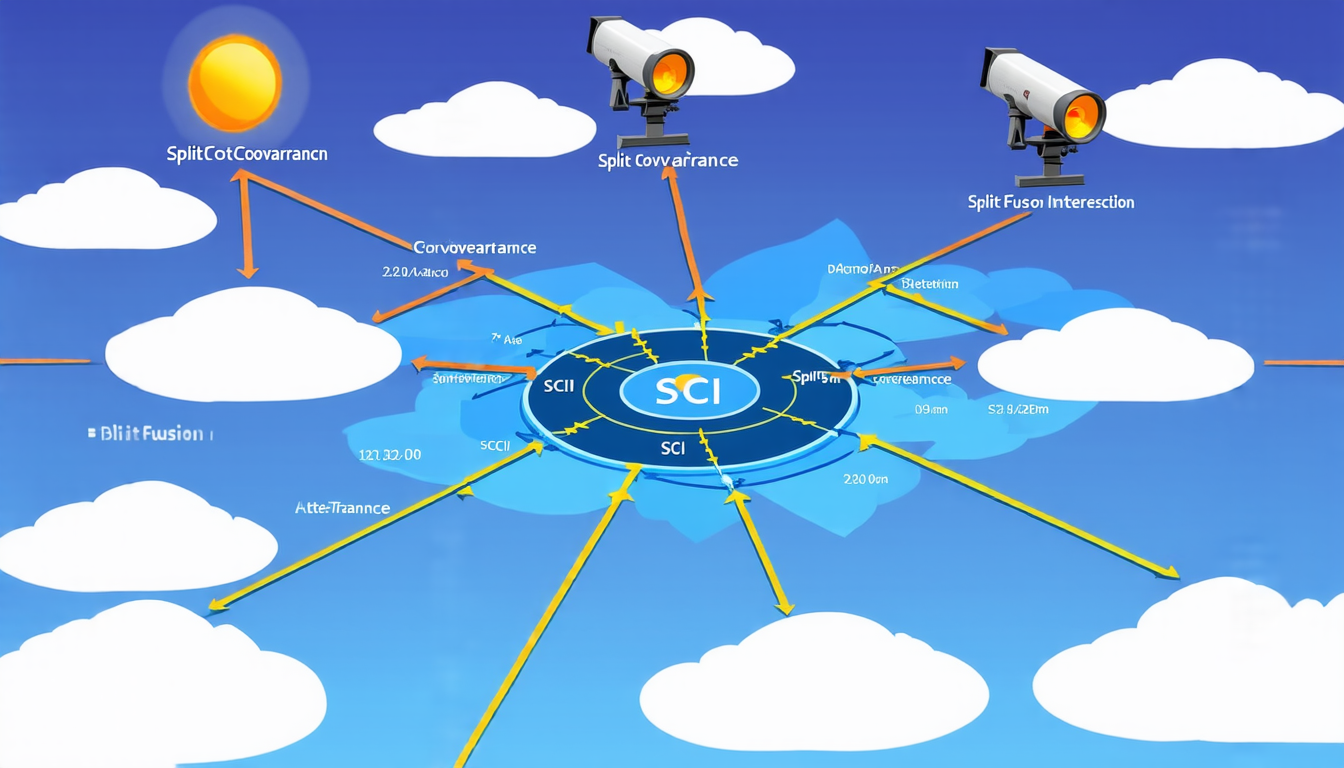
A new approach has emerged that aims to overcome these hurdles by introducing a concept called Split Covariance Intersection (SCI). This innovative method can be applied to various domains, including sensor networks, robotics, and even finance.
The problem of data fusion arises when multiple sensors or sources provide estimates of the same phenomenon. Typically, these estimates are combined using traditional methods such as weighted averaging or maximum likelihood estimation. However, these approaches often neglect the uncertainty inherent in each estimate, leading to suboptimal results.
SCI addresses this issue by separating the covariance matrix into two parts: one for independent and another for correlated components. This allows researchers to accurately account for both types of variability, resulting in more robust estimates. The approach is particularly useful when dealing with scenarios where sensors or sources have unknown correlations or varying levels of noise.
One of the key advantages of SCI is its ability to adapt to changing conditions and uncertainties. By incorporating real-time data and adjusting the covariance matrix accordingly, the method can provide a more accurate representation of the system being observed. This adaptability makes SCI an attractive solution for applications where uncertainty is inherent, such as in weather forecasting or financial modeling.
The benefits of SCI are not limited to improved accuracy alone. The approach also offers reduced computational complexity compared to other methods, making it suitable for real-time processing and implementation in resource-constrained systems. Additionally, SCI’s ability to handle correlated variables can lead to more efficient data transmission and storage, a significant consideration in modern computing.
While SCI shows immense promise, there is still much to be explored in this area. Future research will focus on refining the method, developing new applications, and addressing potential challenges such as scalability and computational efficiency. As researchers continue to push the boundaries of data fusion, it is clear that SCI has the potential to revolutionize our understanding of complex systems.
In recent years, the field of data fusion has seen significant advancements, particularly with the introduction of novel methods like Split Covariance Intersection (SCI). This innovative approach has shown great promise in various domains, including sensor networks, robotics, and finance.
Cite this article: “Revolutionizing Data Fusion with Split Covariance Intersection”, The Science Archive, 2025.
Data Fusion, Split Covariance Intersection, Sci, Sensor Networks, Robotics, Finance, Covariance Matrix, Uncertainty, Noise, Real-Time Processing