

Saturday 08 March 2025
The p-Laplacian, a mathematical construct that’s been gaining traction in recent years, has taken another step forward in its development. Researchers have found a way to extend the theory of eigenvalues and eigenvectors from tensors to signed graphs, opening up new possibilities for understanding complex networks.
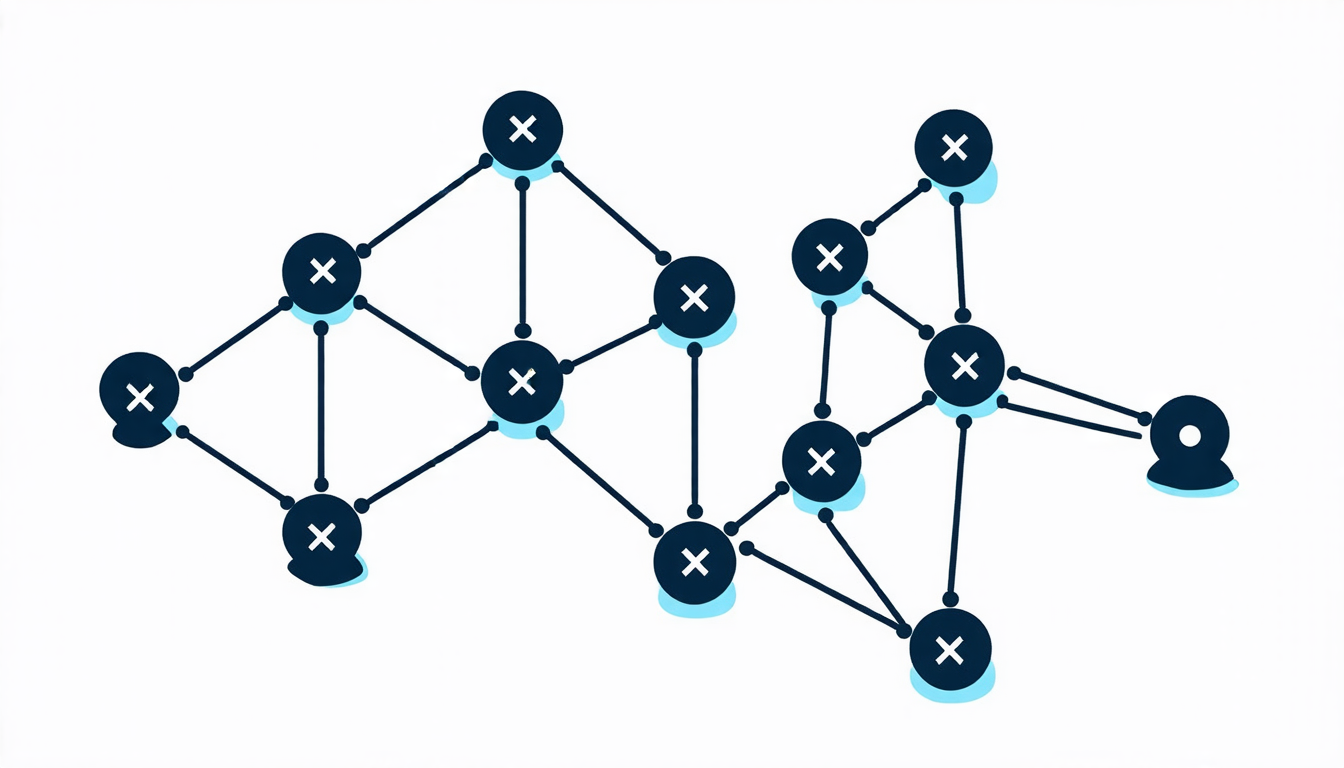
For those unfamiliar with the p-Laplacian, it’s essentially a mathematical tool used to study the structure of graphs. A graph is simply a collection of nodes connected by edges, which can represent everything from social networks to chemical compounds. The p-Laplacian takes this graph and applies a series of transformations to it, allowing researchers to extract valuable information about its properties.
In particular, the p-Laplacian has been used to study the eigenvalues and eigenvectors of graphs. These are special numbers that describe the underlying structure of the graph, much like how the frequency of a musical note describes its pitch. By studying these eigenvalues and eigenvectors, researchers can gain insights into everything from the graph’s connectivity to its resilience to attacks.
The problem is that traditional methods for computing eigenvalues and eigenvectors are limited to specific types of graphs, such as undirected or unweighted ones. Signed graphs, on the other hand, have edges with both positive and negative weights, which can represent things like friendships and rivalries in a social network.
Until now, it’s been difficult to apply the p-Laplacian to signed graphs because the theory didn’t extend well to these types of networks. But researchers have finally cracked the code, developing new algorithms that can efficiently compute the eigenvalues and eigenvectors of signed graphs using the p-Laplacian.
The implications are significant. With this new capability, researchers can now study a wide range of complex systems that were previously out of reach. For example, they could analyze the structure of social networks with both positive and negative relationships between people, or study the spread of diseases through a network of interactions between individuals.
Moreover, these algorithms have potential applications in fields beyond graph theory. By extending the p-Laplacian to signed graphs, researchers can also apply it to other areas like machine learning, where it could be used to improve the performance of neural networks.
One of the most exciting aspects of this development is its potential for shedding light on some of the biggest challenges facing society today. For instance, understanding how social networks function and evolve over time could help us better address issues like online harassment or misinformation spread.
Cite this article: “Unlocking the Secrets of Signed Graphs: A Breakthrough in p-Laplacian Theory”, The Science Archive, 2025.
P-Laplacian, Graph Theory, Tensors, Signed Graphs, Eigenvalues, Eigenvectors, Complex Networks, Social Networks, Machine Learning, Neural Networks
Reference: Chuanyuan Ge, Ouyuan Qin, “Computing the $p$-Laplacian eigenpairs of signed graphs” (2025).





