

Saturday 08 March 2025
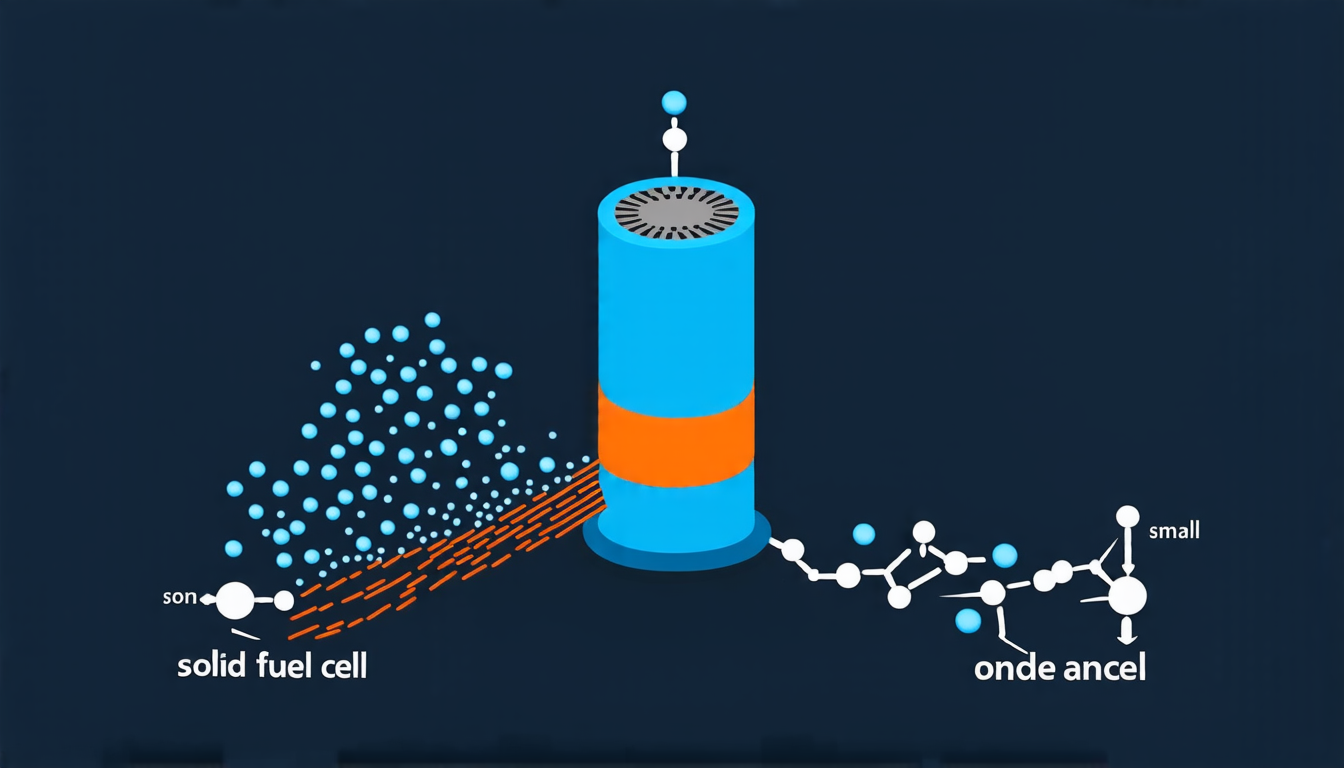
The intricate dance of gases within the anode support layer (ASL) of a solid oxide fuel cell (SOFC) is a complex phenomenon that has been studied extensively in recent years. The ASL, which is responsible for allowing oxygen and hydrogen to diffuse into the cell, plays a crucial role in determining the overall efficiency of the SOFC.
Researchers have long sought to develop a more accurate understanding of the gas transport dynamics within the ASL, as it can greatly impact the performance of the fuel cell. A recent study published in the journal ECS Transactions has made significant strides in this area by developing an analytical model that takes into account the dusty gas transport model and the pressure gradient driven transport.
The researchers used a combination of numerical and analytical techniques to simulate the behavior of hydrogen and water vapor within the ASL, taking into account factors such as the mean pore diameter, hydraulic permeability, and porosity/tortuosity ratio. The results showed that the model accurately predicted the impedance spectra of a button SOFC anode, which is crucial for optimizing fuel cell performance.
One key finding was that neglecting the pressure gradient in the ASL can lead to significant underestimation of the effective hydrogen diffusivity in the support layer. This highlights the importance of considering the complex interplay between gas transport and pressure gradients within the ASL.
The study also demonstrated the potential for using equivalent circuits with the Warburg finite-length element to fit experimental spectra, allowing researchers to identify traps and optimize fuel cell performance. The model parameters, including the Knudsen hydrogen diffusivity, hydraulic permeability, porosity/tortuosity ratio of the support layer, and ionic conductivity, double layer capacitance, and HOR Tafel slope of the active layer, can be obtained by fitting the models to experimental spectra.
The development of this analytical model has significant implications for the optimization of SOFC performance. By better understanding the gas transport dynamics within the ASL, researchers can design more efficient fuel cells that are capable of operating at higher temperatures and with improved power density. This could ultimately lead to the widespread adoption of SOFCs as a clean and sustainable energy source.
The study’s findings also highlight the importance of considering the complex interactions between different components within the fuel cell, including the ASL, active layer, and electrolyte. By taking a more nuanced approach to understanding these interactions, researchers can develop more accurate models that better predict fuel cell behavior and optimize performance.
Cite this article: “Unlocking the Dynamics of Gas Transport in Solid Oxide Fuel Cells”, The Science Archive, 2025.
Solid Oxide Fuel Cells, Anode Support Layer, Gas Transport Dynamics, Analytical Model, Numerical Simulation, Hydrogen Diffusivity, Pressure Gradient, Equivalent Circuits, Warburg Finite-Length Element, Fuel Cell Performance Optimization.





