

Saturday 08 March 2025
A team of researchers has made a significant discovery in the field of quantum computing, observing a previously unknown phenomenon that could have far-reaching implications for the development of more powerful and reliable qubits.
The study, published in a recent issue of Physical Review Letters, details the observation of sub-herz oscillations in the depth of liquid helium within a microchannel device used to trap electrons. These oscillations, which occur at frequencies as low as 0.14 Hz, are thought to be caused by the inertia of superfluid helium flowing through a film that covers the surface of the device.
The discovery is significant because it could help researchers better understand and mitigate the effects of noise on quantum computing systems. Quantum computers rely on the manipulation of qubits, which are delicate quantum states that can exist in multiple positions simultaneously. However, these qubits are highly susceptible to external influences, such as temperature fluctuations or vibrations, which can cause them to decohere and lose their quantum properties.
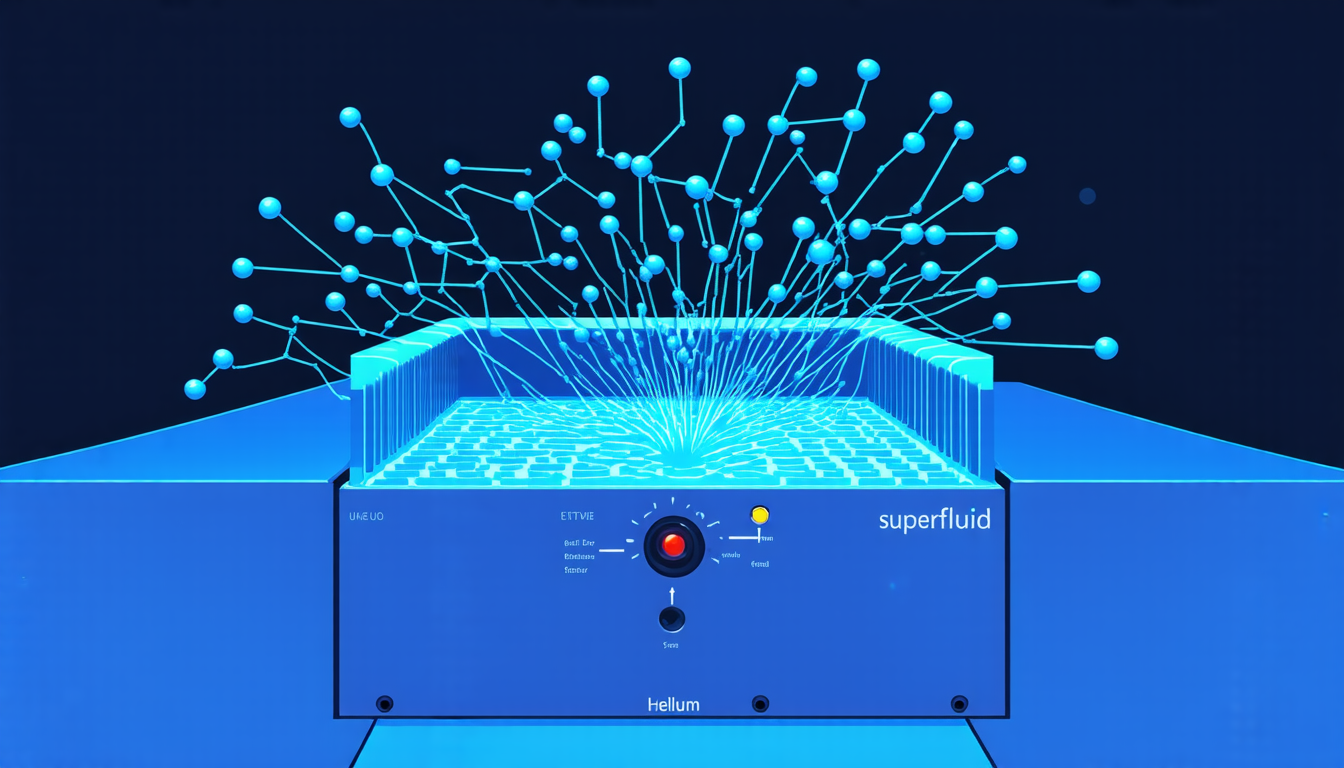
The microchannel device used in the study is designed to trap electrons on a superfluid helium film, allowing researchers to observe the behavior of individual electrons at the quantum level. The device consists of two channels connected by a central channel, with the electrons confined within the channels using electric fields.
In the experiment, the researchers applied a pulse-modulated millimeter-wave radiation to the microchannel device, causing the electrons to transition between different energy states. By monitoring the behavior of these transitions over time, they were able to observe the oscillations in the depth of the liquid helium film.
The researchers found that the frequency of the oscillations was dependent on the cross-sectional area of the superfluid helium film and the total area of the microchannels. They also observed that the amplitude of the oscillations decreased as the frequency increased, suggesting that the phenomenon is related to the flow of superfluid helium through the film.
The discovery has significant implications for the development of more reliable and powerful qubits. By understanding and mitigating the effects of noise on quantum computing systems, researchers may be able to create more robust and scalable devices that can perform complex calculations and simulations with greater precision.
In addition, the study highlights the importance of exploring new materials and technologies in the development of quantum computing. The use of superfluid helium and microchannel devices is a novel approach that could lead to breakthroughs in the field, and further research into this phenomenon may reveal new insights and opportunities for advancing the technology.
Cite this article: “Quantum Computing Breakthrough: Researchers Discover Sub-Herz Oscillations in Liquid Helium”, The Science Archive, 2025.
Quantum Computing, Qubits, Superfluid Helium, Microchannel Device, Noise Mitigation, Quantum States, Decoherence, Millimeter-Wave Radiation, Pulse-Modulated, Oscillations





