

Saturday 08 March 2025
A recent study has shed new light on a fundamental aspect of quantum mechanics, revealing that certain types of non-locality are exclusive to pure states. The researchers used a novel approach to investigate genuine network non-locality in the triangle scenario, where three sources produce entangled particles.
In classical physics, information is local and cannot be instantaneously transmitted between two points. However, quantum mechanics defies this notion by allowing for non-local correlations, where the properties of particles can be influenced by events occurring elsewhere in the universe. This phenomenon has been extensively studied in various contexts, including bipartite systems and networks.
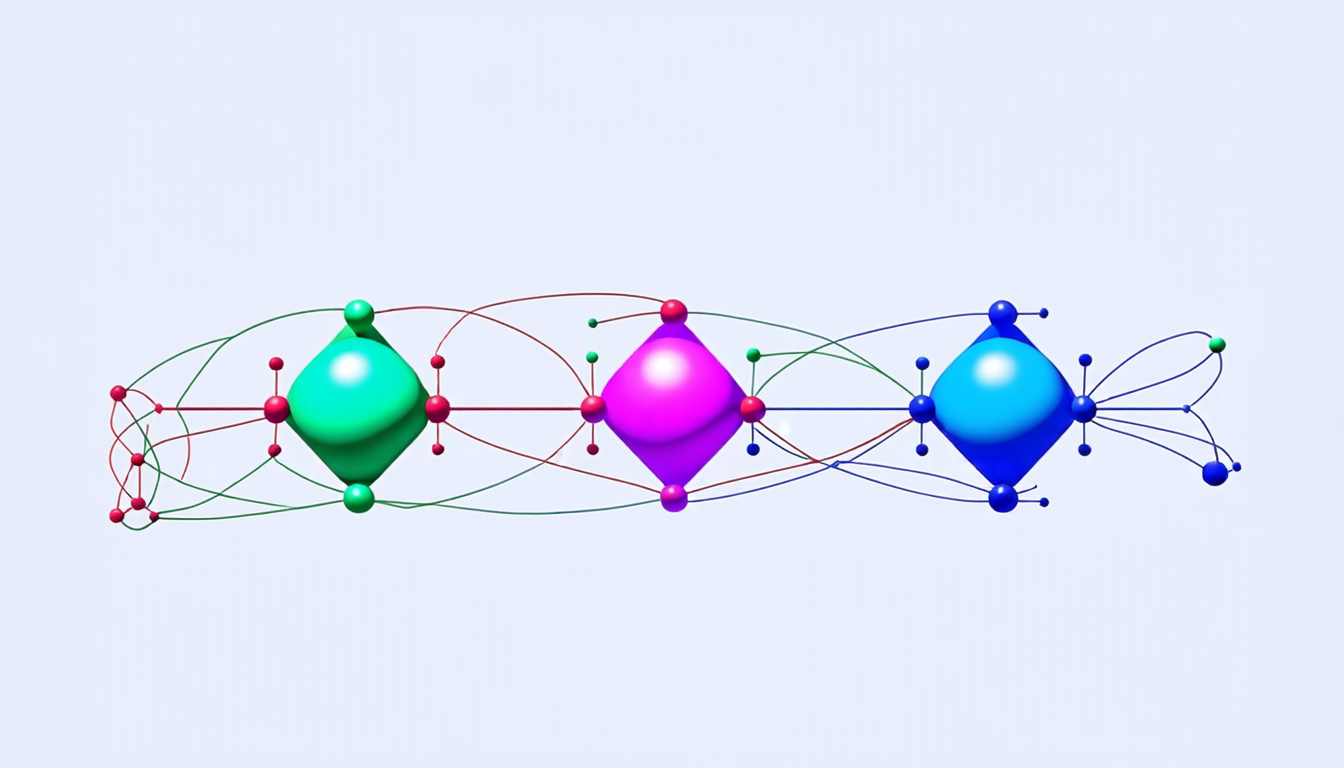
The triangle scenario presents a unique challenge due to its complexity. In this setup, three sources produce entangled particles, which are then measured simultaneously. The correlations between these measurements have been found to exhibit non-local properties, but the precise nature of these correlations has remained unclear.
To tackle this problem, the researchers developed an LHV k-rank neural network model that can accurately study these correlations. They used this model to investigate genuine network non-locality in the triangle scenario and discovered that certain types of non-locality are exclusive to pure states.
The significance of this finding lies in its implications for our understanding of quantum mechanics. Non-locality is a fundamental aspect of quantum theory, but it has been shown to be fragile and can be easily disrupted by noise or imperfections. The discovery of exclusive non-locality in pure states highlights the importance of these states in maintaining the integrity of quantum correlations.
The study also raises questions about the role of entanglement in non-local phenomena. Entanglement is a key feature of quantum mechanics, allowing particles to become connected even when separated by vast distances. However, this connection can be broken by noise or imperfections, which can lead to decoherence and loss of quantum properties.
The researchers’ findings suggest that pure states play a crucial role in maintaining entanglement and non-locality. This has important implications for the development of quantum technologies, such as quantum computing and communication systems.
In addition, the study’s results have significant theoretical implications. The discovery of exclusive non-locality in pure states provides new insights into the nature of quantum correlations and their relationship to entanglement.
The researchers’ novel approach using an LHV k-rank neural network model has opened up new avenues for studying complex quantum systems. This methodology can be applied to a wide range of scenarios, allowing for a deeper understanding of quantum mechanics and its many mysteries.
Cite this article: “Unveiling Exclusive Non-Local Correlations in Pure Quantum States”, The Science Archive, 2025.
Quantum Mechanics, Non-Locality, Pure States, Entanglement, Triangle Scenario, Lhv K-Rank Neural Network, Quantum Correlations, Decoherence, Quantum Computing, Quantum Communication Systems





