

Saturday 08 March 2025
A team of researchers has made a significant breakthrough in understanding how particles settle in fluids, a phenomenon that is crucial for many industrial processes and natural systems.
When you pour a glass of water and add some sugar or coffee grounds, the particles will slowly sink to the bottom. This process, called sedimentation, is influenced by several factors, including the size and shape of the particles, the density of the fluid, and the velocity of the flow. Despite its importance, sedimentation remains poorly understood, particularly in complex systems where multiple types of particles are present.
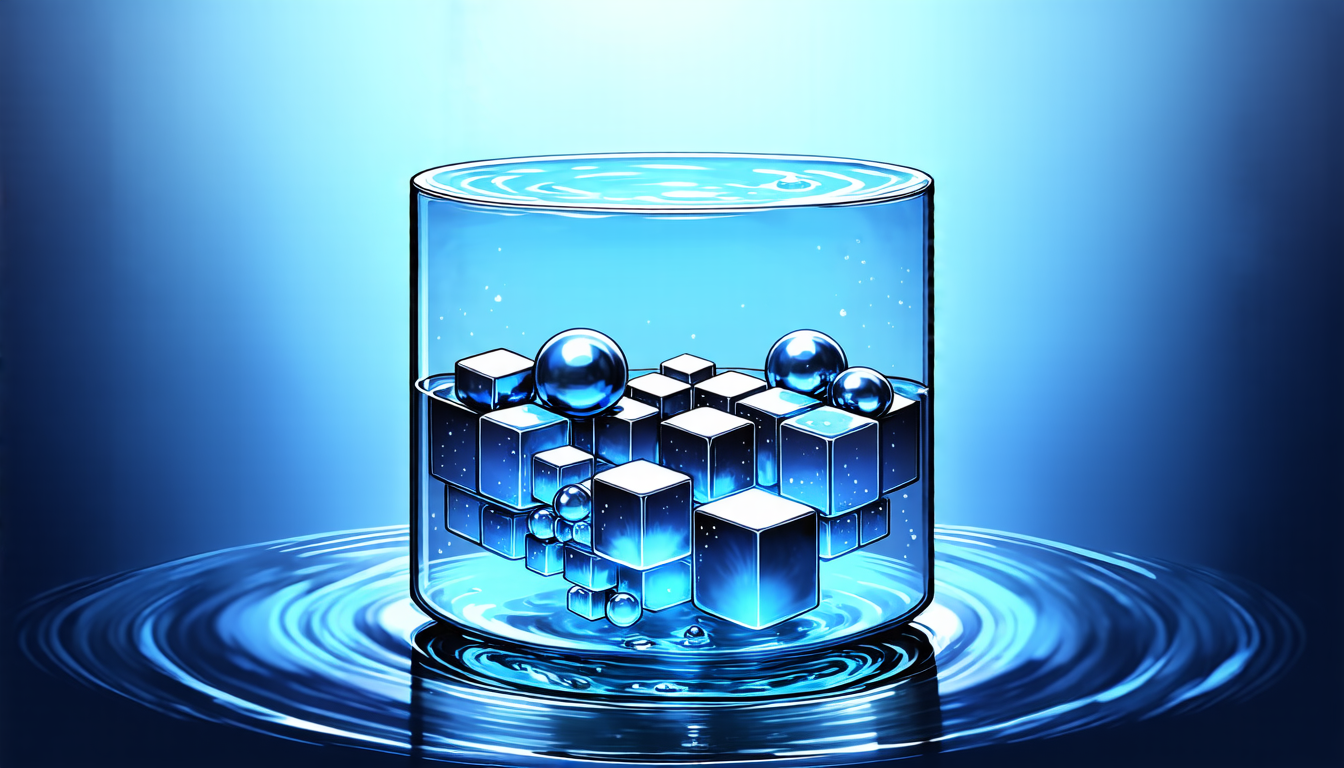
To tackle this challenge, scientists used a combination of theoretical models and computer simulations to study how different shapes and sizes of particles settle in water. They found that cubes and spheres exhibit distinct behaviors when it comes to settling. Cubes, for example, tend to move faster than spheres because they can rotate more easily, which allows them to take advantage of the fluid’s motion.
The researchers also discovered that the shape and size of the particles have a significant impact on the way they interact with each other. In particular, cubes are more likely to collide with each other and form clusters, while spheres tend to settle individually.
These findings have important implications for industries such as mining, where sedimentation plays a critical role in separating minerals from waste rock. By understanding how different particles settle, companies can develop more efficient separation processes, which could lead to significant cost savings and reduced environmental impact.
The research also sheds light on natural systems, such as the way that sediments accumulate at the bottom of lakes and oceans. This knowledge can help scientists better understand the complex interactions between water and sediment, which is essential for predicting the impacts of climate change on these ecosystems.
In addition to its practical applications, this study highlights the importance of fundamental research in understanding the behavior of particles in fluids. By pushing the boundaries of our knowledge, scientists can develop new theories and models that can be used to tackle a wide range of challenges in fields such as medicine, materials science, and environmental engineering.
The next step for researchers is to explore the implications of these findings for more complex systems, where multiple types of particles are present. This could involve studying the settling behavior of mixtures of cubes and spheres, or investigating how different shapes and sizes of particles interact with each other in turbulent flows.
Overall, this research demonstrates the power of interdisciplinary collaboration and highlights the importance of fundamental research in advancing our understanding of complex systems.
Cite this article: “Sedimentation Secrets Unraveled: New Insights into Particle Behavior”, The Science Archive, 2025.
Particles, Fluids, Sedimentation, Settling, Cubes, Spheres, Shape, Size, Density, Velocity





