

Saturday 08 March 2025
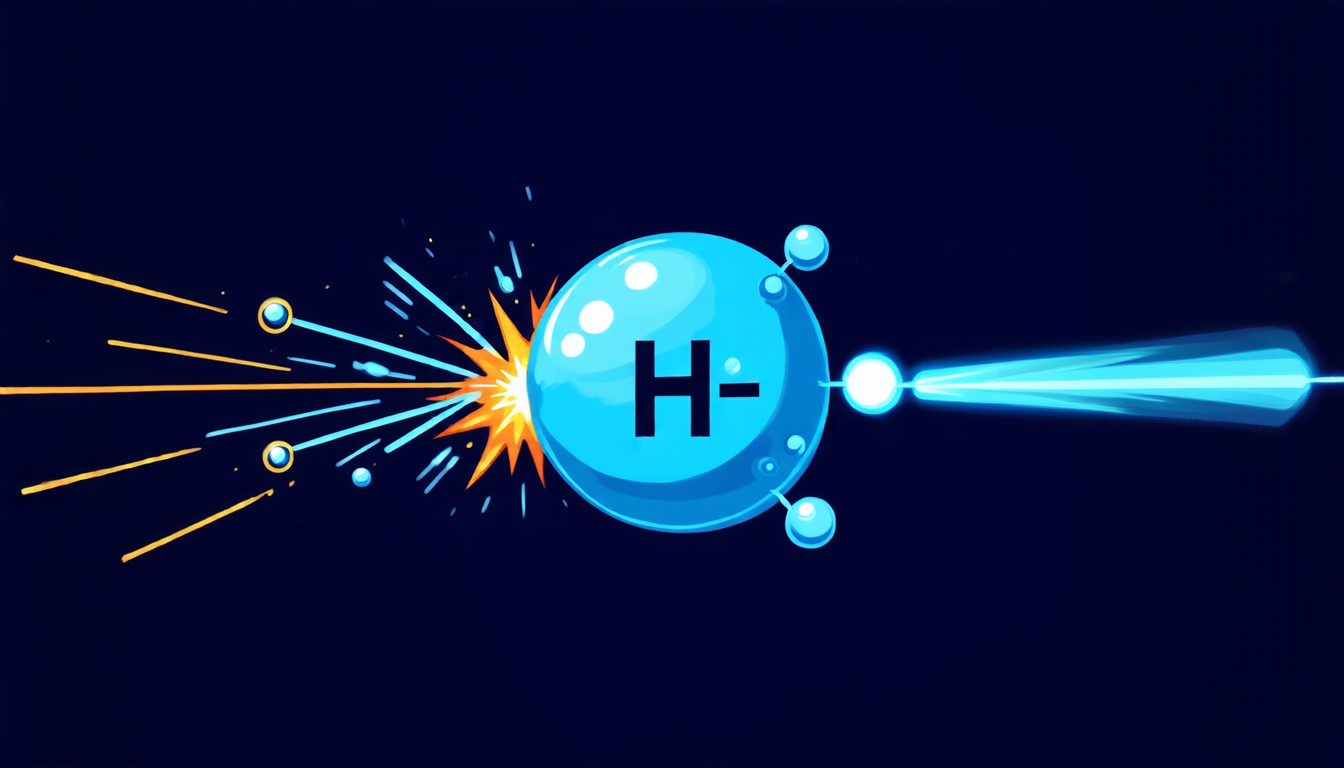
Scientists have made a significant breakthrough in understanding how to strip away electrons from negatively charged hydrogen ions, a crucial step towards creating powerful proton beams for various applications.
The negatively charged hydrogen ion, also known as H-, is a fundamental particle that plays a vital role in many scientific and technological endeavors. One of the most promising ways to harness its potential is through a process called charge exchange injection, where the ion is stripped of its extra electron to create a beam of protons.
To achieve this, scientists have been using strong magnetic fields to strip away the electrons, but this method has several limitations. The new approach uses a laser instead, which offers greater control and flexibility.
Researchers developed a mathematical model to simulate the process of photodetachment, where the H- ion is exposed to a laser beam and absorbs energy, causing it to lose its extra electron. They found that by using a specific wavelength of light, they could achieve a high efficiency in stripping away the electrons.
The study also explored the possibility of using Feshbach resonance, an intermediate state where the H- ion is excited and then decays back into its original state or into neutral hydrogen atom. This approach offers a more efficient way to detach the electron and create a proton beam.
One of the most exciting aspects of this research is its potential applications in various fields. The high-energy protons created through charge exchange injection could be used for cancer treatment, materials analysis, and even as a tool for studying fundamental physics.
The study’s findings are significant because they demonstrate that lasers can be used to strip away electrons from negatively charged hydrogen ions with greater precision and control than traditional methods. This breakthrough has the potential to revolutionize the way scientists work with H- ions and could lead to new discoveries in various fields.
The researchers’ mathematical model provides a powerful tool for simulating the photodetachment process, allowing them to fine-tune their approach and optimize the conditions for achieving high efficiency. The study’s results also shed light on the complex interactions between the laser beam, H- ion, and neutral hydrogen atom, providing valuable insights into the fundamental physics of the process.
Overall, this research marks an important milestone in the development of charge exchange injection technology and has far-reaching implications for various scientific and technological applications.
Cite this article: “Scientists Harness Power of Lasers to Strip Away Electrons from Negatively Charged Hydrogen Ions”, The Science Archive, 2025.
Proton Beams, Charge Exchange Injection, Hydrogen Ions, Laser Technology, Photodetachment, Feshbach Resonance, High-Energy Particles, Cancer Treatment, Materials Analysis, Fundamental Physics.





