

Saturday 08 March 2025
Researchers have long sought to understand and harness the power of perpendicular magnetic anisotropy (PMA), a phenomenon that allows certain materials to maintain their magnetic orientation even in the presence of external fields. PMA is crucial for the development of spintronic devices, which rely on the manipulation of magnetization to store and process information.
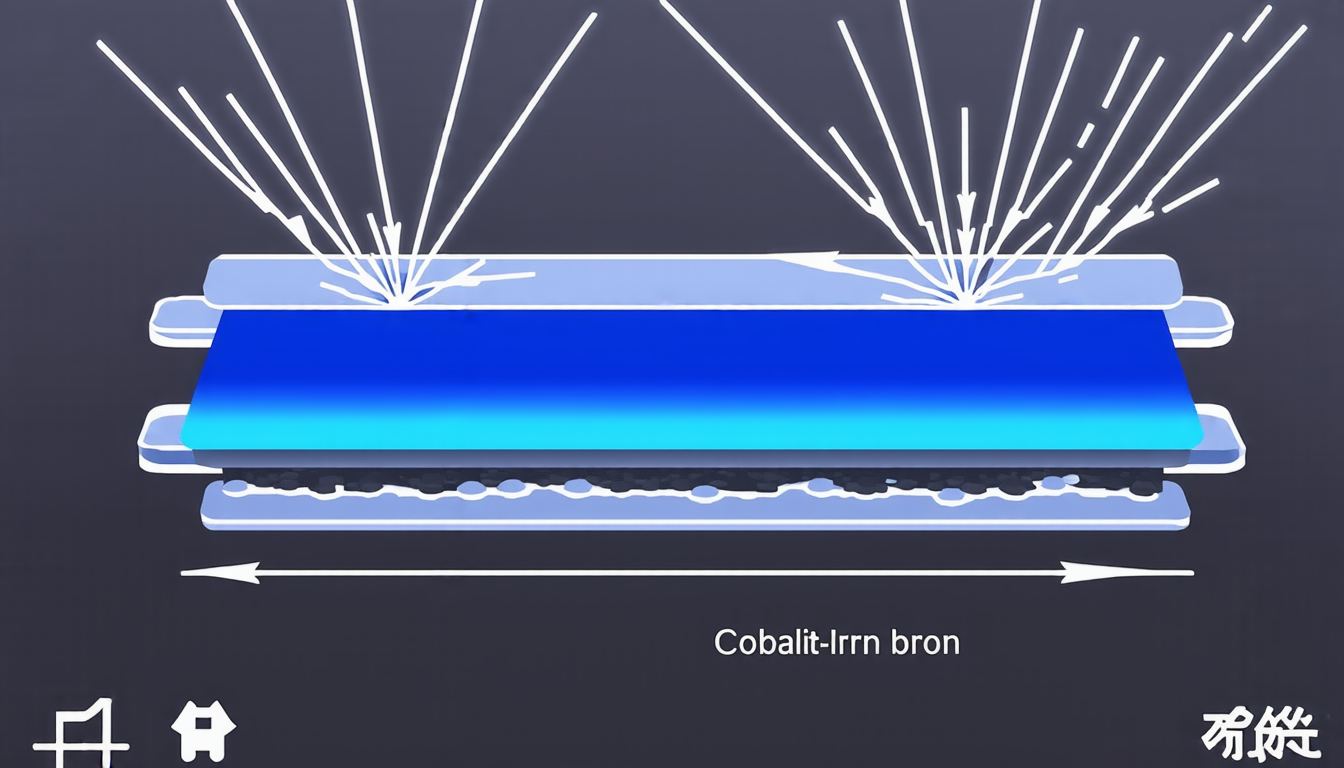
In a recent study, scientists have made significant progress towards understanding the origins of PMA in thin metal films. By combining pulsed laser deposition with in-situ polarized neutron reflectometry (PNR), researchers were able to investigate the formation of PMA in CoFeB/Mo bilayers. These bilayers consist of a layer of cobalt iron boron (CoFeB) sandwiched between two layers of molybdenum (Mo).
The study revealed that PMA can be established in both thin and thick Mo films without requiring any thermal annealing, which is typically necessary to induce PMA in other materials. This finding has significant implications for the development of spintronic devices, as it suggests that PMA can be achieved through a more straightforward process.
One of the key challenges in understanding PMA is identifying the mechanisms by which it forms. In the case of CoFeB/Mo bilayers, researchers found that the interface between the CoFeB and Mo layers plays a crucial role in the formation of PMA. Specifically, they discovered that the spin-orbit torque effect, which arises from the interaction between the spin polarization of electrons and the orbital motion of ions, is responsible for inducing PMA.
This finding has important implications for the development of spintronic devices, as it suggests that PMA can be controlled through the manipulation of the interface between different materials. This could potentially lead to the creation of more efficient and reliable spintronic devices.
The study also highlights the importance of in-situ PNR in understanding the formation of PMA. By using this technique, researchers were able to monitor the growth of the CoFeB/Mo bilayers in real-time and observe the emergence of PMA as it occurs. This capability is critical for understanding the complex mechanisms involved in the formation of PMA.
In addition to its implications for spintronics, the study also has broader significance for our understanding of magnetic materials. The discovery that PMA can be induced through the manipulation of the interface between different materials opens up new avenues for research into the properties and behavior of magnetic materials.
Cite this article: “Unlocking the Secrets of Perpendicular Magnetic Anisotropy in Thin Metal Films”, The Science Archive, 2025.
Perpendicular Magnetic Anisotropy, Spintronics, Pulsed Laser Deposition, In-Situ Polarized Neutron Reflectometry, Cofeb, Mo, Bilayers, Interface, Spin-Orbit Torque Effect, Magnetic Materials.





