

Saturday 08 March 2025
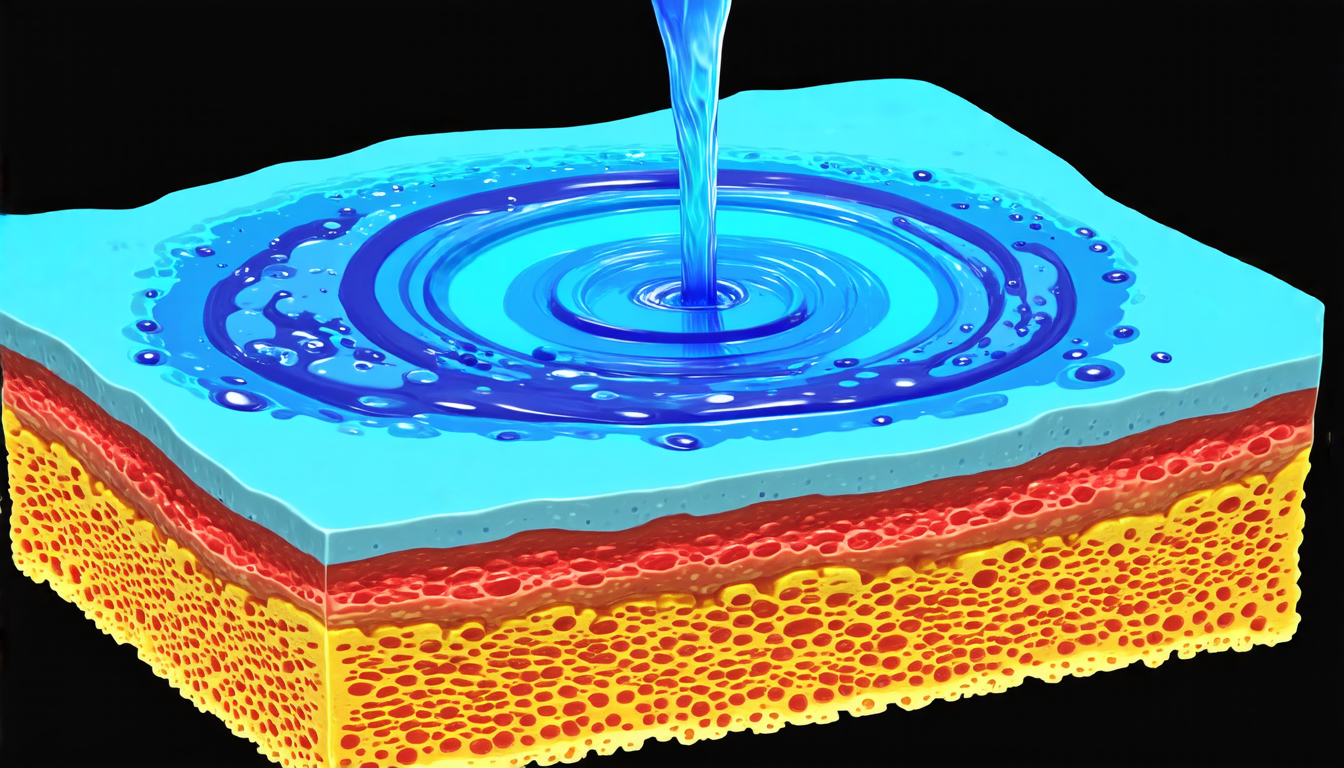
Researchers have long been fascinated by the complex flows that occur in porous media, such as sponges or rocks. These flows are crucial for a wide range of applications, from oil extraction to medical devices. However, understanding these flows is notoriously difficult due to their chaotic nature and the intricate interactions between fluid and solid.
A new study published in Physics of Fluids has shed light on this mystery by uncovering a previously unknown phenomenon that occurs when fluids flow through porous media with circular obstacles. The researchers used large-eddy simulations (LES) to model the flows, which allowed them to capture the intricate details of the turbulent behavior.
The team discovered that as the fluid flows through the pores, it creates a secondary flow instability that causes the flow to break symmetry. This means that the flow becomes asymmetric, with high- and low-velocity channels forming in the pore space. This asymmetry has significant implications for heat transfer, which is critical in many applications.
The researchers found that the circular obstacles enhance heat transfer by promoting attached flow on the obstacle surface. Attached flow occurs when the fluid sticks to the surface of the obstacle, increasing the contact area and therefore heat transfer. The team also discovered that the oscillating vortex wake behind the circular obstacles helps to advect recirculating vortices into the pore space, further enhancing heat transfer.
In contrast, square obstacles do not exhibit this secondary flow instability and thus do not promote attached flow or enhance heat transfer as much. This suggests that the shape of the obstacles has a significant impact on the flow behavior and heat transfer in porous media.
These findings have important implications for engineers designing heat exchangers, cooling systems, and other devices that rely on turbulent flows through porous media. By understanding how to optimize the geometry of the obstacles, engineers can improve the performance of these devices and enhance heat transfer.
The study also highlights the importance of LES simulations in capturing the complex behavior of turbulent flows. These simulations are computationally intensive but provide a level of detail that is difficult or impossible to achieve with experimental methods alone.
Overall, this research provides new insights into the intricate flows that occur in porous media and has significant implications for engineering applications. By understanding these flows, researchers can develop more efficient and effective devices that rely on turbulent flow through porous media.
Cite this article: “Uncovering Hidden Flows in Porous Media”, The Science Archive, 2025.
Porous Media, Fluid Dynamics, Turbulence, Heat Transfer, Circular Obstacles, Square Obstacles, Secondary Flow Instability, Attached Flow, Vortex Wake, Les Simulations.





