

Saturday 08 March 2025
The subtle dance of particles at high energies has long fascinated physicists, and a recent study sheds new light on the intricate ballet that unfolds when protons collide.
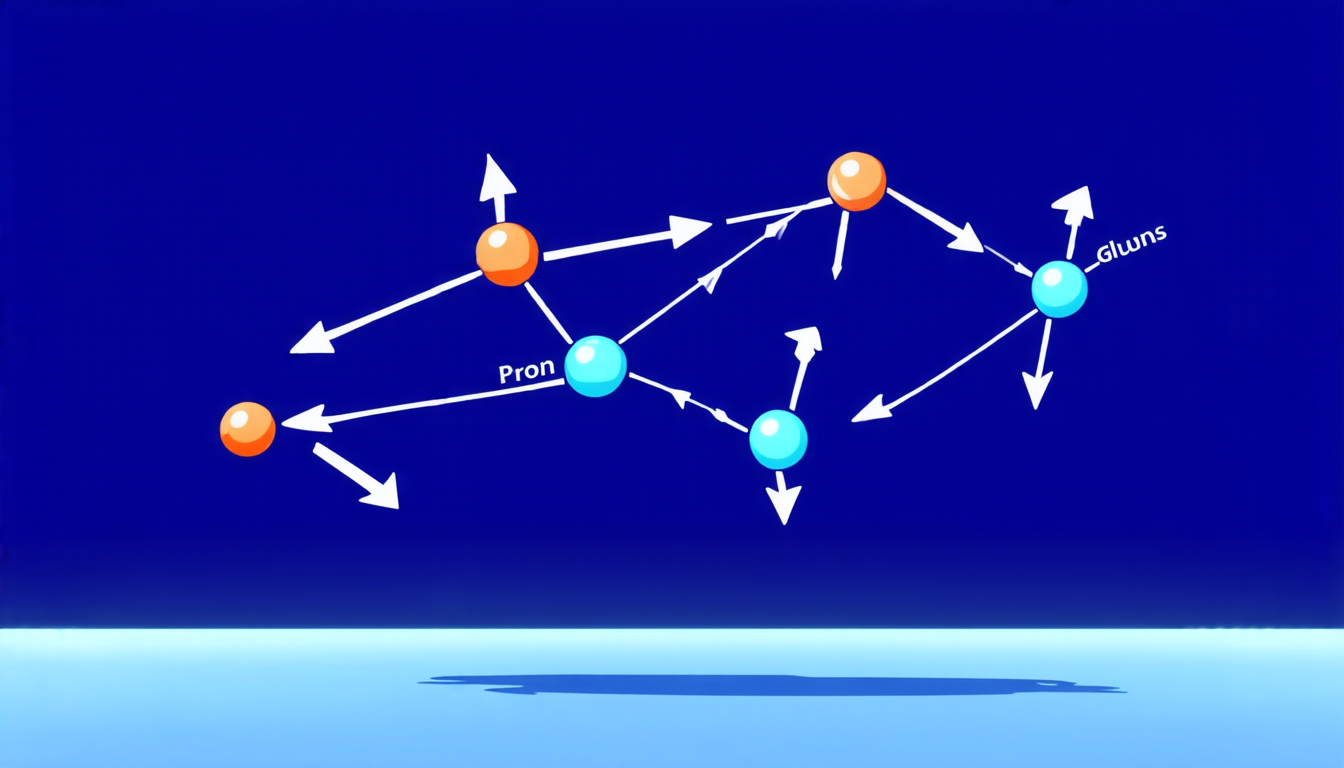
Researchers have been studying the scattering patterns of protons in particle accelerators for decades, seeking to understand the fundamental forces that govern these interactions. At first glance, the data may seem chaotic, with particles careening off each other at incredible speeds. But beneath this apparent randomness lies a hidden order, waiting to be uncovered.
One key aspect of proton scattering is the concept of scaling. In simple terms, scaling refers to the idea that certain properties of the collisions remain constant even as the energy of the protons increases. It’s like finding a hidden pattern in a seemingly random sequence of numbers – once you spot it, everything falls into place.
The latest study reveals that this scaling phenomenon is more complex than previously thought. Using data from the Large Hadron Collider (LHC) and other particle accelerators, researchers have discovered that the scaling patterns are not uniform across all energies. Instead, they exhibit a subtle dependence on energy, which can be described using a set of mathematical equations.
This finding has significant implications for our understanding of the strong nuclear force, which is responsible for holding quarks together inside protons and neutrons. The strong force is mediated by particles called gluons, which are exchanged between quarks during collisions. By studying the scaling patterns in proton scattering, physicists can gain insights into how these gluons behave at high energies.
The research also has practical applications in particle physics. For instance, it could help improve the accuracy of calculations used to predict the outcomes of future collisions at the LHC and other colliders. This is crucial for uncovering new physics beyond the Standard Model, which describes the behavior of fundamental particles and forces.
As researchers continue to probe the mysteries of high-energy collisions, they are likely to uncover even more subtle patterns and relationships waiting to be discovered. The dance of particles may seem chaotic at first glance, but with careful observation and analysis, physicists can tease out the underlying order and gain a deeper understanding of the fundamental forces that shape our universe.
The study’s findings have significant implications for our understanding of the strong nuclear force, which is responsible for holding quarks together inside protons and neutrons. The research also has practical applications in particle physics, such as improving the accuracy of calculations used to predict the outcomes of future collisions at the LHC and other colliders.
Cite this article: “Uncovering Hidden Patterns in High-Energy Particle Collisions”, The Science Archive, 2025.
Proton Scattering, Particle Accelerators, Strong Nuclear Force, Gluons, Quarks, Scaling Patterns, Large Hadron Collider, Fundamental Forces, Particle Physics, High-Energy Collisions





