

Saturday 08 March 2025
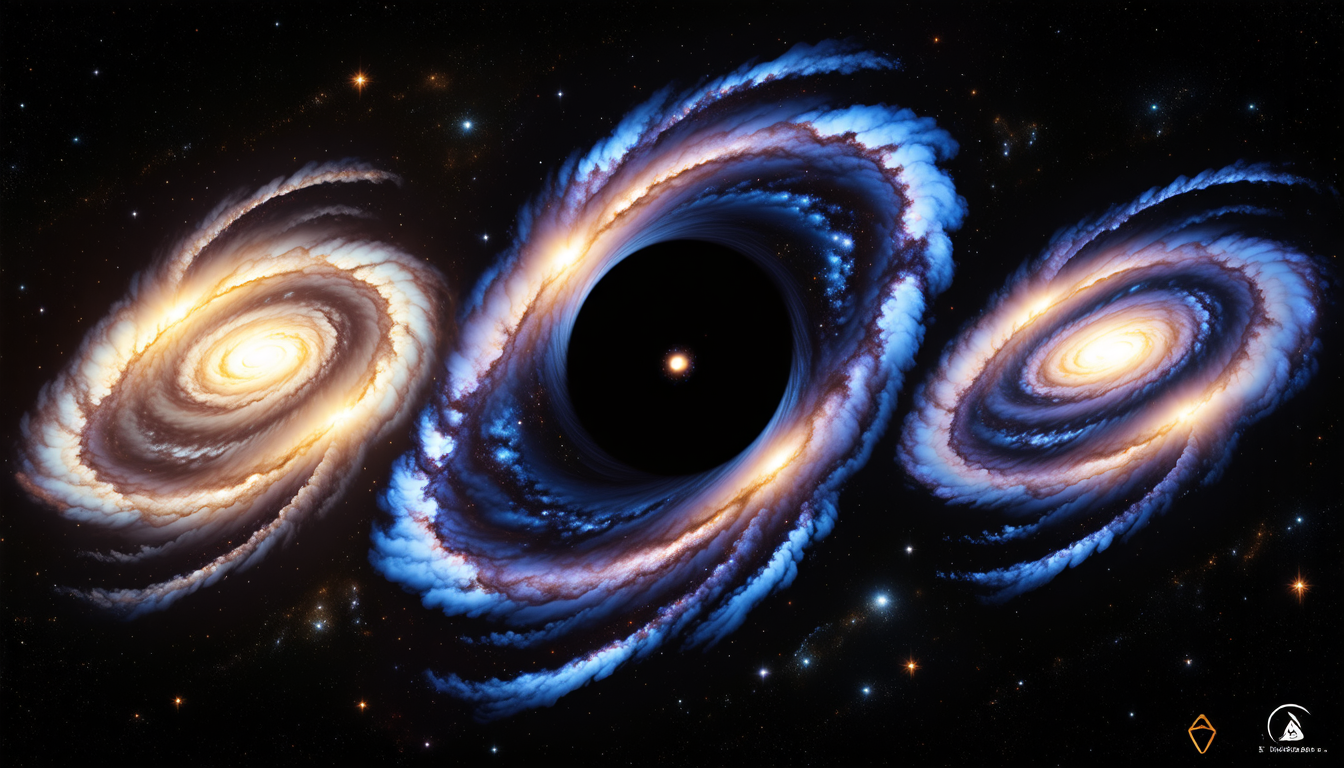
A trio of galaxies is providing astronomers with a unique opportunity to study the complex interplay between star formation and supermassive black holes.
At the heart of this cosmic dance are three galaxies – NGC 7733, NGC 7734, and a smaller, companion galaxy known as NGC 7734S. These galaxies are all interacting with each other, their gravitational forces causing gas and dust to be pulled towards the centers of each galaxy.
This interaction is triggering star formation in some areas, while suppressing it in others. Astronomers have used a range of observations, including data from the Hubble Space Telescope and the European Southern Observatory’s Very Large Telescope (VLT), to study this complex process.
One of the key findings is that the central regions of the galaxies are experiencing intense star formation, with rates that are hundreds or even thousands of times higher than those in our own galaxy. This is likely due to the presence of supermassive black holes at the centers of each galaxy, which are drawing in gas and dust and causing it to heat up.
However, not all parts of the galaxies are experiencing this intense star formation. In some areas, the interaction between the galaxies has actually suppressed star formation, by heating up or expelling gas from the region. This is likely due to the gravitational forces caused by the companion galaxy, NGC 7734S, which is perturbing the motion of gas and dust within the other two galaxies.
The study of these interacting galaxies is providing astronomers with valuable insights into the complex processes that shape the evolution of galaxies over billions of years. It’s also helping scientists to better understand how supermassive black holes interact with their surroundings, and how they affect the formation of stars within a galaxy.
One of the key challenges facing astronomers is trying to disentangle the different factors that are influencing star formation in these galaxies. The interaction between the galaxies is complex, and it’s difficult to separate out the effects of each individual factor.
To overcome this challenge, scientists are using a range of techniques, including computer simulations and observations of other interacting galaxies. By combining these approaches, they hope to build up a more complete picture of how star formation evolves in these complex systems.
The study of these interacting galaxies is also providing insights into the potential for life beyond our own planet. The intense star formation occurring in some areas of the galaxies could potentially give rise to new stars and planets, which could then support life.
Cite this article: “Cosmic Dance: A Study of Interacting Galaxies”, The Science Archive, 2025.
Galaxies, Star Formation, Supermassive Black Holes, Interaction, Gravitational Forces, Hubble Space Telescope, European Southern Observatory’S Very Large Telescope, Vlt, Starburst, Galaxy Evolution, Life Beyond Earth





