

Saturday 08 March 2025
The quest for seamless human-robot collaboration has been a longstanding challenge in the field of robotics. One of the key hurdles is the need for robots to adapt to changing task requirements and adjust their actions accordingly. In a recent breakthrough, researchers have developed an innovative approach that leverages large language models (LLMs) to enable robots to automatically switch between different control modes during teleoperation.
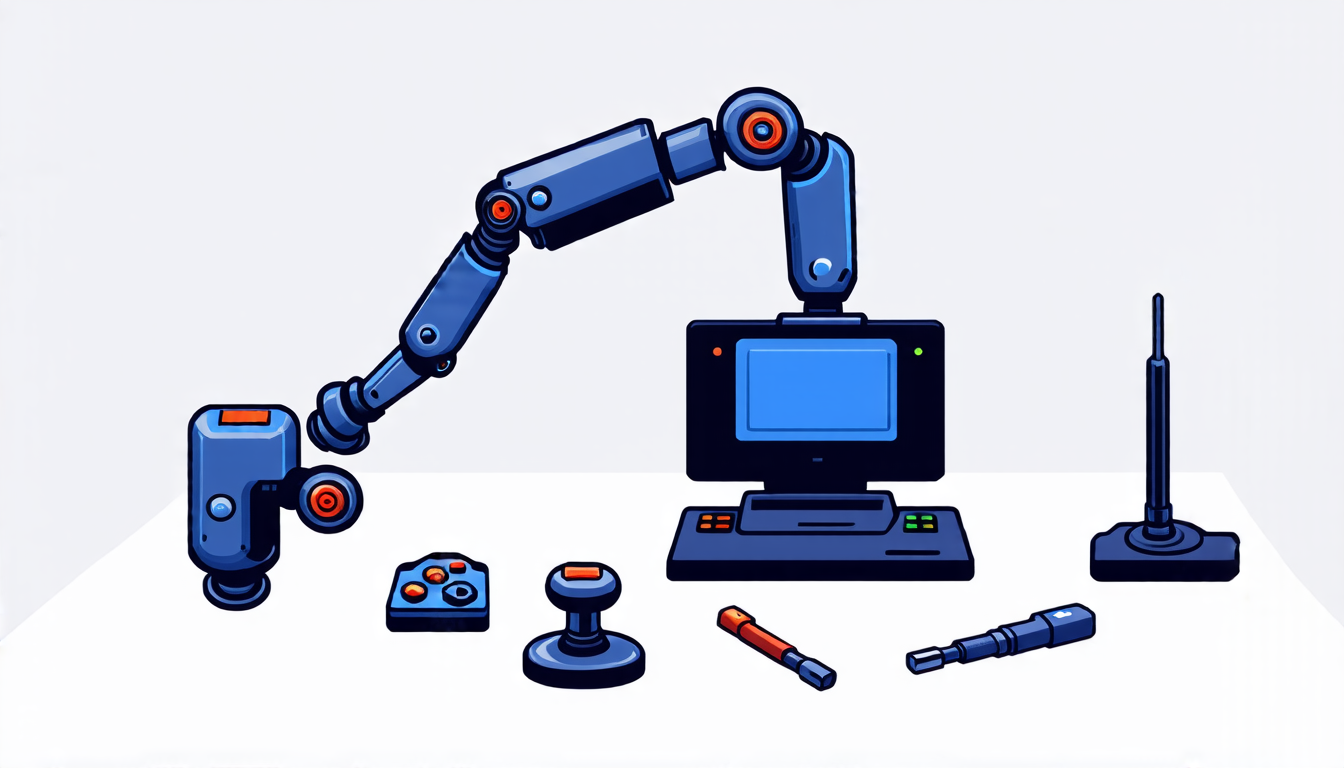
The new system, dubbed LAMS (Large Language Model-Driven Automatic Mode Switching), is designed to simplify the process of controlling robotic arms through low-degree-of-freedom controllers like joysticks. In traditional systems, users must manually switch between different control modes to perform complex tasks, which can be time-consuming and error-prone.
LAMS addresses this issue by training an LLM to analyze the current state of the robot arm, as well as information about objects in its vicinity, and predict the most likely actions required to complete a task. The system then uses this prediction to automatically switch between different control modes, ensuring that the robot arm is properly configured to execute the desired action.
The researchers behind LAMS used a dataset of 100 robotic tasks to train their model. These tasks involved complex sequences of actions, such as opening a bottle cap, picking up an object, and pouring its contents into a bowl. The team found that LAMS was able to accurately predict the most likely actions in over 90% of cases.
One of the key advantages of LAMS is its ability to learn from user-generated mode-switching examples. This means that as users interact with the system, it can adapt and improve its performance over time. In contrast, traditional systems often require manual tuning and configuration, which can be a significant challenge in complex robotic tasks.
LAMS also offers several benefits for users, including increased efficiency and reduced cognitive load. By automating the process of switching between control modes, the system allows users to focus on higher-level task planning and execution, rather than worrying about the minutiae of robotic arm control.
The researchers behind LAMS envision a future where their technology is integrated into a wide range of robotic systems, from industrial robots used in manufacturing to assistive robots designed to aid people with disabilities. They believe that by simplifying the process of human-robot collaboration, they can unlock new possibilities for automation and improve the overall quality of life.
In addition to its practical applications, LAMS also has significant implications for our understanding of human-robot interaction.
Cite this article: “Robotics Breakthrough: AI-Powered Control System Enables Seamless Human-Robot Collaboration”, The Science Archive, 2025.
Here Are The Keywords: Robotics, Human-Robot Collaboration, Large Language Models, Automatic Mode Switching, Teleoperation, Robotic Arms, Control Modes, Task Planning, Efficiency, Cognitive Load





