

Saturday 08 March 2025
The quest for efficient problem-solving has led researchers to develop innovative algorithms that can tackle complex constraints, such as those found in Sudoku puzzles. A recent study has shed light on the performance of modern SMT (Satisfiability Modulo Theories) solvers compared to traditional SAT (Boolean Satisfiability) and legacy SMT solvers.
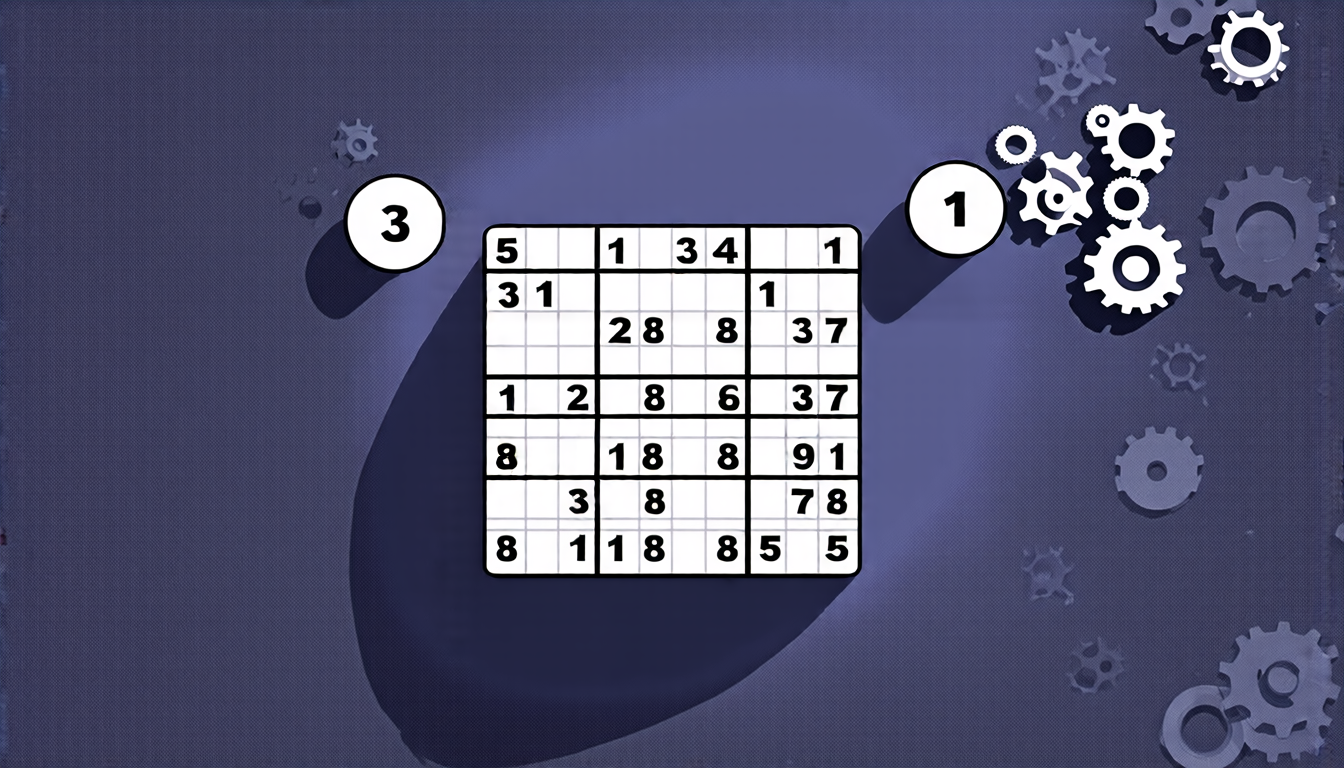
The investigation focused on solving large-scale 25×25 Sudoku puzzles, which provide a challenging testbed for evaluating solver efficiency. The results demonstrate that modern SMT solvers, such as Z3 and CVC5, significantly outperform classical SAT solvers like DPLL in terms of success rates, solving times, and propagation efficiency.
The study found that the advanced theory-reasoning capabilities of SMT solvers enable them to efficiently handle complex constraints, leading to faster and more accurate solutions. In contrast, traditional SAT solvers struggle with Boolean reasoning alone, resulting in slower and less effective solving times.
One notable aspect of this research is the fine-tuning of SMT solvers for specific problem domains. By optimizing parameters such as heuristics for branching and variable selection, researchers can further improve solver performance on targeted problems. This adaptability highlights the potential for SMT solvers to be tailored for various applications beyond Sudoku, such as hardware and software verification.
The integration of machine learning (ML) techniques and large language models (LLMs) into solvers is another promising direction. By combining ML’s high-level reasoning capabilities with SMT solvers’ low-level precision, this approach could unlock novel solutions to complex problems. Potential applications include automated theorem proving, formal methods, and AI-driven scientific discovery.
The researchers also explored new application domains for these solvers, such as hardware and software verification, formal verification of AI systems, and even proving mathematical theorems through formal methods. Understanding how solver techniques generalize across diverse applications will provide valuable insights into their versatility and potential impact.
Overall, this study demonstrates the significant advantages of modern SMT solvers in solving complex constraint satisfaction problems like Sudoku puzzles. The results have important implications for a wide range of applications, from artificial intelligence to scientific discovery, and highlight the need for continued research and development in this area.
Cite this article: “Advances in SMT Solvers for Efficient Problem-Solving”, The Science Archive, 2025.
Smt Solvers, Sat Solvers, Sudoku Puzzles, Constraint Satisfaction Problems, Algorithmic Efficiency, Problem-Solving, Satisfiability Modulo Theories, Boolean Satisfiability, Machine Learning, Large Language Models
Reference: Liam Davis, Tairan Ji, “Evaluating SAT and SMT Solvers on Large-Scale Sudoku Puzzles” (2025).





