

Saturday 08 March 2025
Scientists have successfully deployed a new type of detector in a particle accelerator, marking a significant milestone in the development of advanced calorimeters for future high-energy physics experiments.
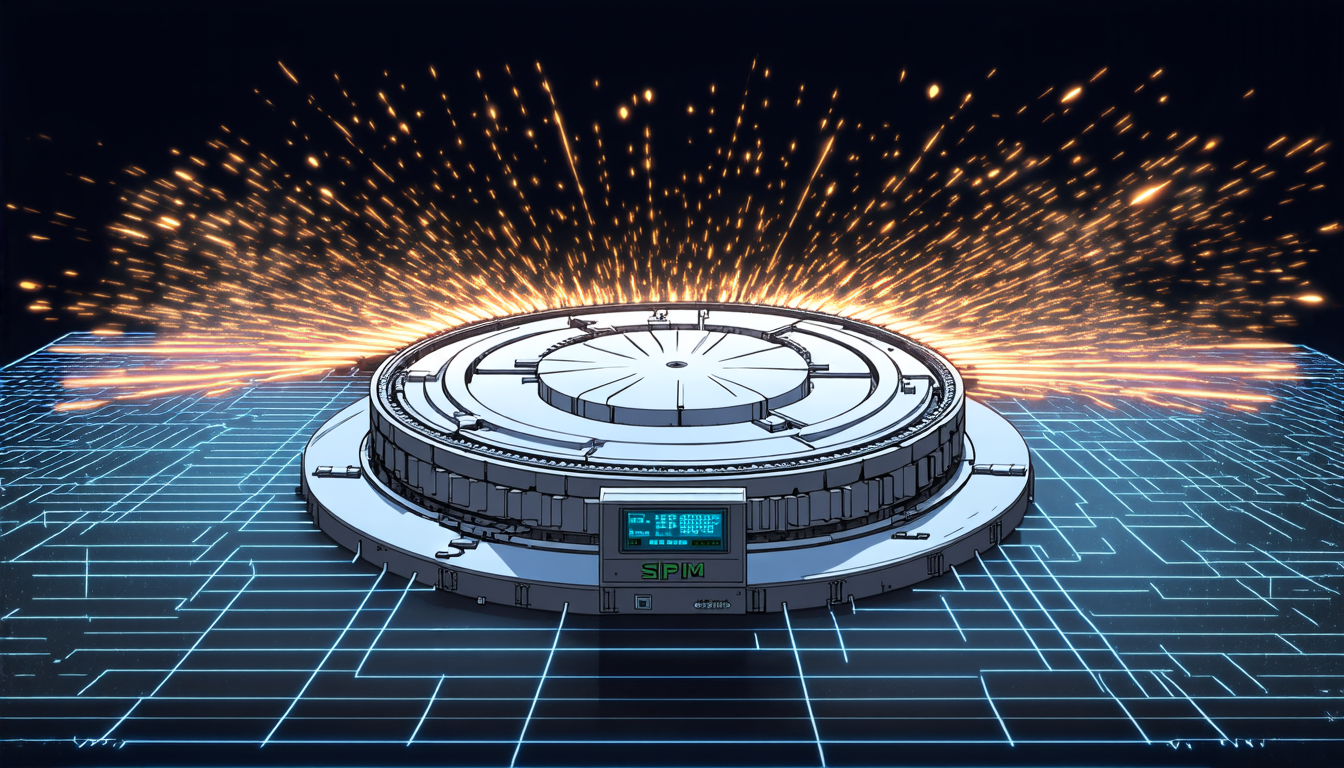
The detector, known as SiPM-on-Tile, is designed to measure the energy released by particles colliding at incredibly high speeds. By tracking these collisions, physicists can gain insights into the fundamental nature of matter and the universe itself.
This particular experiment was conducted at the Relativistic Heavy Ion Collider (RHIC), a powerful particle accelerator located at Brookhaven National Laboratory in New York. During the test, researchers collided protons with energies equivalent to those found in high-speed car crashes, producing a shower of particles that were then detected by the SiPM-on-Tile calorimeter.
The results were impressive, with the detector accurately measuring the energy released by the particles and providing valuable data for physicists to analyze. This achievement is particularly noteworthy because it marks the first time this type of calorimeter has been deployed in an actual collider environment.
SiPM-on-Tile technology uses tiny light-sensitive sensors called silicon photomultipliers (SiPMs) to detect the faint signals emitted by particles as they collide and interact with each other. These SiPMs are arranged on a grid-like pattern, allowing researchers to pinpoint the location of individual particles within the detector.
The benefits of this approach include increased precision and sensitivity compared to traditional calorimeter designs. This is especially important for future high-energy physics experiments, such as those planned for the Electron-Ion Collider (EIC), which will study the properties of quarks and gluons in unprecedented detail.
The RHIC test also demonstrated the detector’s ability to withstand the intense radiation environment found in particle accelerators. This is a critical consideration, as detectors must be able to operate reliably even under extreme conditions.
In addition to its technical achievements, this experiment highlights the collaborative nature of high-energy physics research. The SiPM-on-Tile calorimeter was developed by a team of researchers from several institutions, including Brookhaven National Laboratory and the University of California, Riverside.
As scientists continue to push the boundaries of human knowledge, advances like the SiPM-on-Tile detector will play an essential role in unlocking new secrets of the universe. With its precision, sensitivity, and ability to operate in harsh environments, this technology is poised to make significant contributions to our understanding of the cosmos.
Cite this article: “Advances in Calorimeter Technology for High-Energy Physics Experiments”, The Science Archive, 2025.
Particle Accelerator, Calorimeter, High-Energy Physics, Sipm-On-Tile, Detector, Particle Collisions, Brookhaven National Laboratory, Rhic, Eic, Silicon Photomultipliers.





