

Saturday 08 March 2025
Physicists are on the hunt for dark matter, a mysterious substance that makes up about a quarter of our universe but has yet to be directly detected. While we’ve had hints of its existence through its gravitational pull on normal matter, scientists have struggled to pin down what it is and how it behaves.
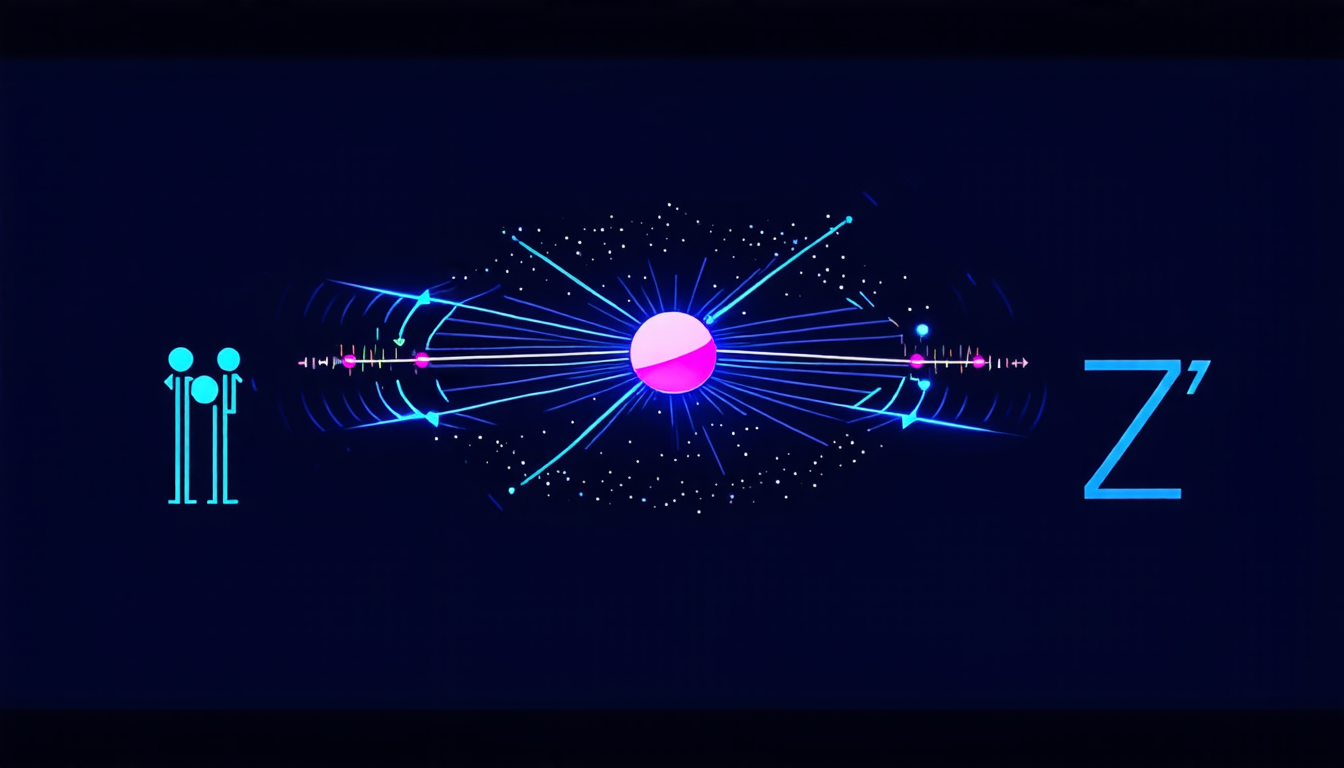
Enter the U(1)Lµ−Lτ model, a theoretical framework that proposes a new gauge boson, known as Z’, as the mediator between dark matter particles. This particle would interact with normal matter only through the weak nuclear force and electromagnetism, making it incredibly difficult to detect using traditional methods.
A team of researchers has recently revisited this model, exploring its implications for dark matter detection. Using a combination of theoretical calculations and experimental constraints, they found that there’s still a significant window where Z’ particles could exist and interact with normal matter in a way that might be observable.
The key to detecting Z’ particles lies in their interaction with electrons. Since the Z’ boson doesn’t directly couple to quarks, it would only affect electrons in a very specific way – by modifying the anomalous magnetic moment of muons. This effect is already being hunted for by experiments like the Muon g-2 experiment at Fermilab.
The researchers used a range of theoretical tools and experimental constraints to narrow down the possible parameter space where Z’ particles could exist. They found that if the mass of the Z’ boson is around 10 MeV, it would be within reach of future experiments designed to detect dark matter-electron interactions.
One potential way to detect these interactions is through the use of highly sensitive detectors that can measure tiny changes in electron behavior. These detectors could be used to search for evidence of Z’ particles interacting with electrons in a way that’s not possible with normal matter.
The implications of this study are significant – if Z’ particles do exist, it would provide strong evidence for the U(1)Lµ−Lτ model and shed light on the nature of dark matter. However, even if they don’t show up, the research has already pushed our understanding of particle physics forward and will inform future experiments designed to detect dark matter.
In short, scientists are one step closer to unraveling the mystery of dark matter, and it’s an exciting time for particle physicists.
Cite this article: “Detecting Dark Matters Hidden Mediator”, The Science Archive, 2025.
Dark Matter, U(1)Lµ−Lτ Model, Z’ Boson, Gauge Boson, Weak Nuclear Force, Electromagnetism, Muons, Anomalous Magnetic Moment, Fermilab, Particle Physics





