

Saturday 08 March 2025
The quest for reliable and fast wireless communication has been a long-standing challenge in the field of telecommunications. With the increasing demand for high-speed data transmission, researchers have been working tirelessly to develop new technologies that can meet these demands. A recent study published in a scientific journal sheds light on an innovative approach to improve indoor wireless coverage using passive reflectors.
The problem with current wireless communication systems is that they often struggle to maintain strong signals indoors, particularly in non-line-of-sight (NLOS) environments where the signal has to travel around obstacles such as walls and furniture. This can lead to weak or lost signals, resulting in poor reception and slow data transfer rates.
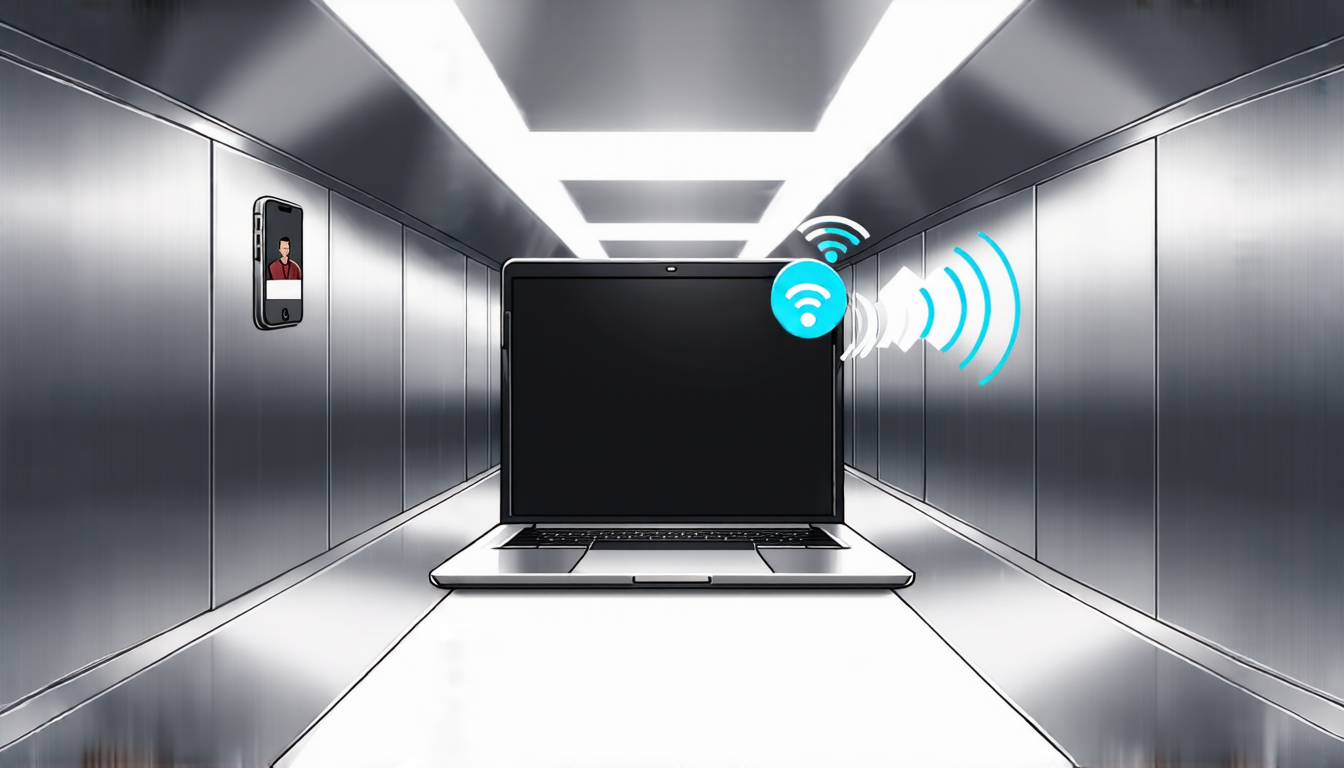
To address this issue, researchers have been exploring ways to enhance indoor wireless coverage using passive reflectors. These devices are designed to bounce radio waves back towards the receiver, effectively increasing the signal strength and range. In a recent study, scientists investigated the use of rectangular metal reflectors and arrayed antennas to improve NLOS coverage at 60 GHz frequencies.
The experiment was conducted in an L-shaped corridor, where researchers placed a rectangular metal reflector horizontally and vertically to test its effectiveness. The results showed that the received power increased by approximately 24 dB when the reflector was placed horizontally, and by around 12 dB when it was placed vertically. These findings suggest that passive reflectors can significantly enhance indoor wireless coverage in NLOS environments.
To further improve performance, researchers also designed an array of grooved metallic antennas to be used in a T-shaped corridor. The results showed that the maximum received power was obtained when the receiver antenna was oriented towards the direction of the reflector array. This demonstrates the potential of using passive reflectors and beamforming techniques to enhance indoor wireless coverage.
In addition, the study examined the impact of human blocking on wireless signal strength. Researchers found that a human body can introduce additional losses of up to 25 dB, which highlights the importance of understanding human activity in indoor wireless communication systems.
The implications of this research are significant for future wireless communication systems. By using passive reflectors and beamforming techniques, designers can create more reliable and efficient indoor wireless networks. This is particularly important for applications such as smart homes, offices, and public spaces where high-speed data transmission is crucial.
In the age of rapid technological advancements, it is essential to continue exploring innovative solutions to improve wireless communication systems.
Cite this article: “Enhancing Indoor Wireless Coverage Using Passive Reflectors and Beamforming Techniques”, The Science Archive, 2025.
Wireless Communication, Indoor Coverage, Passive Reflectors, Nlos Environments, 60 Ghz Frequencies, Signal Strength, Beamforming Techniques, Human Blocking, Smart Homes, Wireless Networks





