
Saturday 08 March 2025
Scientists have long been fascinated by the intricate dance of oscillations that govern many natural systems, from the beating of our hearts to the rhythms of the brain. But understanding these complex patterns has proven a daunting task, requiring a deep dive into the math and physics behind them.
Now, a new study has cracked open a fresh approach to grasping these oscillations, using a technique called phase-amplitude reduction. This method allows researchers to distill the essence of these patterns down to their most fundamental components, making it easier to analyze and predict how they’ll behave.
The key insight behind phase-amplitude reduction is that oscillations are not just simple cycles, but intricate webs of phase (the timing) and amplitude (the intensity). By separating these two aspects, scientists can tease apart the underlying mechanisms driving the behavior. It’s like trying to understand a complex song by analyzing its melody (phase) and harmony (amplitude).
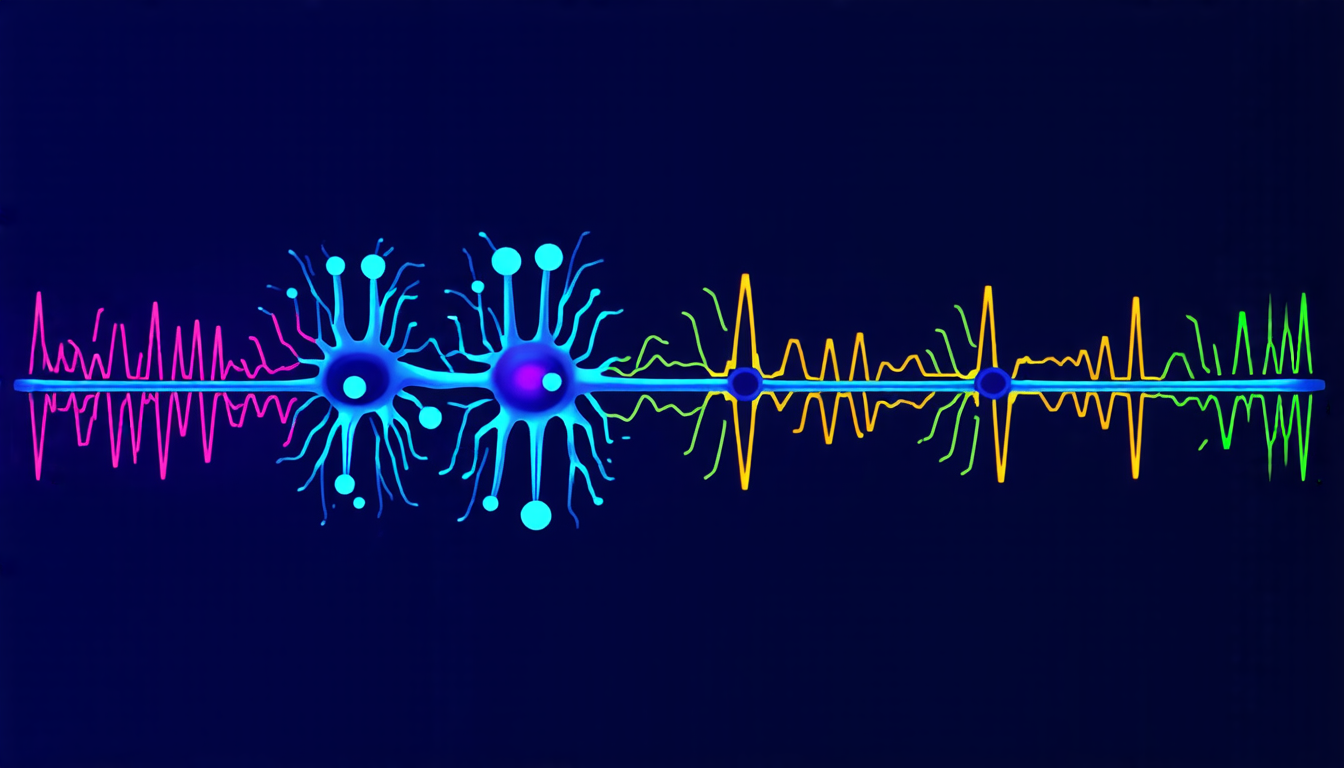
The researchers employed this technique on a mathematical model of a neuron, a fundamental building block of our brains. They found that phase-amplitude reduction allowed them to identify subtle patterns in the neuron’s activity that would have been impossible to detect otherwise.
But what does this mean for our understanding of the brain? For starters, it could help us better grasp how different neurons communicate with each other. In a network of connected neurons, subtle changes in phase and amplitude can have far-reaching consequences for information processing. By understanding these patterns, scientists may be able to develop new treatments for neurological disorders like epilepsy or Parkinson’s disease.
The technique also has implications for other fields, such as physics and chemistry. Oscillations play a crucial role in many natural systems, from the behavior of subatomic particles to the rhythms of chemical reactions. Phase-amplitude reduction could help researchers decipher these patterns, potentially leading to breakthroughs in our understanding of complex phenomena.
One of the most exciting aspects of this research is its potential for data-driven analysis. By applying phase-amplitude reduction to real-world datasets, scientists can gain new insights into the behavior of oscillations without having to make simplifying assumptions about their underlying mechanisms. This could be particularly valuable in fields like neuroscience, where experimental data is often messy and difficult to interpret.
Of course, there’s still much work to be done before phase-amplitude reduction becomes a standard tool in scientific research. But this study represents a significant step forward in our understanding of oscillations, and its implications are likely to reverberate across many fields.
Cite this article: “Cracking the Code of Oscillations: A New Technique for Understanding Complex Patterns”, The Science Archive, 2025.
Oscillations, Phase-Amplitude Reduction, Neurons, Brain, Neuroscience, Mathematics, Physics, Chemistry, Epilepsy, Parkinson’S Disease