

Saturday 08 March 2025
Scientists have long been fascinated by the mysteries of black holes, those cosmic voids that warp space and time around them. Recently, a team of researchers has made significant strides in understanding how these behemoths affect their surroundings.
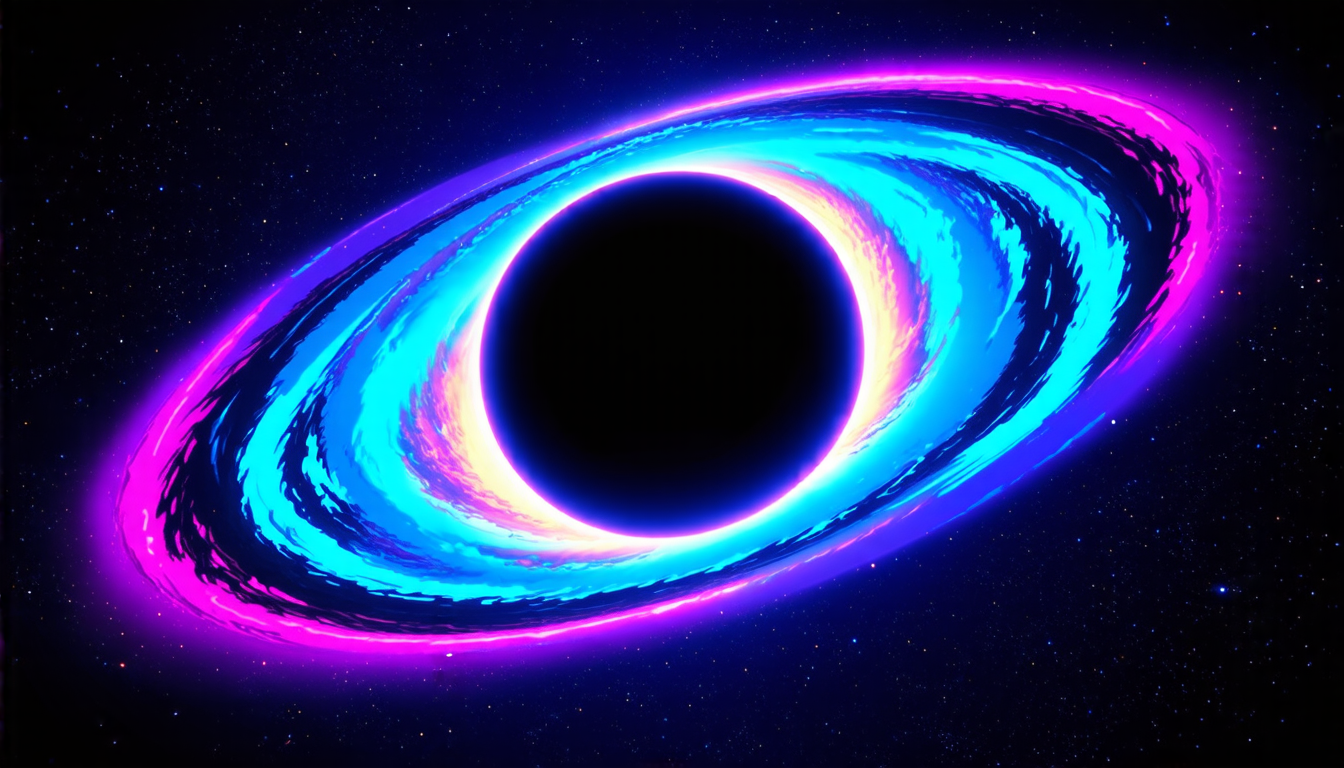
Black holes are formed when massive stars collapse under their own gravity, creating an intense gravitational field that warps the fabric of spacetime. As matter approaches the event horizon, the point of no return, it begins to heat up and emit radiation. This radiation is what allows scientists to study black holes from afar, but it’s not a straightforward process.
The team used advanced computer simulations to model the behavior of black holes in different spacetimes. They found that the way matter behaves near the event horizon depends on the curvature of spacetime around the black hole. In other words, if you were to travel through spacetime and approach a black hole, you would experience different conditions depending on how curved the spacetime is.
The researchers used a technique called general relativistic magnetohydrodynamics (GRMHD) to model the behavior of matter near the event horizon. GRMHD takes into account the strong gravitational forces and magnetic fields that are present in these regions. The team found that the curvature of spacetime affects the way matter accretes onto the black hole, which in turn affects the radiation it emits.
One of the most interesting findings is that the radiation emitted by the black hole changes depending on how curved the spacetime is around it. This means that if you were to observe a black hole from afar, you would see different patterns of radiation depending on its mass and spin. The team’s simulations suggest that this could be used as a way to determine the properties of a black hole.
The implications of these findings are significant. By studying the radiation emitted by black holes, scientists may be able to learn more about their role in the universe. Black holes play a crucial role in many astrophysical processes, from regulating star formation to influencing the growth of galaxies.
The team’s research has also shed light on the behavior of matter near the event horizon. As matter approaches the point of no return, it begins to heat up and emit radiation. The researchers found that this radiation is affected by the curvature of spacetime around the black hole.
In addition to its scientific significance, this research has important implications for our understanding of the universe. Black holes are thought to be responsible for many of the mysteries of the cosmos, from dark matter to dark energy.
Cite this article: “Unlocking the Secrets of Black Holes Cosmic Influence”, The Science Archive, 2025.
Black Holes, Spacetime, Gravity, Event Horizon, Radiation, Simulation, General Relativistic Magnetohydrodynamics, Accretion, Curvature, Astrophysics





