
Saturday 08 March 2025
Mathematics is often seen as a dry and abstract subject, but it has a way of revealing hidden patterns and connections that can be both fascinating and beautiful. A recent paper takes us on a journey through one such pattern, known as subpowers, which have been hiding in plain sight for centuries.
Subpowers are a mathematical concept that describes the number of ways to arrange objects in different combinations. Sounds simple enough, but it’s a bit like trying to count the number of grains of sand on a beach – it seems straightforward, but the numbers quickly get out of hand. The paper explores how subpowers can be used to solve problems in combinatorics, which is the branch of mathematics that deals with counting and arranging objects.
One of the most surprising things about subpowers is that they have been around since the 18th century, yet they remain largely unknown outside of mathematical circles. The concept was first introduced by Leonhard Euler, a Swiss mathematician who lived in the 1700s. Despite its long history, the paper shows how subpowers can still be used to solve modern problems in fields such as computer science and engineering.
The authors use an analogy to help explain what subpowers are – they compare them to the number of ways you can arrange a set of toys on a shelf. If you have three toy cars and two toy dogs, there’s more than one way to arrange them on the shelf. Subpowers count the number of different arrangements possible. This might seem like a simple problem, but it has far-reaching implications in fields such as coding theory and cryptography.
The paper also explores the connections between subpowers and other mathematical concepts, such as harmonic numbers and Bernoulli numbers. These are familiar concepts to mathematicians, but they may be less well-known outside of academia. The authors show how subpowers can be used to simplify complex problems in these areas, making them more accessible to non-specialists.
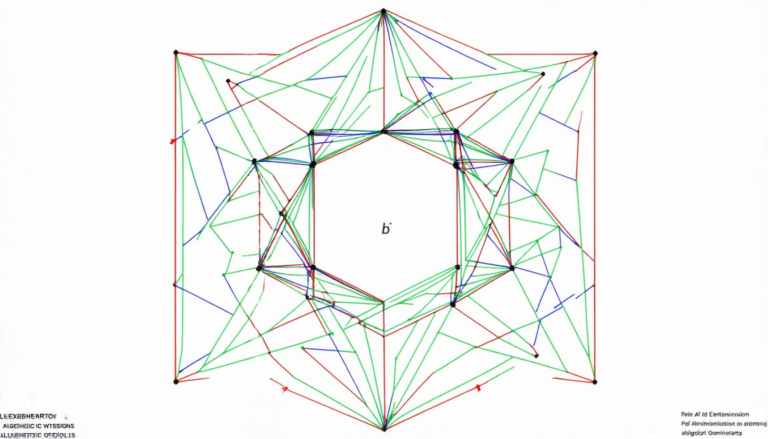
One of the most interesting aspects of the paper is its use of visualizations to illustrate the concept of subpowers. The authors create intricate diagrams that show how different combinations of objects can be arranged. These diagrams are not only beautiful but also help to convey complex mathematical ideas in a way that’s easy to understand.
The paper is a testament to the power of mathematics to reveal hidden patterns and connections. It shows how a concept that was first introduced centuries ago can still be used to solve modern problems.
Cite this article: “Uncovering Hidden Patterns: The Fascinating World of Subpowers”, The Science Archive, 2025.
Mathematics, Subpowers, Combinatorics, Leonhard Euler, Computer Science, Engineering, Coding Theory, Cryptography, Harmonic Numbers, Bernoulli Numbers
Reference: Mircea Dan Rus, “Yet another note on notation” (2025).