

Saturday 08 March 2025
A peculiar star in a distant galaxy has been throwing astronomers for a loop, and scientists have finally figured out what’s behind its unusual behavior. The star, known as SDSS J1115+0544, is a type of object called a low-ionization nuclear emission-line region (LINER) galaxy, which sounds like a mouthful but essentially means it’s an old, cool star that’s not particularly luminous.
But here’s the thing: this LINER galaxy has been acting strange. It started flashing bright in the ultraviolet, optical, and mid-infrared parts of the spectrum, and then just as suddenly stopped. Astronomers were baffled – what could be causing such a dramatic outburst?
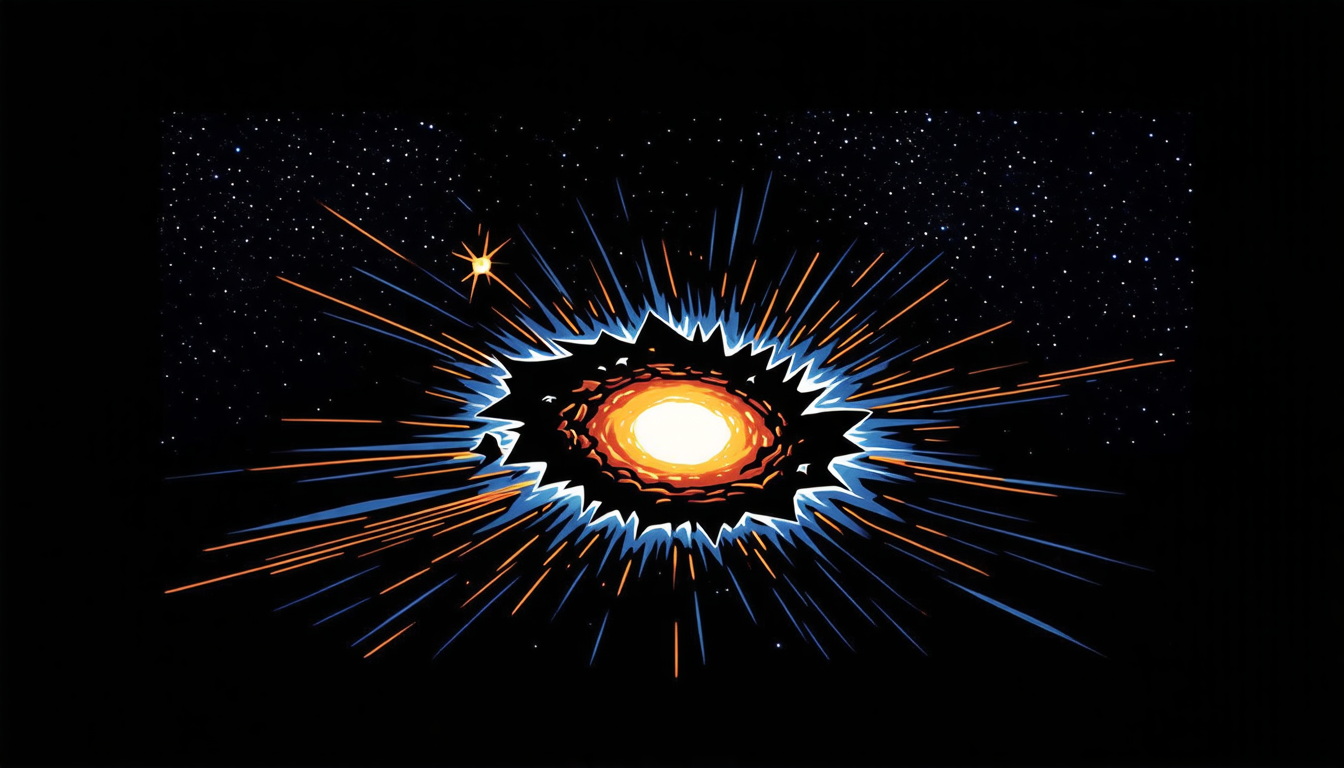
After years of observations and analysis, scientists have now identified the culprit: a stellar tidal disruption event (TDE). In other words, a star wandered too close to the supermassive black hole at the galaxy’s center and got ripped apart by its intense gravity. This released an enormous amount of energy, causing the bright outburst astronomers observed.
But here’s where things get really interesting. The researchers noticed something peculiar – the radio emissions from the TDE took a long time to develop, showing up three years after the initial outburst. This is unusual because most TDEs don’t exhibit delayed radio signals. It’s like the star’s demise was followed by a second, slower-burning fire that only became visible much later.
The scientists used computer simulations to model what might have happened. They found that the black hole’s gravity could have triggered a delay in the outflow of energy from the star’s remains, causing the radio signals to emerge so much later. It’s like a delayed reaction, with the star’s fragments only slowly becoming visible as they interacted with their surroundings.
This discovery has significant implications for our understanding of TDEs and how they can affect the environment around black holes. By studying these events, scientists can gain insight into the complex interactions between stars, black holes, and the surrounding material that makes up galaxies.
The research also highlights the importance of multi-wavelength observations – astronomers used a combination of telescopes and instruments to study SDSS J1115+0544 across different parts of the electromagnetic spectrum. This allowed them to piece together what was happening during the TDE and identify the delayed radio signals.
Cite this article: “Unraveling the Mystery of a Peculiar Stars Unusual Behavior”, The Science Archive, 2025.
Astronomy, Galaxy, Star, Black Hole, Tidal Disruption Event, Ultraviolet, Optical, Mid-Infrared, Radio Emissions, Stellar Death





