
Saturday 08 March 2025
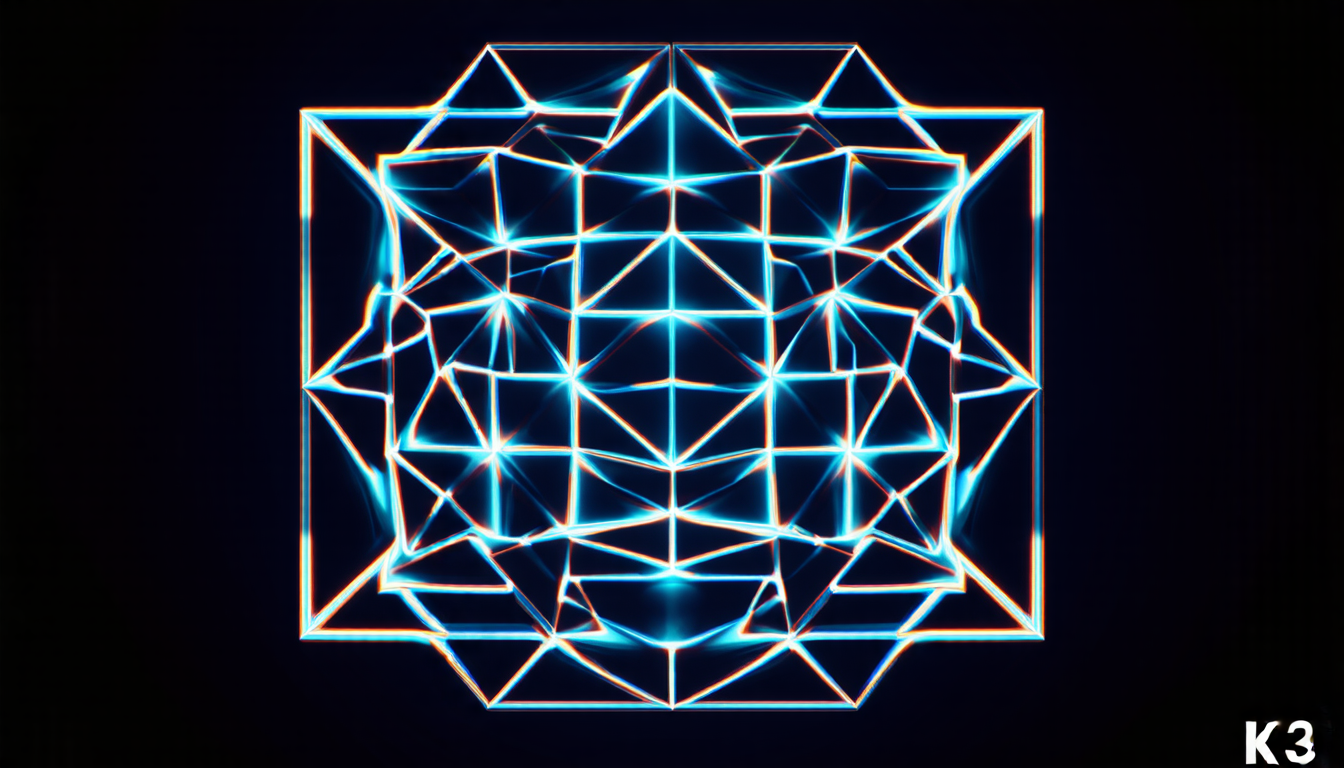
In a fascinating breakthrough, researchers have uncovered new insights into the world of mathematics and geometry. By delving deep into the realm of K3 surfaces – complex geometric structures that are crucial to understanding various areas of physics and mathematics – scientists have made significant strides in our comprehension of these enigmatic objects.
K3 surfaces are a type of hyperkähler manifold, which is a mathematical construct used to describe spaces with intricate symmetries. These surfaces play a pivotal role in many branches of mathematics, including algebraic geometry, topology, and number theory. They are also essential in understanding the behavior of particles in quantum mechanics and the properties of black holes.
The researchers’ findings focus on the concept of derived- natural automorphisms, which are transformations that preserve the underlying geometric structure of a K3 surface. These transformations have far-reaching implications for our understanding of the symmetries present within these surfaces.
One of the most significant discoveries is the ability to describe certain derived-natural automorphisms using a novel approach. This method involves analyzing the autoequivalences of the derived category, a mathematical construct that represents the fundamental algebraic structure underlying the K3 surface.
The researchers have demonstrated that this approach can be used to construct and study various types of derived-natural automorphisms, including those that arise from symplectic involutions. These involutions are transformations that preserve the symplectic form on the K3 surface, which is a crucial property that governs the surface’s geometric behavior.
The findings also shed light on the connections between derived-natural automorphisms and other areas of mathematics. For instance, the researchers have shown how these automorphisms can be related to the study of moduli spaces, which are critical in understanding the properties of complex algebraic varieties.
The implications of this research are far-reaching and have significant potential for advancing our understanding of K3 surfaces. The discovery of new derived-natural automorphisms could lead to breakthroughs in areas such as quantum gravity, string theory, and the study of black holes.
Moreover, the novel approach developed by the researchers has the potential to be applied more broadly within mathematics and physics. It could provide a powerful tool for studying other complex geometric structures and shed light on long-standing open problems.
In summary, this research represents a significant step forward in our understanding of K3 surfaces and their underlying symmetries.
Cite this article: “Unveiling the Secrets of K3 Surfaces: A Breakthrough in Geometry and Physics”, The Science Archive, 2025.
K3 Surfaces, Derived-Natural Automorphisms, Algebraic Geometry, Topology, Number Theory, Quantum Mechanics, Black Holes, Symplectic Involutions, Moduli Spaces, Complex Algebraic Varieties