

Saturday 08 March 2025
The quest for a deeper understanding of quantum systems has long been a challenge for scientists. These tiny, subatomic entities exhibit strange and fascinating behavior, defying our intuitive grasp of the world around us. Recently, researchers have made significant progress in unraveling the mysteries of these quantum systems, and their findings have far-reaching implications for fields such as thermodynamics and information theory.
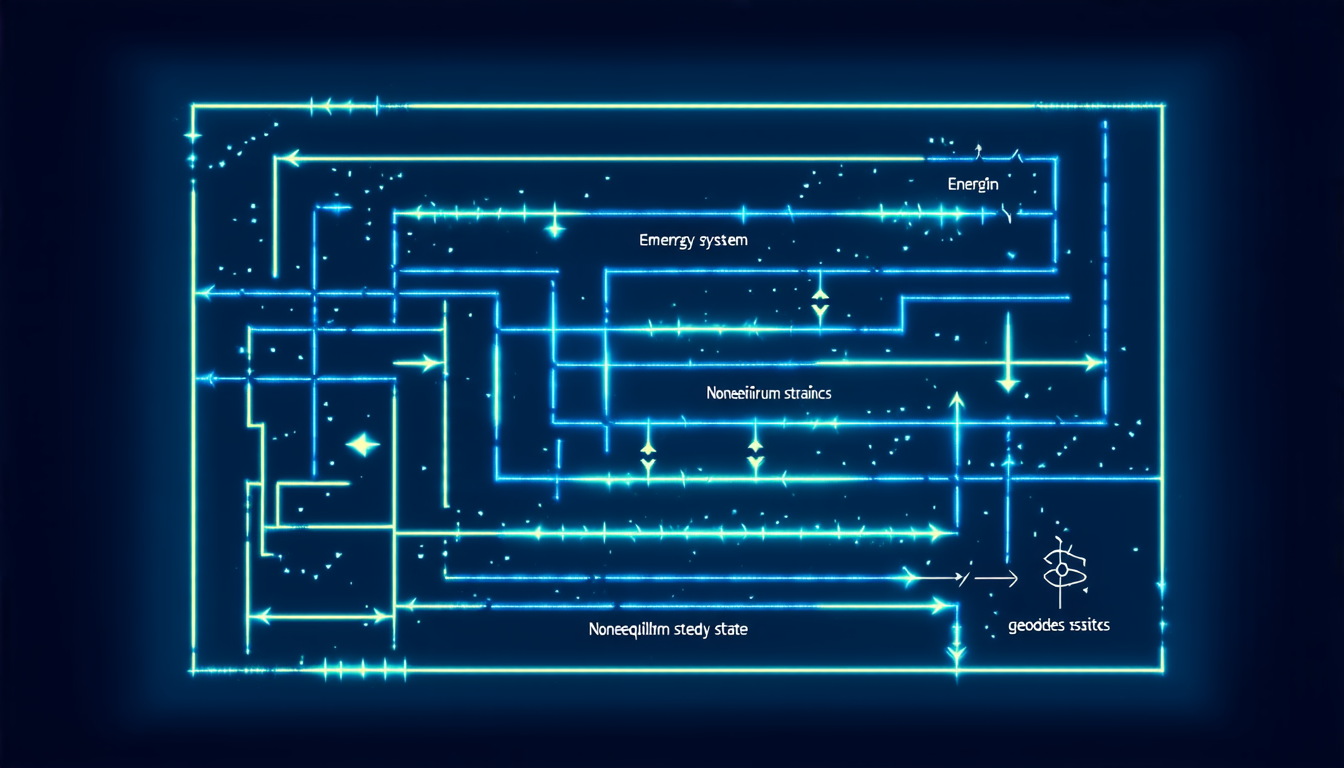
At the heart of this research is the concept of nonequilibrium steady states (NESS), a phenomenon where energy flows continuously through a system, driving it away from equilibrium. This is crucial for understanding real-world applications, like molecular motors or quantum computers, which rely on these non-equilibrium conditions to function.
The key innovation here lies in developing a new framework to analyze the transition between NESS. By connecting the excess entropy flux with the geometry of control parameters, researchers have created a toolset that allows them to quantify and optimize dissipation in these systems. This has significant implications for fields like quantum thermodynamics, where understanding the flow of energy is crucial.
One of the most striking aspects of this research is its application to a simple, yet fascinating system: the three-level maser. This device, which converts electromagnetic waves into sound waves, is often used as an example in quantum mechanics textbooks. By analyzing the transition between NESS in this system, researchers have uncovered new insights into how energy flows and dissipation occurs.
The team’s work also explores the concept of geodesics, which describe the most efficient path for a system to evolve from one state to another. In the context of quantum systems, these geodesics play a crucial role in understanding how information is transmitted and processed. By finding the shortest path between NESS, researchers can optimize the transfer of energy and reduce dissipation.
The paper’s findings also have implications for our understanding of time itself. The authors show that the quantum Fisher information with respect to time, a concept traditionally used in classical statistics, can be extended to quantum systems. This has significant implications for fields like quantum computing, where understanding the flow of time is crucial for developing robust and efficient algorithms.
In short, this research represents a major step forward in our understanding of quantum systems and their behavior under nonequilibrium conditions. By developing new tools and frameworks for analyzing these systems, scientists can unlock new insights into energy flow, dissipation, and information processing – with significant implications for fields like thermodynamics, computing, and beyond.
Cite this article: “Unraveling Quantum Systems: A New Framework for Understanding Energy Flow and Information Processing”, The Science Archive, 2025.
Quantum Systems, Nonequilibrium Steady States, Entropy Flux, Geometry Of Control Parameters, Quantum Thermodynamics, Energy Flow, Dissipation, Geodesics, Quantum Fisher Information, Time





