

Saturday 08 March 2025
Scientists have been studying the behavior of particles at the molecular level for decades, trying to understand how they interact and move in different environments. Recently, researchers have made significant progress in developing a new model that can simulate the complex interactions between charged particles.
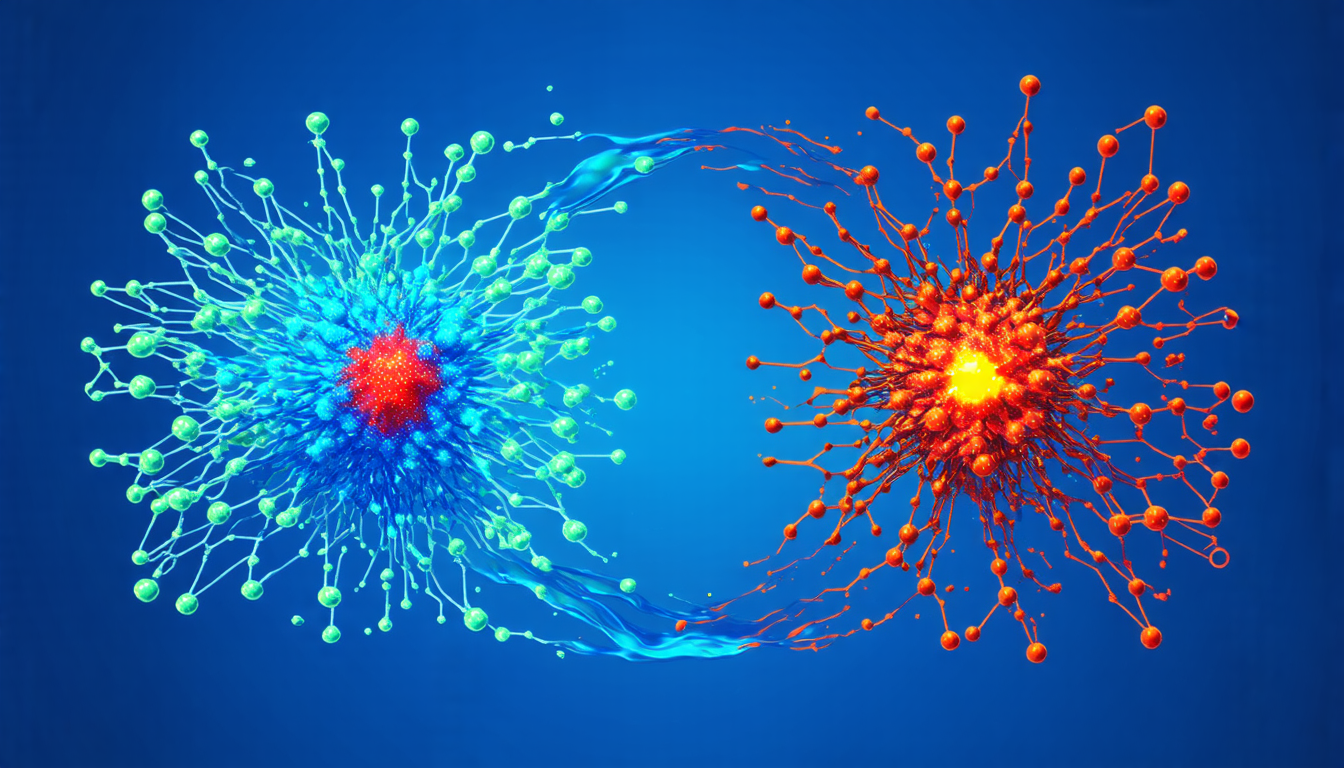
The model, known as patchy colloids, is designed to mimic the behavior of real-world particles such as proteins, DNA, and nanoparticles. These particles are often irregularly shaped and have different regions with unique properties. For example, one region might be positively charged while another is negatively charged.
To study these complex interactions, researchers use computer simulations to model the behavior of millions of particles. However, traditional simulation methods can be limited by their simplicity and lack of realism. The new patchy colloid model aims to address this limitation by incorporating more realistic features into the simulation.
The key innovation of the patchy colloid model is its ability to capture the directional interactions between charged regions on the surface of the particles. This means that the model can accurately simulate how particles with different charge distributions interact and move in response to each other.
To test the model, researchers conducted a series of computer simulations using two different simulation methods: Monte Carlo and molecular dynamics. The results showed that the patchy colloid model was able to accurately capture the complex interactions between charged particles, including the formation of specific bonds and the movement of particles over time.
The implications of this research are significant, as it could lead to a better understanding of how biological systems function at the molecular level. For example, the model could be used to study the behavior of proteins in living cells or the structure of DNA molecules.
Furthermore, the patchy colloid model has potential applications in fields such as materials science and nanotechnology. By simulating the behavior of particles with complex charge distributions, researchers can gain insights into how to design new materials with specific properties.
In addition to its scientific significance, this research also highlights the importance of collaboration between scientists from different disciplines. The development of the patchy colloid model required expertise in both theoretical physics and computational biology.
Overall, the patchy colloid model is an important step forward in our understanding of complex molecular interactions. Its potential applications are vast, ranging from biological systems to materials science and nanotechnology.
Cite this article: “Simulating Complex Molecular Interactions with Patchy Colloids”, The Science Archive, 2025.
Molecular Simulation, Patchy Colloids, Charged Particles, Computational Biology, Materials Science, Nanotechnology, Molecular Interactions, Proteins, Dna, Monte Carlo Methods





