

Sunday 09 March 2025
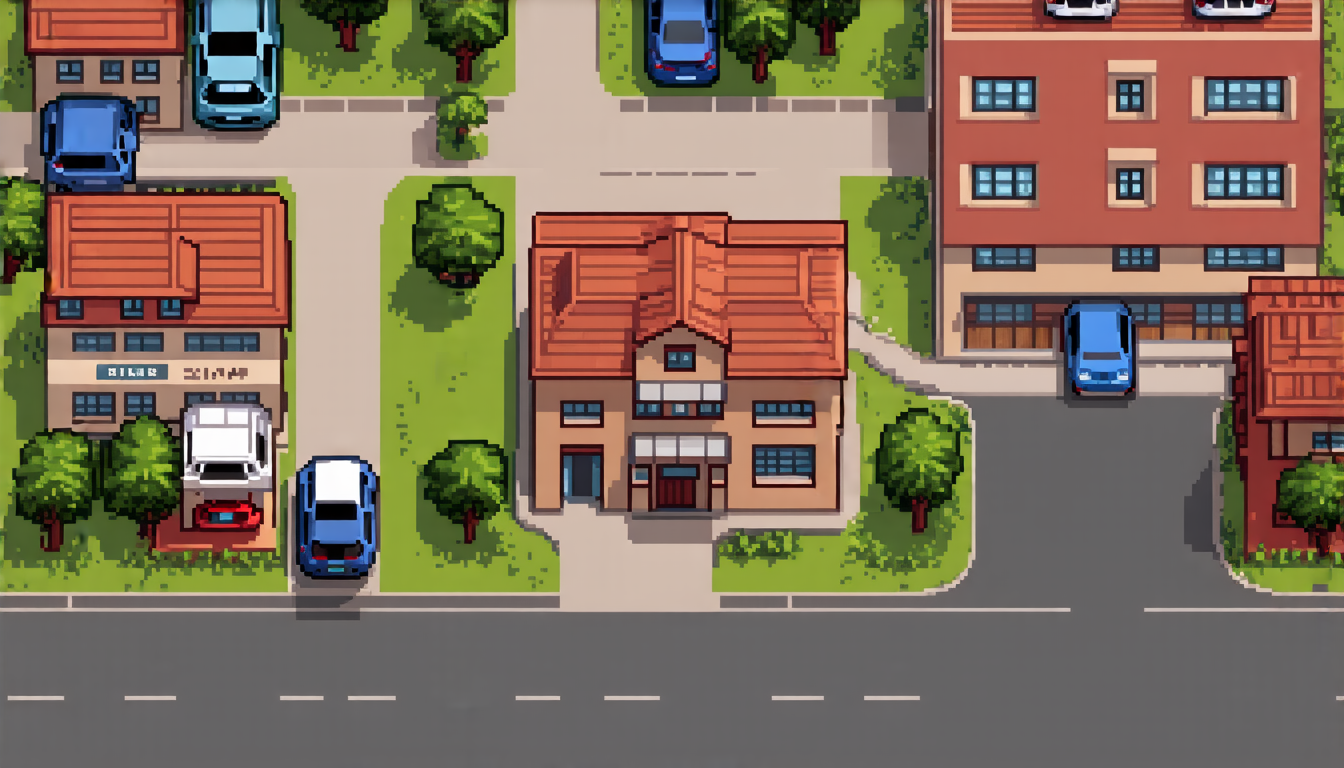
The dream of generating entire cities, complete with buildings, roads, and even vehicles, has long fascinated computer scientists and engineers. For years, researchers have been working on developing algorithms that can create these virtual environments, but the results have often been limited to small, simplified scenes.
Recently, a team of scientists from Nanyang Technological University in Singapore made significant progress in this area by creating a system called CityDreamer4D. This innovative technology is capable of generating unbounded 3D cities, complete with complex buildings, dynamic traffic scenarios, and detailed urban landscapes.
The key to CityDreamer4D’s success lies in its ability to separate static objects like buildings from dynamic ones like vehicles. This allows the system to generate more realistic scenes by using different types of neural fields for background stuff, buildings, and vehicles. The algorithm also employs customized generative hash grids and periodic positional embeddings as scene parameterizations.
One of the most impressive aspects of CityDreamer4D is its ability to create large-scale, high-quality city imagery complete with 3D instance annotations. This means that not only can the system generate entire cities, but it can also provide detailed information about each individual object within those cities.
The potential applications of CityDreamer4D are vast and varied. The technology could be used in fields such as urban planning, where it could help city designers create more realistic and efficient cityscapes. It could also be used in the entertainment industry to create more immersive gaming experiences or in film production to generate realistic backgrounds for movies.
The system’s ability to generate dynamic scenes is particularly noteworthy, as it allows for the creation of complex traffic scenarios and simulations. This could have significant implications for fields such as autonomous vehicle development, where realistic simulation environments are crucial for testing and training self-driving cars.
Despite its impressive capabilities, CityDreamer4D is not without its limitations. The system is currently limited to generating scenes that are based on real-world data, which means that it may struggle to create truly original or fantastical environments. However, the researchers behind the technology are working to address this limitation and develop more advanced algorithms that can generate entirely new and unique cityscapes.
Overall, CityDreamer4D represents a significant step forward in the field of computer-generated cities. Its ability to generate realistic and dynamic scenes has the potential to revolutionize a wide range of industries and could eventually enable the creation of entire virtual worlds.
Cite this article: “CityDreamer4D: A Breakthrough in Generating Realistic 3D Cities”, The Science Archive, 2025.
Computer-Generated Cities, 3D Cities, Citydreamer4D, Neural Fields, Generative Hash Grids, Periodic Positional Embeddings, Urban Planning, Entertainment Industry, Autonomous Vehicles, Virtual Worlds.





