

Sunday 09 March 2025
A new study has shed light on a long-standing mystery in astrophysics: how supermassive black holes at the centers of galaxies can merge and produce gravitational waves, which are ripples in the fabric of spacetime that were predicted by Einstein’s theory of general relativity. For decades, scientists have been trying to understand what drives these mergers, but a new simulation has revealed a crucial role for gas in the process.
In a typical galaxy, there are many black holes ranging from stellar-mass (about 10 times the mass of our sun) to supermassive (about 100 million solar masses). The latter reside at the centers of galaxies and play a key role in shaping their evolution. When two supermassive black holes meet, they can merge to form an even more massive one, releasing an enormous amount of energy in the process.
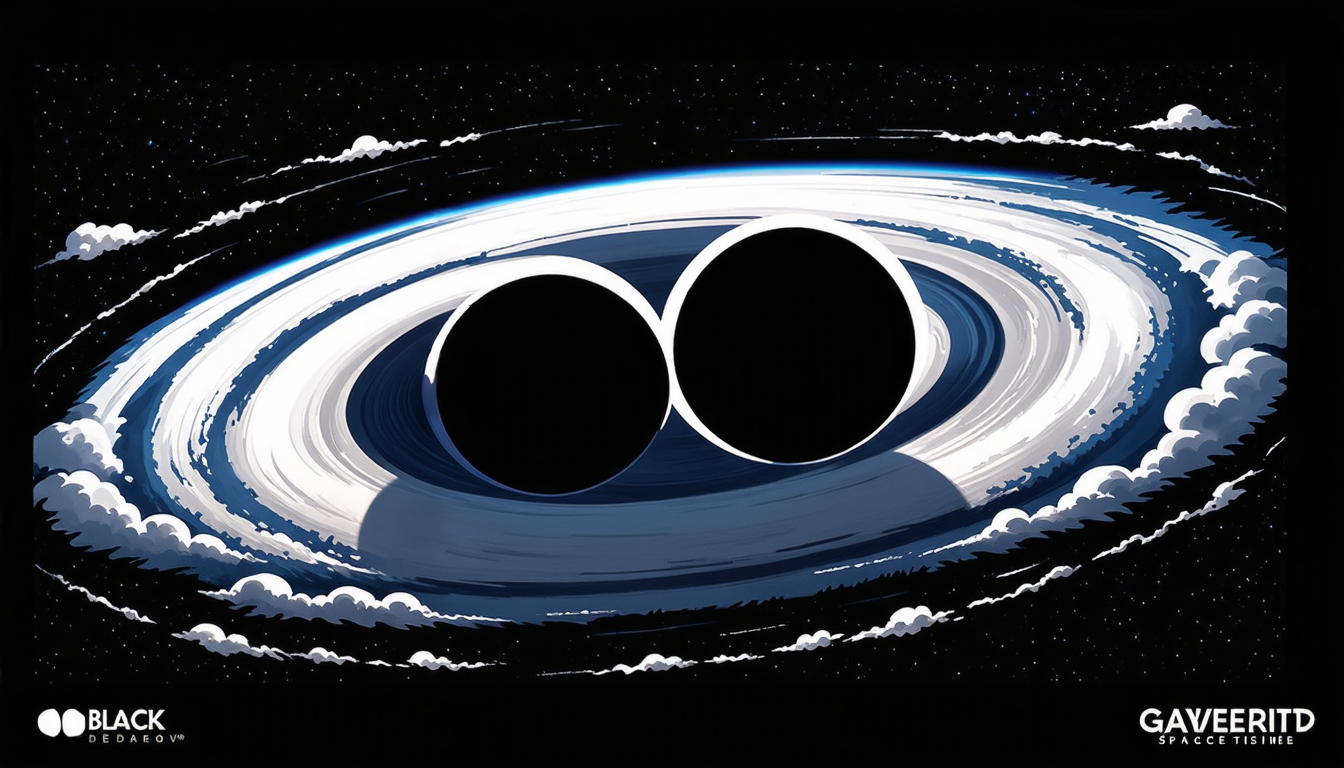
However, this merger process is not straightforward. The black holes must first orbit each other closely before eventually colliding and merging. This close proximity can stir up gas from the surrounding galaxy, which then gets caught between the two black holes. As they dance around each other, this gas becomes hotter and denser, releasing energy that can either slow down or speed up the merger.
The new simulation, run on powerful supercomputers, has shown that gas plays a crucial role in determining whether these mergers occur quickly or slowly. When there’s a lot of gas present, it can actually help to harden the orbit of the black holes, allowing them to merge faster and produce more energetic gravitational waves.
This is important because the detection of gravitational waves by LIGO (Laser Interferometer Gravitational-Wave Observatory) and VIRGO (VIRGO Collaboration) has opened up a new window into understanding these cosmic events. By studying the properties of these waves, scientists can learn more about the black holes that produced them, including their mass and spin.
The simulation also revealed that the merger rate for supermassive black holes could be much higher than previously thought. This is significant because it suggests that gravitational wave astronomy may become a powerful tool for understanding galaxy evolution and the growth of these massive black holes.
In addition to providing new insights into the merger process, this study highlights the importance of incorporating gas dynamics into simulations of galaxy evolution. Gas can have a profound impact on the behavior of supermassive black holes, and neglecting its effects can lead to inaccurate predictions about their mergers and gravitational wave emissions.
Cite this article: “Gas Plays Crucial Role in Supermassive Black Hole Mergers”, The Science Archive, 2025.
Black Holes, Galaxies, Supermassive, Gas Dynamics, Simulations, General Relativity, Gravitational Waves, Ligo, Virgo, Galaxy Evolution





