

Sunday 09 March 2025
The quest for more efficient and powerful artificial intelligence (AI) has led researchers to explore innovative architectures that can accelerate AI processing while reducing energy consumption. A recent study proposes a novel approach, dubbed Atleus, which leverages heterogeneous computing resources and non-volatile memory (NVM) to achieve significant performance gains.
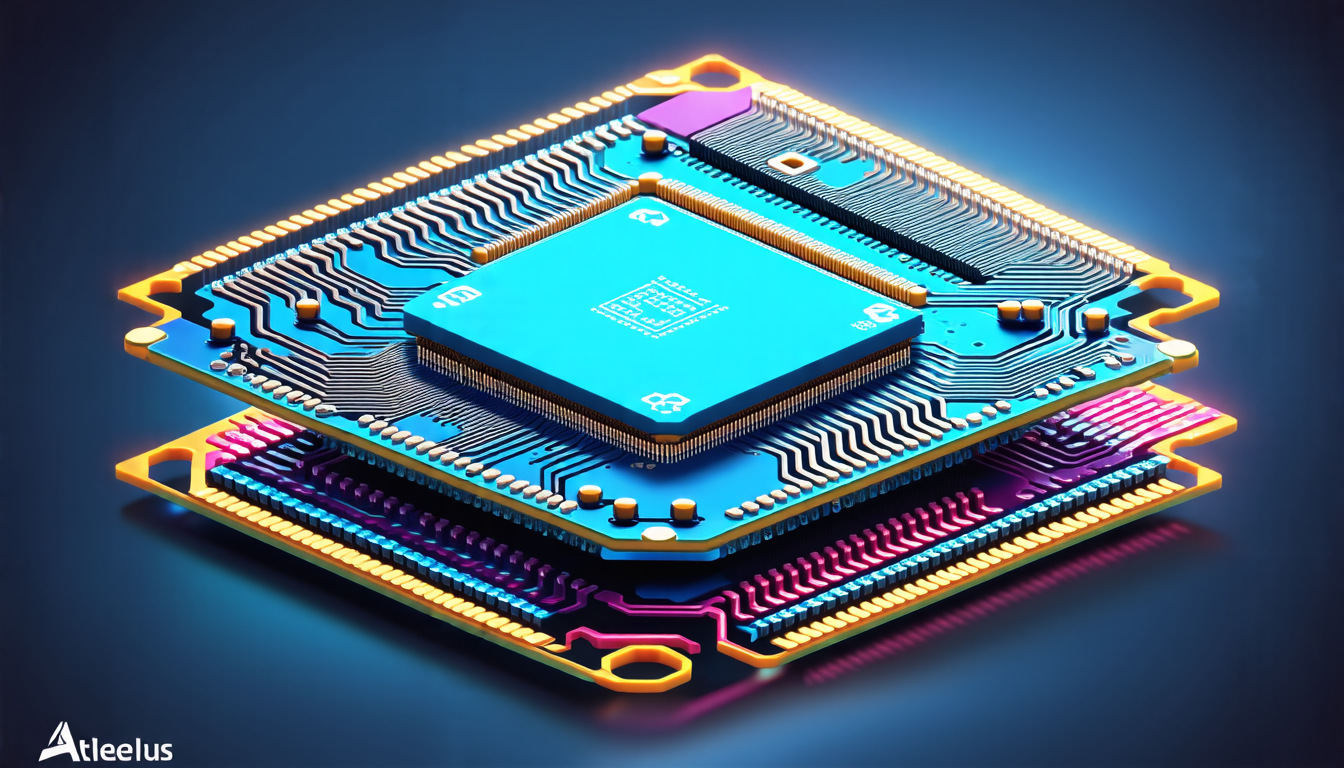
At the heart of Atleus is a 3D manycore architecture that combines diverse computing elements, including systolic arrays and ReRAM cores. These components work in tandem to optimize transformer-based AI models, which are notoriously energy-hungry and computationally intensive. By exploiting the strengths of each component, Atleus demonstrates remarkable speedups and energy efficiency improvements compared to existing solutions.
The core innovation lies in the way Atleus pipelines transformer layers across heterogeneous computing resources. This approach enables the system to process multiple layers simultaneously, reducing overall processing time while minimizing energy consumption. The systolic arrays, specifically designed for matrix multiplication, accelerate the feed-forward (FF) and self-attention mechanisms, which are critical components of transformer models.
ReRAM cores, with their unique properties of low power consumption and high storage density, play a crucial role in storing pre-trained model weights and fine-tuning parameters. This approach eliminates the need for costly and energy-intensive data transfers between different computing elements, resulting in significant energy savings.
Experimental results demonstrate that Atleus outperforms existing accelerators by up to 56 times in terms of speed and 64.5 times in terms of energy efficiency. The system’s performance is further enhanced through crossbar-wise quantization, which reduces the precision of model weights and activations while maintaining accuracy.
Atleus also showcases impressive versatility, as it can be easily adapted for both transformer fine-tuning and inference tasks. This flexibility makes it an attractive solution for a wide range of AI applications, from natural language processing to computer vision.
The implications of Atleus are far-reaching, with potential applications in various domains. For instance, the system could enable more efficient edge AI processing, allowing for real-time object detection and recognition on resource-constrained devices. Additionally, Atleus could be used to accelerate complex scientific simulations, such as climate modeling or materials science research.
As AI continues to play an increasingly important role in our daily lives, innovative architectures like Atleus are crucial for unlocking its full potential while minimizing environmental impact. By leveraging heterogeneous computing resources and NVM, researchers have made significant strides towards creating more efficient and powerful AI processing systems.
Cite this article: “Atleus: A Novel AI Accelerator Architecture for Efficient Processing”, The Science Archive, 2025.
Artificial Intelligence, Accelerator, Heterogeneous Computing, Non-Volatile Memory, 3D Manycore Architecture, Systolic Arrays, Reram Cores, Transformer Models, Energy Efficiency, Edge Ai Processing





