

Sunday 09 March 2025
Researchers have developed a new way to navigate virtual reality environments, using geometric shapes rather than images to help computers locate their position and orientation. This approach, known as Mesh2SLAM, has been shown to be faster and more accurate than traditional methods, making it potentially useful for a range of applications from gaming to robotics.
In traditional SLAM (simultaneous localization and mapping) systems, cameras use images to detect and track features in the environment. However, this approach can be computationally intensive and prone to errors, particularly in situations where lighting or other environmental factors affect the quality of the images.
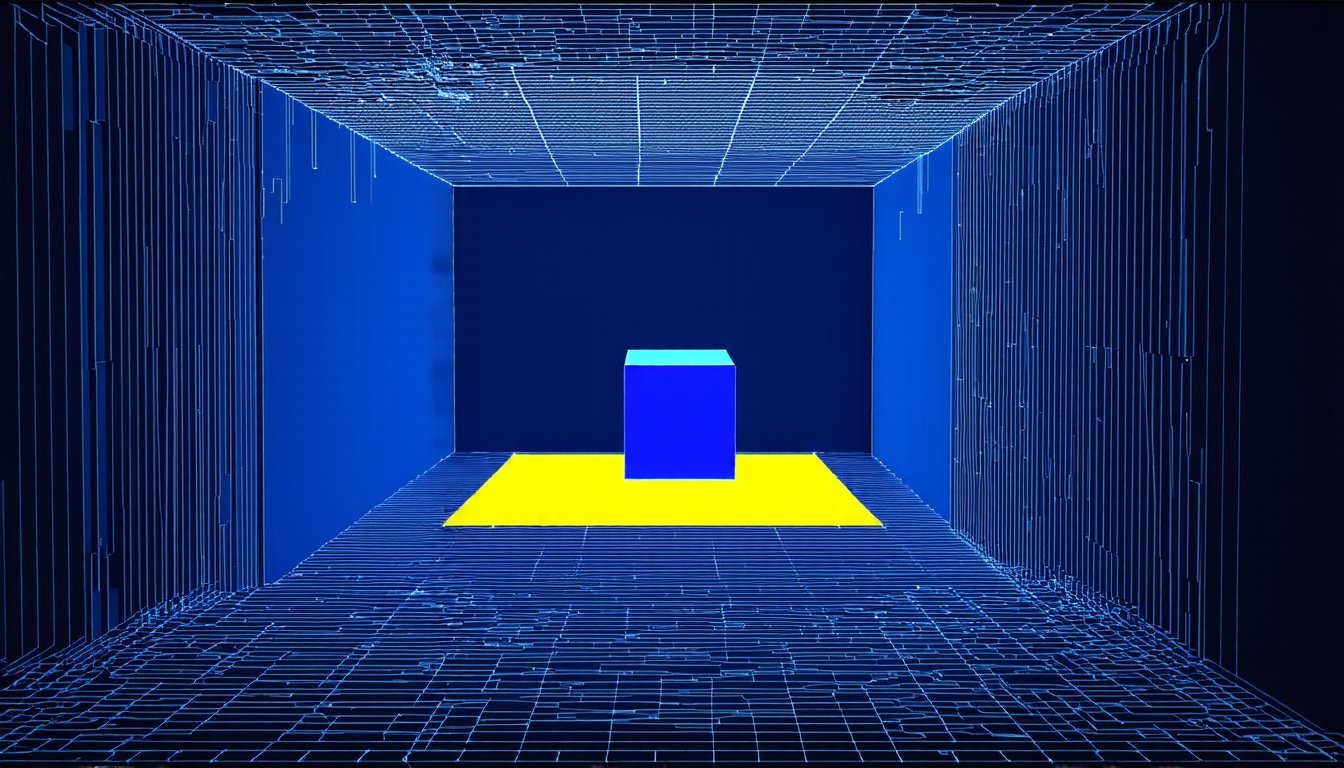
Mesh2SLAM, on the other hand, uses polygonal meshes – three-dimensional geometric shapes composed of vertices and edges – to create a map of the virtual environment. These meshes are then used by the computer to estimate its position and orientation, allowing it to move through the environment with greater accuracy and speed.
One of the key benefits of Mesh2SLAM is its ability to process data in real-time, making it suitable for applications where quick responses are necessary. This could include gaming, where a player’s movement needs to be tracked quickly and accurately, or robotics, where a robot may need to navigate a complex environment with precision.
The system has been tested on a range of virtual reality environments, from simple 3D models to more complex simulations. In each case, Mesh2SLAM was found to outperform traditional SLAM systems in terms of speed and accuracy.
One potential limitation of Mesh2SLAM is its reliance on the quality of the mesh data. If the meshes are not accurate or complete, the system may struggle to provide reliable location estimates. However, researchers believe that this can be mitigated by using high-quality mesh data and incorporating additional sensors or features into the system.
The development of Mesh2SLAM could have significant implications for a range of fields, from gaming and robotics to architecture and engineering. By providing a faster and more accurate way to navigate virtual environments, it could enable new applications and improve existing ones.
In addition to its potential uses in specific industries, Mesh2SLAM also highlights the ongoing quest to improve our ability to interact with and understand virtual environments. As virtual reality becomes increasingly widespread, researchers will continue to develop new techniques and technologies to make these environments more intuitive and immersive.
Cite this article: “Fast and Accurate Virtual Reality Navigation with Mesh2SLAM”, The Science Archive, 2025.
Virtual Reality, Navigation, Slam, Mesh2Slam, Polygonal Meshes, 3D Modeling, Robotics, Gaming, Real-Time Processing, Localization And Mapping.





