

Sunday 09 March 2025
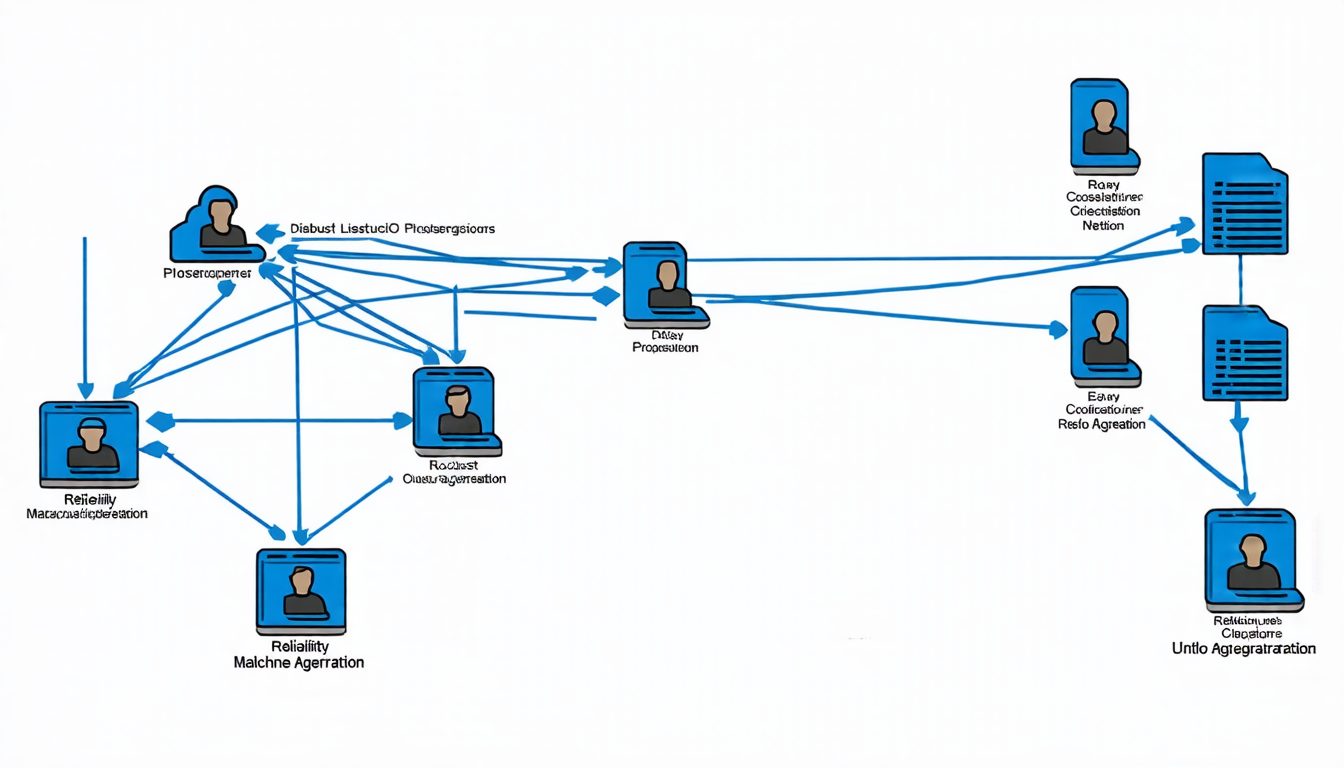
A team of researchers has made significant strides in developing a novel approach to ensure the reliability and resilience of distributed machine learning systems. These systems, which involve multiple workers processing data simultaneously, are increasingly crucial for many applications, including image recognition, natural language processing, and recommender systems.
The traditional approach to handling Byzantine failures, where malicious nodes intentionally send incorrect information, is often based on a simple majority vote or median-based aggregation methods. However, these techniques can be vulnerable to attacks that manipulate the voting process or introduce noise into the data stream.
To address this issue, the researchers proposed a weighted robust aggregator (WRA) that combines the strengths of two existing algorithms: Coordinate-Wise Median (CWMed) and Weighted Geometric Median (WeightedGM). The WRA uses a novel weighting scheme to assign higher importance to more reliable nodes in the system, thereby reducing the impact of Byzantine failures.
The researchers tested their approach on two popular datasets, MNIST and CIFAR-10, using a simulated environment with varying numbers of workers and Byzantine attacks. The results showed that the WRA outperformed traditional aggregation methods in terms of test accuracy and robustness against various types of attacks, including label flipping, sign flipping, Little, and Empire.
The WRA’s performance was also compared to other state-of-the-art algorithms, such as µ2-SGD with fixed parameters and momentum-based SGD. The results indicated that the WRA achieved better or comparable test accuracy in most scenarios, while being more resistant to Byzantine failures.
One of the key advantages of the WRA is its ability to adapt to changing node arrival patterns and Byzantine attacks. This is achieved through a dynamic weighting scheme that adjusts the importance of each node based on their reliability and availability.
The researchers also proposed an extension to the WRA, called ω-CTMA (omega-CTMA), which incorporates a variance-reduction technique to improve the algorithm’s convergence rate in asynchronous environments. The ω-CTMA variant demonstrated improved performance compared to the original WRA in certain scenarios.
The findings of this study have significant implications for the development of distributed machine learning systems that can operate reliably and efficiently in environments prone to Byzantine failures. The proposed weighted robust aggregator offers a promising approach to improve the resilience of these systems, which is essential for many real-world applications.
Cite this article: “Enhancing Reliability and Resilience in Distributed Machine Learning Systems with Weighted Robust Aggregator”, The Science Archive, 2025.
Distributed Machine Learning, Byzantine Failures, Weighted Robust Aggregator, Coordinate-Wise Median, Weighted Geometric Median, Robustness, Resilience, Reliability, Node Importance, Asynchronous Environments





