

Sunday 09 March 2025
A recent study published in the journal Astronomy and Astrophysics has shed new light on a fascinating phenomenon in the field of astronomy – the shape of a nova shell around the star V1425 Aql.
For those who may not be familiar, novae are explosive events that occur when a white dwarf star accumulates material from its companion star and reaches a critical mass. This accumulation triggers a thermonuclear reaction on the surface of the white dwarf, leading to a massive explosion that can outshine an entire galaxy for several days.
One of the most intriguing aspects of novae is their shells, which are formed as the ejected material expands into space. These shells are often observed to be spherical in shape, but recent observations have revealed that not all nova shells follow this pattern.
The study in question focused on the star V1425 Aql, a binary system located approximately 12,000 light-years from Earth. The researchers used the Multi-Unit Spectroscopic Explorer (MUSE) instrument at the Very Large Telescope (VLT) to observe the shell surrounding V1425 Aql and gather data on its shape and composition.
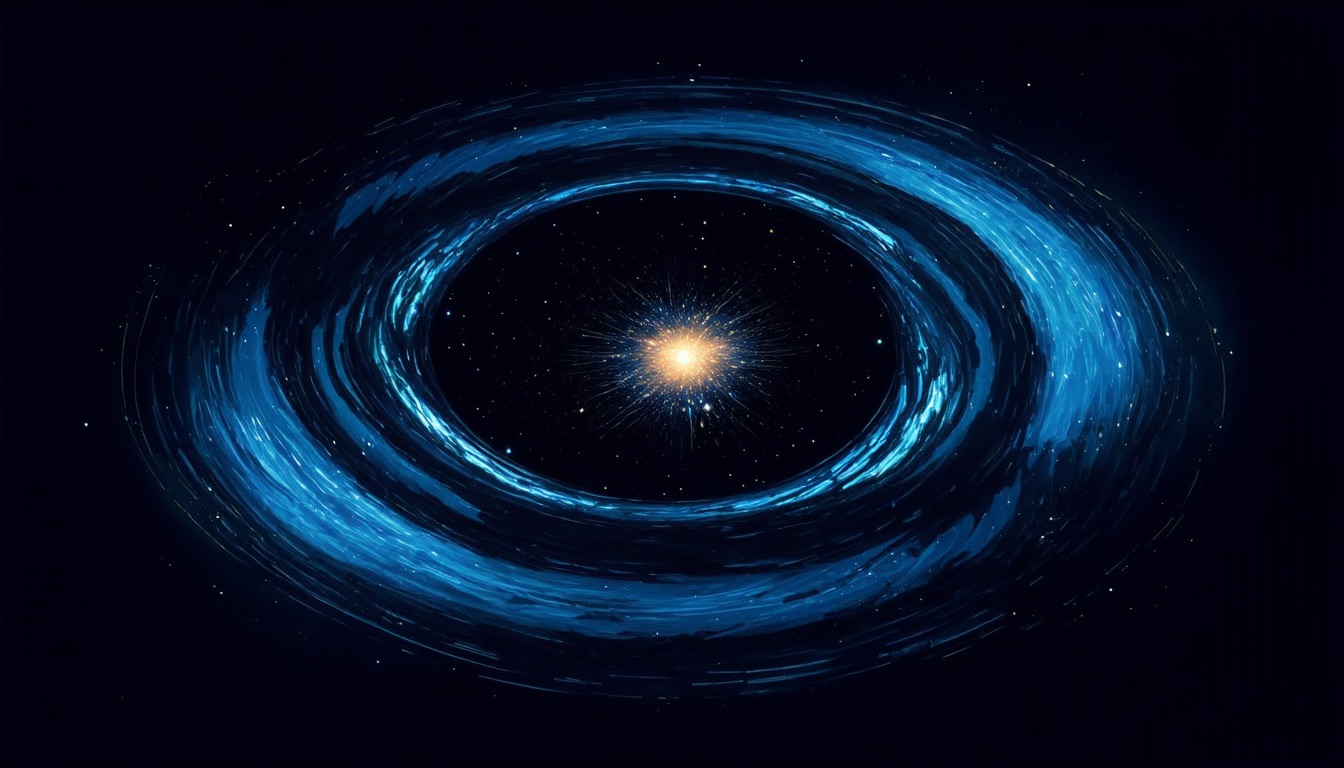
The results were surprising: instead of a spherical shell, the team discovered an arc-shaped structure that partially encircles the inner shell. This unusual geometry challenges our current understanding of nova shells and raises questions about the underlying physics driving these explosions.
One possible explanation for this shape is the presence of a magnetic white dwarf in V1425 Aql. Magnetic fields can influence the direction and speed at which material is ejected during a nova, potentially leading to asymmetrical shell formation.
Another possibility is that the shell is being shaped by interactions with the surrounding interstellar medium (ISM). The ISM can exert a significant impact on the expansion of the shell, causing it to become distorted or irregular in shape.
The study’s findings also highlight the importance of continued observations and monitoring of novae. By studying these explosive events in greater detail, astronomers can gain a deeper understanding of the physics involved and potentially uncover new insights into the nature of these mysterious objects.
In addition to its scientific significance, this discovery also has implications for our understanding of the life cycle of stars. Novae are an important phase in the evolution of binary star systems, and understanding their behavior can help us better comprehend the complex interplay between stars and their surroundings.
The researchers’ work serves as a reminder of the importance of continued exploration and observation in the field of astronomy.
Cite this article: “Unveiling the Mysterious Shape of a Nova Shell”, The Science Archive, 2025.
Astronomy, Astrophysics, Nova, Shell, White Dwarf, Binary System, Explosion, Magnetic Field, Interstellar Medium, Star Evolution





