

Sunday 09 March 2025
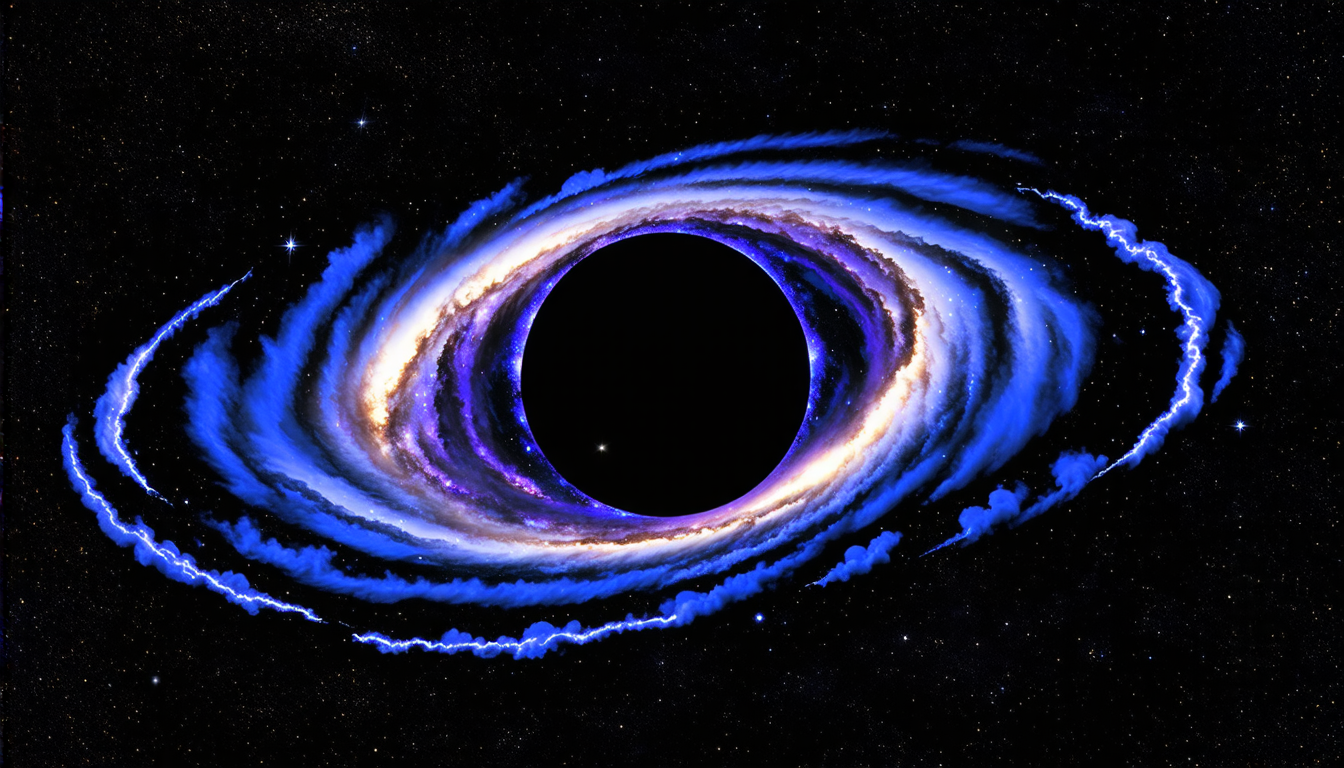
The quest for understanding black holes has long been a fascinating and complex endeavor. For decades, scientists have sought to uncover the secrets of these cosmic behemoths, which are known for their intense gravitational pull and ability to warp space-time. Recently, a team of researchers made a significant breakthrough in this area by developing a new model that explains how supermassive black holes at the centers of galaxies grow over time.
The study, published in a recent issue of The Astrophysical Journal Letters, presents a comprehensive picture of the growth process, which is driven by the merger of smaller black holes. According to the researchers, these mergers occur when smaller black holes are consumed by larger ones, resulting in the formation of even more massive black holes.
The model developed by the team is based on observations of the gravitational wave background produced by these mergers. The researchers used data from pulsar timing arrays (PTAs) to measure the amplitude and frequency of this background signal, which they then compared to theoretical predictions made using their new model.
The results of the study are strikingly consistent with the predictions made by the team’s model. The data indicates that supermassive black holes at the centers of galaxies grow through a process of mergers and accretion, with the smaller black holes being consumed by larger ones over time. This growth is driven by the gravitational force between the black holes, which causes them to merge and form more massive black holes.
The implications of this study are far-reaching and have significant potential for understanding the evolution of galaxies. By understanding how supermassive black holes grow, scientists can gain insights into the formation and development of galaxy structures. This knowledge can also shed light on the role that these black holes play in shaping the cosmos.
In addition to its scientific significance, this study has important implications for our understanding of the universe as a whole. The discovery of gravitational waves by LIGO and VIRGO have opened up new avenues for studying cosmic phenomena, including black hole mergers. This study highlights the potential of pulsar timing arrays (PTAs) as a tool for detecting these mergers and gaining insights into the growth of supermassive black holes.
Overall, this study represents an important step forward in our understanding of black holes and their role in shaping the cosmos. The development of new models and techniques for studying these phenomena is crucial for advancing our knowledge of the universe and its many mysteries.
Cite this article: “Unlocking the Secrets of Supermassive Black Hole Growth”, The Science Archive, 2025.
Black Holes, Supermassive Black Holes, Galaxy Centers, Gravitational Waves, Pulsar Timing Arrays, Ptas, Mergers, Accretion, Cosmic Evolution, Universe Formation





