

Monday 10 March 2025
For decades, physicists have been searching for a solution to the black hole balance problem – the question of whether two or more black holes can exist in stable equilibrium. The answer has long been thought to be no, but new research suggests that this may not always be the case.
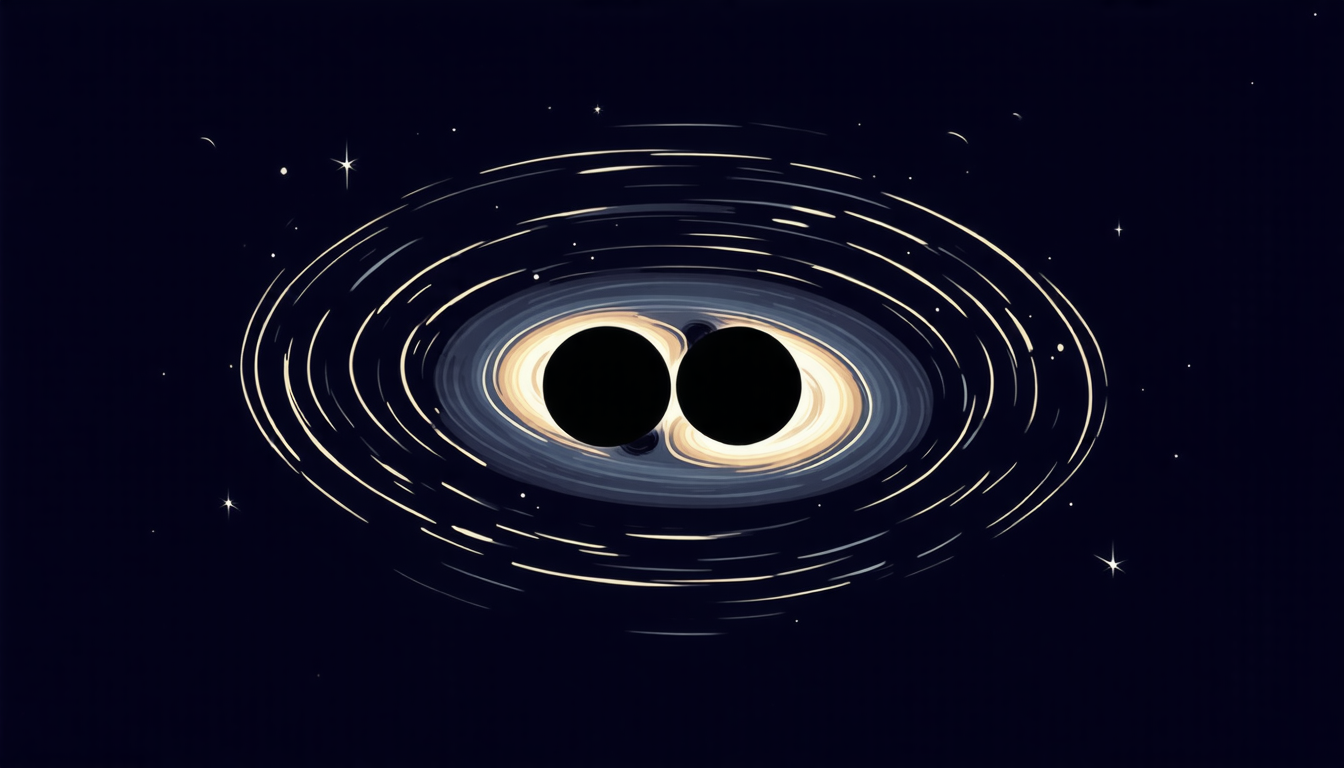
The problem arises when considering the gravitational attraction between two black holes. As they approach each other, their gravity should cause them to merge into a single, more massive black hole. However, if the black holes are rotating, their spin can create an opposing force that counteracts the gravitational pull. This raises the possibility that the black holes could remain stable and in equilibrium.
Researchers have been using soliton methods to study the behavior of black holes in these situations. Solitons are nonlinear waves that preserve their shape even after colliding with other solitons, making them an ideal tool for understanding complex physical systems like black holes.
One of the key findings is that the Ernst potential – a mathematical function used to describe the gravitational field of a rotating black hole – plays a crucial role in determining whether two black holes can exist in equilibrium. The Ernst potential is a complex function that encodes information about the black hole’s mass, spin, and charge.
The researchers have discovered that for certain values of the Ernst potential, it is possible to find stable solutions where two black holes coexist in equilibrium. However, these solutions are extremely sensitive to small changes in the parameters, making them difficult to find.
The study also highlights the importance of considering the effects of spin-spin repulsion between the black holes. This interaction can cause the black holes to move away from each other, even if they are not gravitationally bound. The researchers found that this effect plays a crucial role in determining whether two black holes can exist in equilibrium.
The findings have significant implications for our understanding of black hole behavior and the nature of gravity itself. They suggest that the universe may be home to more complex and dynamic systems than previously thought, with multiple black holes coexisting in stable equilibrium.
The research also opens up new avenues for studying black hole mergers and the role they play in shaping the universe’s evolution. By better understanding how black holes interact and merge, scientists can gain insights into the fundamental laws of physics that govern the cosmos.
The study is a testament to the power of mathematical techniques in unlocking the secrets of the universe.
Cite this article: “Stable Equilibrium of Rotating Black Holes”, The Science Archive, 2025.
Black Holes, Equilibrium, Gravity, Spin, Solitons, Ernst Potential, Nonlinear Waves, Complex Systems, Gravitational Attraction, Mergers
Reference: Jörg Hennig, “Soliton methods and the black hole balance problem” (2025).





