

Monday 10 March 2025
A new approach to understanding the intricate structures of foliated manifolds has emerged, offering a fresh perspective on the interplay between topology and geometry. This breakthrough is built upon the concept of ratified F-completions, which provide a framework for studying foliations with polytope boundaries.
Foliations are an essential tool in mathematics, used to decompose complex spaces into simpler components. They’re like a map that helps us navigate through intricate territories. However, when dealing with foliated manifolds, the complexity of these structures can be overwhelming, making it challenging to grasp their underlying properties.
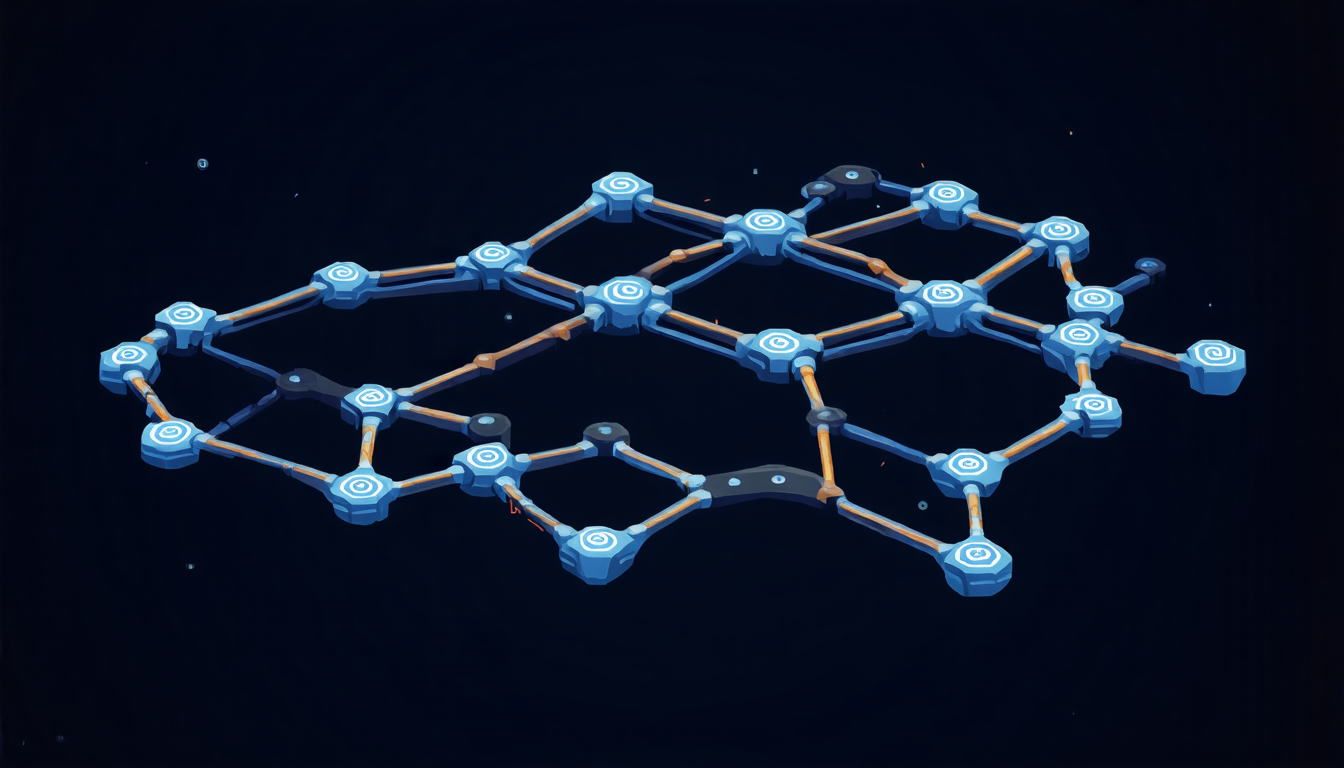
The researchers behind this new approach have tackled this challenge by introducing a novel concept: the Γ-set. This is essentially a topological graph that encodes the relationships between the various components of the foliation. The Γ-set serves as a bridge between the geometric and topological aspects of the manifold, allowing for a more comprehensive understanding of its structure.
One of the key insights from this research is the connection between the holonomy group of spinor fields and the Ihara zeta function. Holonomy refers to the way vector fields transform as they’re transported around closed loops within the foliation. The Ihara zeta function, on the other hand, is a mathematical construct that describes the properties of these vector fields.
The researchers have shown that there’s a direct relationship between the holonomy group and the zeros of the Ihara zeta function. This duality provides a powerful tool for studying foliated manifolds, as it allows us to analyze their topological properties in relation to their geometric structure.
This new approach has far-reaching implications for various fields, including topology, geometry, and algebraic geometry. It can be applied to the study of higher-dimensional foliated spaces, which could lead to a deeper understanding of complex systems in physics and engineering.
The researchers have also demonstrated how the twist map, a mathematical operation that permutes the components of the Γ-set, affects the cohomology of the foliated manifold. Cohomology is a branch of algebraic topology that studies the properties of spaces through the use of chains and boundaries.
By applying the twist map, the researchers have shown that it’s possible to create new topological invariants, which are essential for understanding the structure of the foliation. This has significant implications for our ability to analyze and classify complex systems.
Cite this article: “Unlocking the Secrets of Foliated Manifolds: A New Approach to Topology and Geometry”, The Science Archive, 2025.
Foliated Manifolds, Ratified F-Completions, Polytope Boundaries, Topology, Geometry, Algebraic Geometry, Holonomy Group, Ihara Zeta Function, Twist Map, Cohomology





