

Monday 10 March 2025
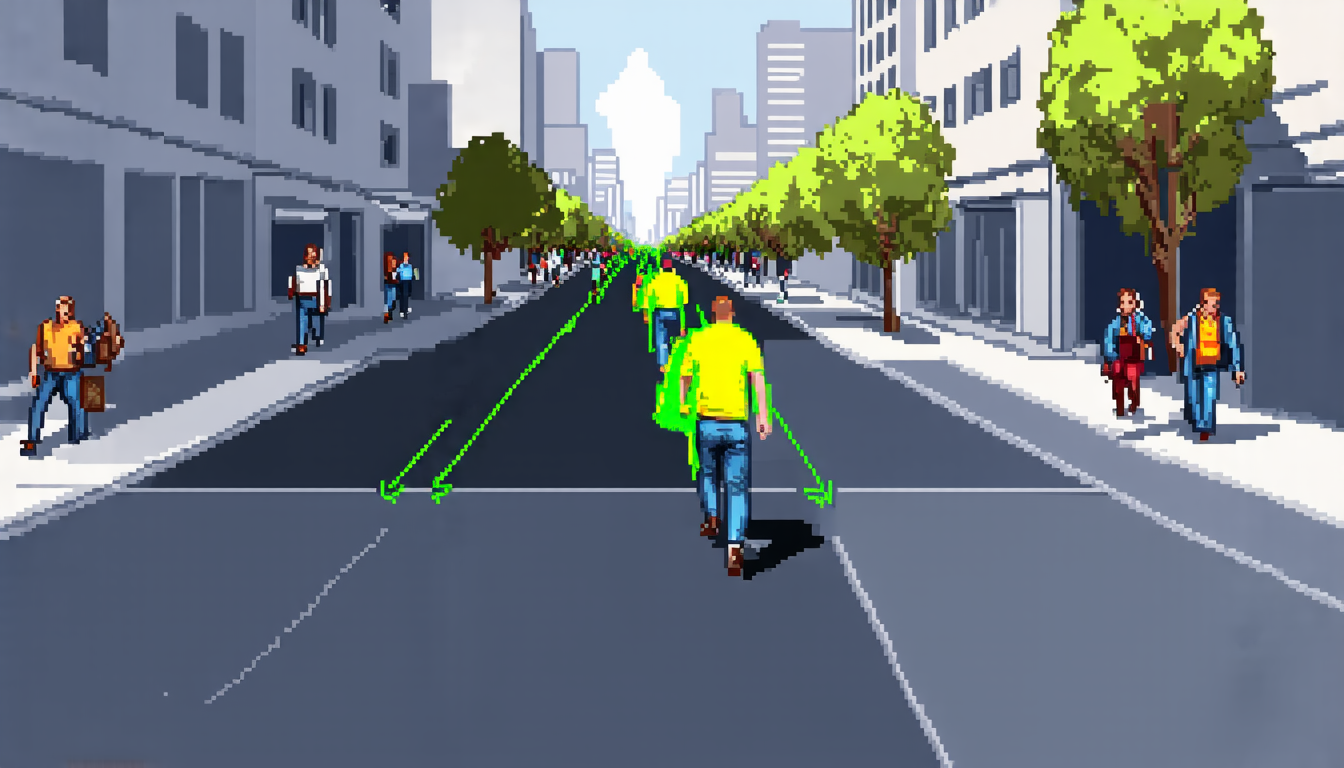
A team of researchers has developed a new model for predicting pedestrian trajectories that outperforms existing methods by a significant margin. The model, called ASTRA, uses a combination of scene-aware and agent-aware embeddings to forecast the future movements of individuals in crowded areas.
Traditionally, trajectory prediction models have relied on simple techniques such as linear interpolation or machine learning algorithms that focus solely on the past behavior of agents. However, these approaches often struggle to accurately predict the complex and unpredictable movements of pedestrians in busy environments.
ASTRA addresses this challenge by incorporating a range of contextual factors into its predictions. The model uses a U-Net-based feature extractor to capture scene representations, which are then combined with agent-aware embeddings generated by a transformer encoder. This allows ASTRA to take into account not only the past behavior of individual agents but also their social interactions and the layout of the surrounding environment.
The researchers tested ASTRA on two popular pedestrian trajectory datasets: ETH-UCY and PIE. In both cases, the model outperformed state-of-the-art methods in terms of accuracy and robustness. For example, on the ETH-UCY dataset, ASTRA achieved an average displacement error (ADE) of 0.28 meters, compared to 0.37 meters for the next best method.
One of the key innovations of ASTRA is its ability to generate multimodal trajectories. This means that the model can predict not just a single future trajectory for each agent but also multiple possible paths. This is particularly useful in real-world applications, where unexpected events or changes in the environment can cause agents to deviate from their predicted routes.
The researchers also developed a range of visualization techniques to help users understand and interpret the predictions made by ASTRA. These include Grad-CAM heatmaps, which highlight the regions of the scene that contribute most strongly to the model’s predictions, as well as multimodal trajectory visualizations that show multiple possible future paths for each agent.
The potential applications of ASTRA are numerous. For example, it could be used to improve the accuracy of autonomous vehicles or to optimize traffic flow in crowded cities. The model could also be adapted for use in other domains where predicting human movement is important, such as sports analytics or search and rescue operations.
Overall, the development of ASTRA represents an important advance in the field of trajectory prediction. By incorporating a range of contextual factors into its predictions, the model has shown that it can outperform existing methods in terms of accuracy and robustness.
Cite this article: “ASTRA: A Novel Model for Accurate Pedestrian Trajectory Prediction”, The Science Archive, 2025.
Pedestrian Trajectory Prediction, Astra Model, Scene-Aware Embeddings, Agent-Aware Embeddings, U-Net Feature Extractor, Transformer Encoder, Machine Learning, Eth-Ucy Dataset, Pie Dataset, Multimodal Trajectories.





