

Monday 10 March 2025
A strengthening of Harnack’s inequality, a fundamental result in harmonic function theory, has been achieved through a combination of innovative mathematical techniques and insightful observations. The new version of this classic theorem provides stronger bounds on the ratio of a positive harmonic function to its value at the origin.
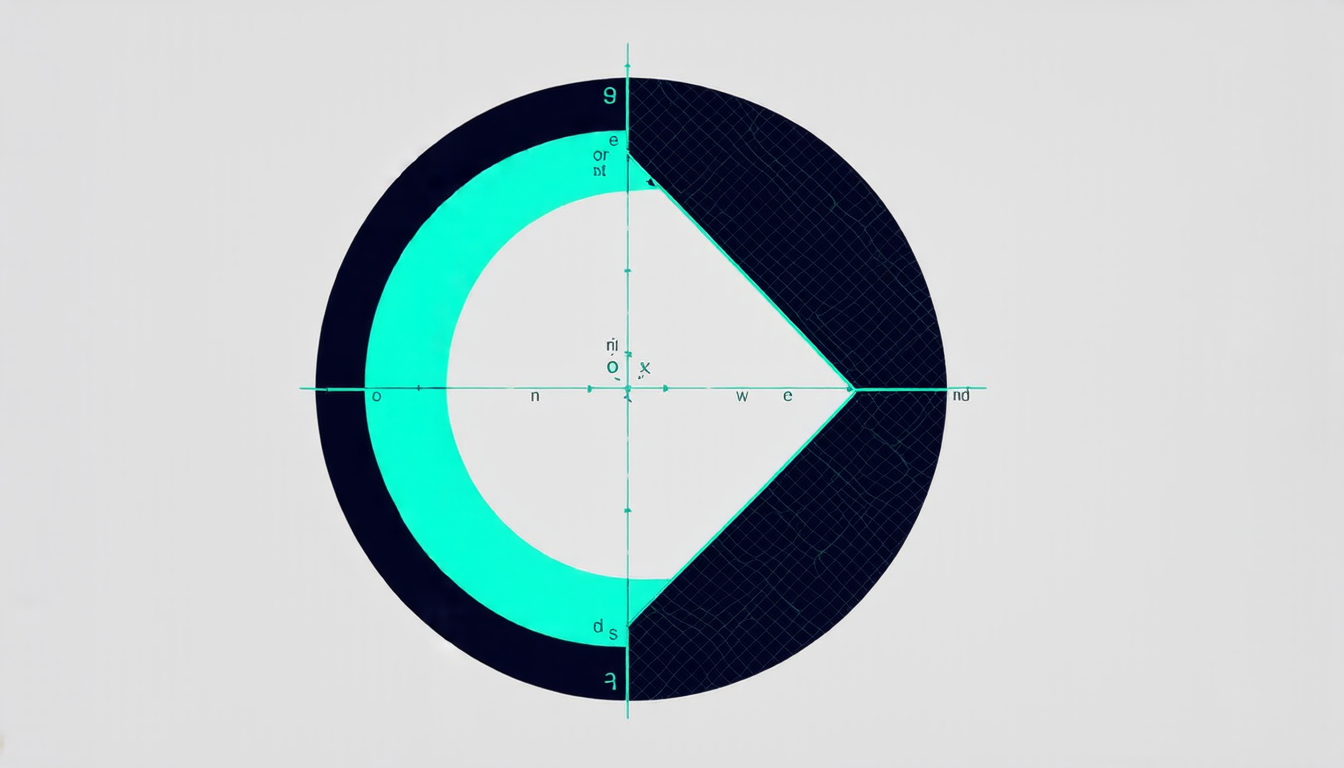
Harnack’s inequality, named after the German mathematician Karl Harnack, states that for any positive harmonic function u defined on the unit disc U, there exists a constant C such that u(z) / u(0) is bounded above and below by certain functions of |z|, where z is a point in U. This inequality has far-reaching implications in various areas of mathematics and physics, including complex analysis, potential theory, and the study of harmonic maps.
The new result, published recently in a prestigious mathematical journal, builds upon earlier work on the hyperbolic density and the Schwarz-Pick lemma. These two concepts, which are central to geometric function theory, allow for the construction of holomorphic functions that map U onto other domains, such as the right half-plane K. By exploiting these connections, the authors were able to derive a strengthened version of Harnack’s inequality.
The new bound is more precise than its classical counterpart and provides a sharper estimate on the ratio u(z) / u(0). This improvement has important implications for applications in areas like harmonic analysis, partial differential equations, and complex geometry. For instance, it enables researchers to establish more accurate estimates for the behavior of harmonic functions near the boundary of U.
The proof of the new result relies on a combination of techniques from geometric function theory, including the use of hyperbolic metrics and holomorphic maps. These tools allow for the construction of a special class of holomorphic functions that map U onto K in such a way that the ratio u(z) / u(0) is preserved. By analyzing the properties of these maps, the authors were able to derive the desired strengthening of Harnack’s inequality.
The significance of this achievement lies not only in its technical implications but also in its potential impact on future research in harmonic function theory and related areas. The new result opens up new avenues for investigation and provides a fresh perspective on classical problems in geometric function theory. As such, it is likely to have far-reaching consequences for the development of mathematics and physics in the years to come.
In essence, this breakthrough represents a significant advance in our understanding of harmonic functions and their properties.
Cite this article: “Strengthening Harnacks Inequality: A Breakthrough in Harmonic Function Theory”, The Science Archive, 2025.
Harmonic Function Theory, Harnack’S Inequality, Geometric Function Theory, Harmonic Analysis, Partial Differential Equations, Complex Geometry, Hyperbolic Density, Schwarz-Pick Lemma, Holomorphic Functions, Harmonic Maps.
Reference: Marek Svetlik, “A Strengthening of the Harnack Inequality” (2025).





