

Monday 10 March 2025
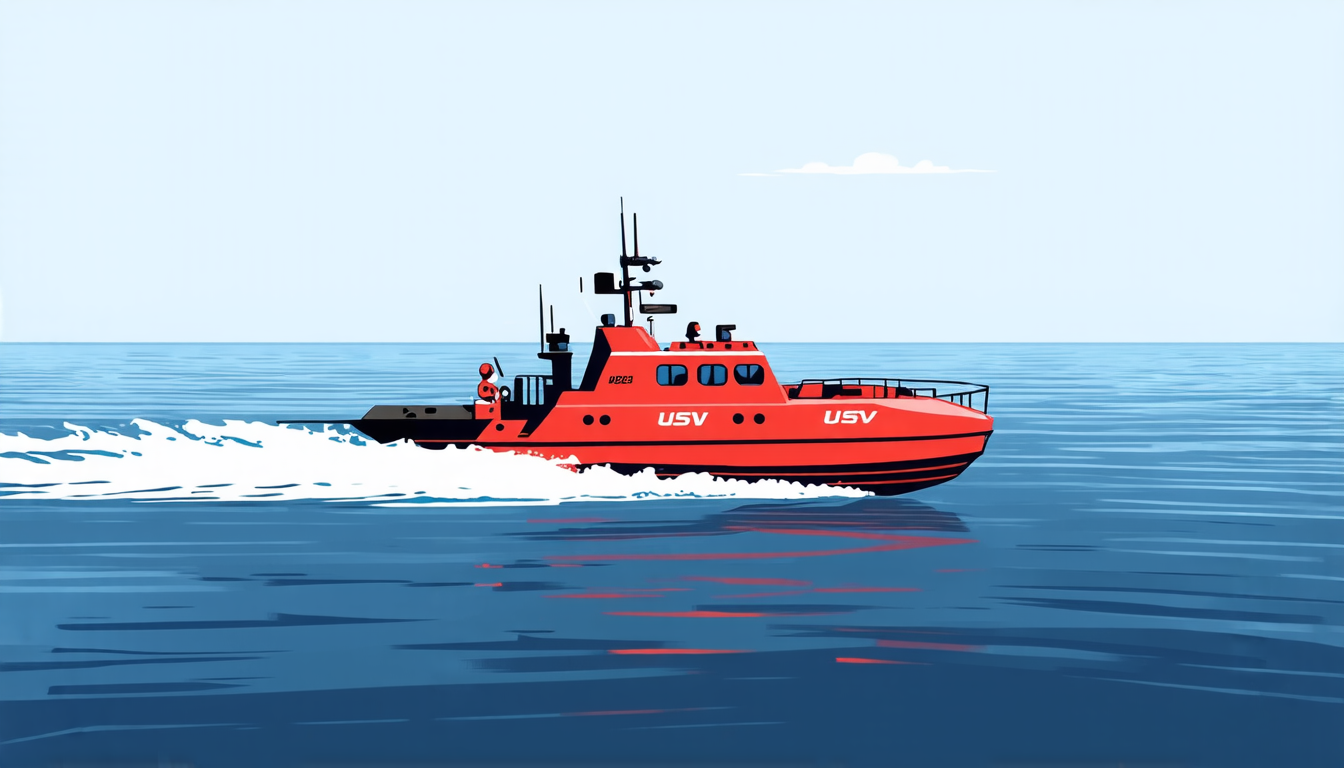
Unmanned surface vessels (USVs) are increasingly being used for a variety of tasks, from surveying marine environments to transporting goods. But one major challenge in deploying these autonomous boats is teaching them how to navigate complex routes and respond to unexpected disturbances.
Researchers have been working on developing algorithms that can learn from human demonstrations to enable USVs to autonomously replicate the same tasks. Now, a new approach has been developed that uses Gaussian mixture models and Sontag’s universal formula to learn the nonlinear dynamics of ship trajectories and control them in real-time.
The method involves using data collected from human operators demonstrating how to navigate through a port or follow a specific route. This data is then used to train an algorithm that can recognize patterns and make adjustments as needed. The algorithm also takes into account environmental factors such as wind and currents, which can affect the vessel’s trajectory.
In testing the new approach, researchers used real-world data collected from a USV navigating through the port of Ceuta in Spain. They found that the algorithm was able to accurately learn the complex routes and respond to disturbances such as changes in wind direction.
The ability to learn from human demonstrations has several advantages over traditional methods of programming USVs. For one, it allows for more flexibility and adaptability in response to changing environmental conditions. It also enables the development of more sophisticated algorithms that can handle complex tasks.
One potential application of this technology is in search and rescue missions. Imagine a USV being deployed to search for survivors after a natural disaster. With its ability to learn from human demonstrations, it could be programmed to navigate through debris-filled waters and adjust its route as needed to locate survivors.
The new approach also has implications for the development of autonomous ships, which are expected to revolutionize the maritime industry in the coming years. Autonomous ships will require sophisticated navigation systems that can adapt to changing conditions, and this technology could play a key role in making them a reality.
Overall, the development of an algorithm that can learn from human demonstrations marks a significant step forward in the development of autonomous USVs. It has the potential to enable these vessels to navigate complex routes and respond to unexpected disturbances with greater ease and accuracy than ever before.
Cite this article: “Autonomous Boats Learn from Human Demonstrations”, The Science Archive, 2025.
Unmanned Surface Vessels, Autonomous Boats, Navigation Algorithms, Gaussian Mixture Models, Sontag’S Universal Formula, Nonlinear Dynamics, Ship Trajectories, Real-Time Control, Environmental Factors, Search And Rescue Missions.





