

Monday 10 March 2025
The latest breakthrough in machine learning has left many experts scratching their heads, trying to wrap their minds around the sheer complexity of it all. Researchers have developed a new type of decision tree called Bayesian Additive Decision Trees (BAMDT), which uses a combination of hard and soft splits to create a more accurate model.
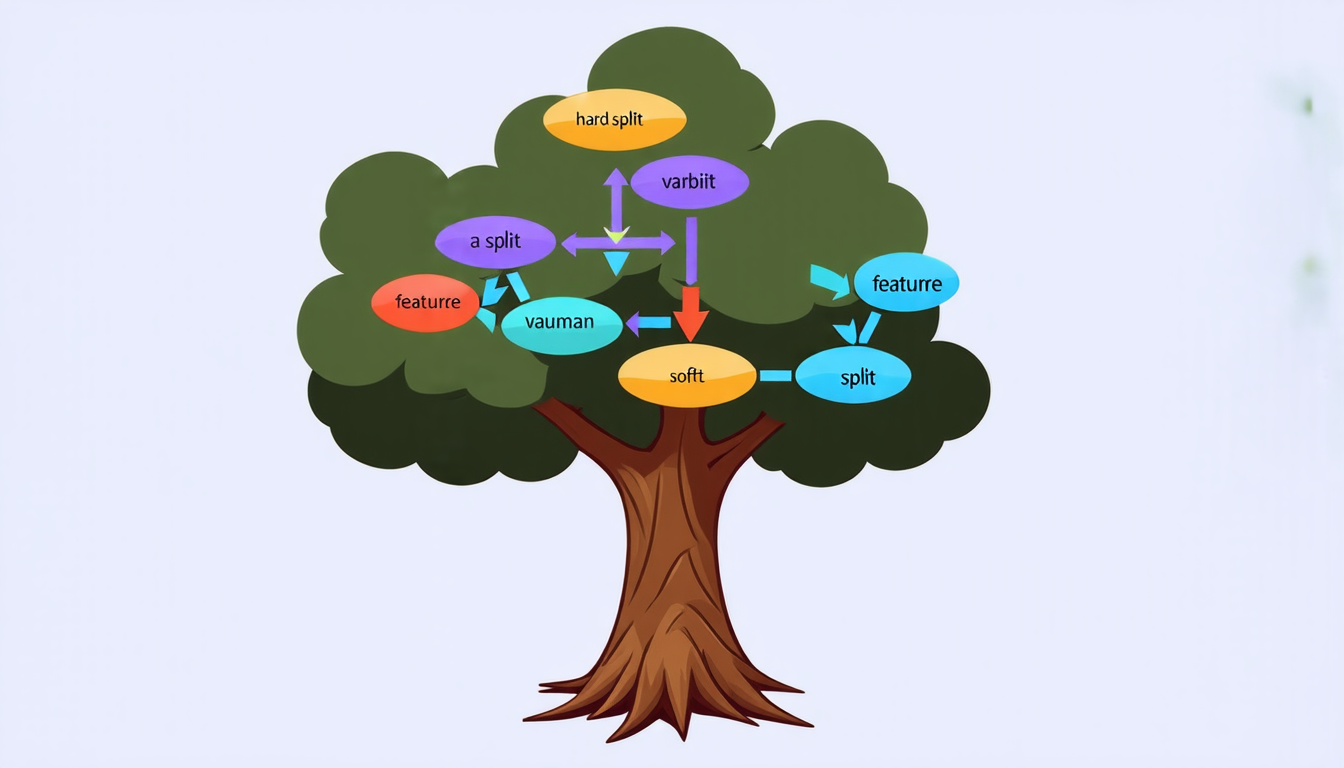
At its core, BAMDT is an extension of traditional decision trees, where each node represents a feature or a split in the data. However, unlike traditional decision trees, BAMDT allows for both hard and soft splits, giving it a significant advantage over its predecessors.
Hard splits are straightforward: they divide the data into two distinct groups based on a single feature. Soft splits, on the other hand, allow for more nuanced decisions, where multiple features are taken into account to determine which group a piece of data belongs to.
By combining these two types of splits, BAMDT is able to create a more accurate model that can handle complex relationships between features and target variables. This is particularly useful in cases where traditional decision trees struggle to capture the nuances of real-world data.
One of the key advantages of BAMDT is its ability to adapt to different problem domains. Unlike other machine learning algorithms, which often require significant tuning and tweaking before they can be applied to a new dataset, BAMDT is relatively easy to use and requires minimal setup.
Another advantage is that it can handle high-dimensional data, where traditional decision trees often struggle to scale. This makes BAMDT particularly useful for applications such as image classification, where the number of features can be in the tens or even hundreds of thousands.
But how does it work? In simple terms, BAMDT uses a combination of Bayesian inference and random forests to create its models. The algorithm starts by selecting a set of candidate features and then uses a series of statistical tests to determine which ones are most relevant for the target variable.
Once the most important features have been identified, the algorithm creates a decision tree using these features as nodes. However, unlike traditional decision trees, BAMDT allows each node to be either hard or soft, depending on the type of split that is most effective at predicting the target variable.
The result is a model that is not only more accurate but also more interpretable than its predecessors. By allowing for both hard and soft splits, BAMDT is able to capture complex relationships between features and target variables in a way that traditional decision trees cannot.
Cite this article: “Bayesian Additive Decision Trees: A New Era in Machine Learning”, The Science Archive, 2025.
Machine Learning, Bayesian Additive Decision Trees, Bamdt, Decision Trees, Soft Splits, Hard Splits, Feature Selection, Random Forests, Bayesian Inference, High-Dimensional Data, Image Classification





