

Monday 10 March 2025
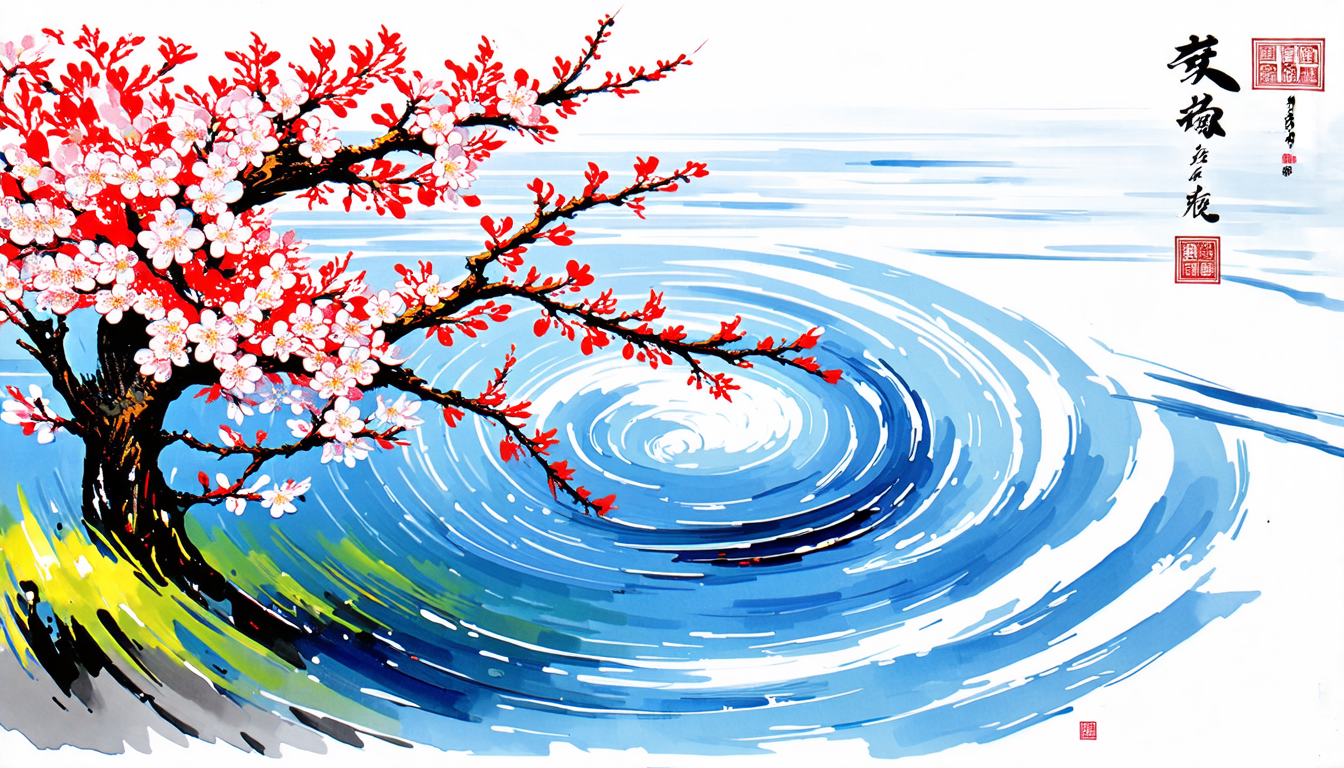
A team of researchers has made a fascinating discovery about the art of Japanese painter Ogata K¯orin, whose work dates back to the 18th century. They found that his depiction of water in one of his most famous paintings, Red and White Plum Blossoms, exhibits properties similar to those found in real-world turbulent flows.
For those unfamiliar with turbulence, it’s a phenomenon that occurs when fluids like air or water move in chaotic, unpredictable patterns. This can happen in everything from the swirling eddies behind a boat to the wispy tendrils of smoke rising from a chimney. In order to understand and predict these movements, scientists have developed complex mathematical models that describe how fluids behave under different conditions.
But here’s the thing: K¯orin didn’t need any fancy math or computer simulations to create his beautiful, swirling water patterns. He simply used traditional Japanese painting techniques to capture the essence of turbulent flow on canvas. And yet, despite being created centuries ago, his work exhibits remarkable similarities to real-world turbulence.
The researchers analyzed K¯orin’s painting using advanced image processing techniques and found that it displays a power-law scaling in its luminance spectrum – in other words, the intensity of the light reflected from the painting decreases with increasing frequency at a rate consistent with the Obukhov-Corrsin spectrum, a mathematical model used to describe turbulent flows.
But that’s not all. The team also found that K¯orin’s depiction of water exhibits intermittent scaling, meaning that its statistical properties change depending on the scale at which they are observed. This is another key feature of real-world turbulence, where the behavior of fluids can change dramatically depending on the size of the scales involved.
The implications of this discovery are significant. For one, it highlights the incredible skill and observational powers of K¯orin, who managed to capture the essence of turbulent flow without ever having seen a mathematical equation or computer simulation in his life. It also suggests that there may be more to art than just aesthetics – perhaps the most skilled artists can tap into fundamental principles of physics and mathematics without even realizing it.
Of course, this isn’t the first time that scientists have found connections between art and science. From Leonardo da Vinci’s famous drawings of water flow to the intricate patterns of Islamic geometry, there are countless examples of artists who have intuitively grasped complex mathematical concepts and translated them into beautiful works of art.
Cite this article: “Art Meets Science: Ogata Kōrins Turbulent Masterpiece”, The Science Archive, 2025.
Ogata Kōrin, Japanese Painter, Turbulence, Water Flow, Mathematics, Physics, Power-Law Scaling, Obukhov-Corrsin Spectrum, Intermittent Scaling, Art And Science, Leonardo Da Vinci.
Reference: Takeshi Matsumoto, “Turbulent scaling law in Ogata Kōrin’s Red and White Plum Blossoms” (2025).





